A group of physicists studies the moral behavior of people through their interaction with others, using game theory. Meanwhile, neuroscientists try to understand how creative thought arises.
Science tries to answer questions about the universe and everything we see in it. Although it may seem incredible, scientists have managed to advance in the understanding of phenomena that arouse our curiosity, such as the origin of the universe and the evolution of stars. Researchers have also made progress in many other areas, although others seem to remain isolated from the major scientific advance. For example, it seems we know more about the Milky Way than about life in our oceans or that it is easier to explain planetary orbits than bird migration.
Although I am more interested in knowledge related to physics and astrophysics, I cannot help but be curious about other things, different from protons and neutrons.
It happens that it seems to be "simpler" to study the behavior of elementary particles than that of living organisms, which are also made up of those particles.
Just as bricks are all the same, but the houses built with them can be very different, elementary particles are the same, but what is generated from them is not.
And perhaps here, the "softer" sciences have to contribute a lot. After all, electrons and photons are not social. I mean, their behavior can be understood exclusively in light of our understanding of the laws of nature that physicists are discovering.
But living beings, and within that set, human beings, seem to be influenced by other variables.
Certainly, living beings must also obey natural laws, but we cannot understand the behavior of two people exclusively with that view.
That is: it is possible to know in advance what will be produced from the collision of two protons, under certain circumstances, because all those collisions should produce the same thing in the same context.
With human beings, in part, we can say something similar. If we imagine two cars with such an initial speed, and a certain direction and sense (say opposite), we can calculate what will happen.
But what happens if I put two people in front of a "non-physical" situation:
A and B are hungry and are in front of a food cart that the owner neglects. Is it possible that A "borrows" a little food and B does not?
Yes, it is possible. What does this depend on? Why can't this be studied in the same way as elementary particles?
Furthermore, why is one person extroverted and another not, or someone seems to be more creative and another not so much?
In these fields, the social sciences step a little stronger than the "hard" sciences because, apparently, the variables of our behavior are tied to our social environment. Education, the socialization process, seems to influence our moral behavior, so that there are type A people or type B people.
Can't the hard sciences say something about it? Or, making the question more spicy: Can physics say something about morality or about creativity?
I read in Physicsworld about the work of Dirk Helbing, who according to Wikipedia studied physics and mathematics in Göttingen. His doctoral thesis was on modeling social processes based on the approach of game theory and systems theory.
The basic idea is that individual interests are impoverished in the face of cooperative behavior. But in this interaction, "punishments" are produced in response to an action, which also requires time and effort (and generates antipathy). I imagine a classroom where the teacher leaves a problem to solve and leaves. The students can try to solve the dilemma together. But some start chatting about other things, making jokes, or drawing on the blackboard. Others question that action (the "punishers"), who end up "losing" to those who say nothing (the "non-punishers"), who in turn "lose" to the "loners," those who do not cooperate with others and try to solve the problem on their own, period.
That scenario is poorer than a situation where everyone collaborates. It is "the tragedy of the commons."
How, then, does cooperation arise? Some researchers propose that cooperating punishers could survive through indirect reciprocity: the idea that working for the common good will strengthen a person's reputation. But Helbing's group does not believe that cooperation flourishes in that way.
They think so after focusing on how individuals behave with their closest neighbors, rather than in a broader group.
Their model based on game theory comprises a network of many points, each representing an individual who has four strategy options: cooperate without punishing loners, cooperate and punish ("moralist"), be a loner, or be a loner and also punish other loners ("immoral"). Initially the four strategies are randomly distributed among the individuals and the system evolves to find which behavior wins in the long run.
This evolution is influenced by three variables: the fines that penalize loners, the cost of administering punishments, and the "synergy factor," which stipulates how the sum of individual contributions is reinforced by collective actions.
With this they perform computer simulations. The program chooses an individual at random and calculates how much they will gain in relation to their four closest neighbors, given the strategies employed by each neighbor. The exercise is repeated for the neighbors themselves. The strategy employed by each individual is then modified in light of the success of their neighbors, and thus individuals imitate those who performed better.

When running the simulation up to 10 million iterations, some interesting results occurred: if all three variables were low, everyone will be loners, just as moralists will prevail if the ends are very high. And they also believe that moralists will be able to win even if the cost of punishing was high because the imitation of the best performances of neighbors leads to small groups of cooperators and moralists in a sea of loners. In that scenario, moralists deal better with loners and dominate.
But collaboration between moral and immoral individuals also occurs if the cost of punishing is low and the synergy is not particularly high and the ends are high.
Attila Szolnoki from the Institute for Materials Science in Budapest, a colleague of Helbing, says: "the contribution of statistical physics to this field of research could mean that a large group of players can result in a new type of behavior that cannot be derived from the analysis of two players. Computational models can be considered as pre-experiments and help design more sophisticated laboratory experiments."
The debate among researchers about whether science can answer moral questions remains interesting in several aspects. What is the common good, after all?
On the NPR 13.7 blog, a juicy discussion on the matter took place, in English: Can Science Answer Moral Questions?.
Science and Creativity
Research on creativity does not seem very far from this to me. I spoke a bit here about how scientific discoveries occur.
Neuroscientists have something to say about this by using Magnetic Resonance Imaging (MRI) technology to try to monitor what happens to us humans inside the brain while we perform a creative task.
The New York Times publishes an article by Patricia Cohen about the work of Rex Jung, a researcher at the Mind Research Network and a member of the University of Mexico.
But, as in the previous topic, everything starts with definitions. What is creativity? According to John Kounios, a psychologist at Drexel University, it is the ability to restructure our understanding of a situation in a non-obvious way. But there is no single way to measure creativity, there is no test like the IQ, which supposedly measures intelligence.
However, there are some ways to try to identify creativity through lateral thinking questionnaires and even more complex indices.
Apparently, while intelligence and skills are associated with the speed and efficiency of neural processes, subjects who seem to be more creative have axon connections that slow down brain traffic, in the frontal cortex, a region where emotions and cognitive abilities are integrated.
According to Kounios, Dr. Jung's work remains in seeking the correlation between creativity and a single region of the brain, in an outdated approach.
"Creativity is a collection of different processes that work in different areas of the brain," he noted.
Mark Beeman, a psychologist at Northwestern, published a paper on the "Aha! Moment" in which he indicates that when faced with a certain problem, some subjects responded immediately, while others had to think about the possibilities.
In those Aha! moments, there is a greater intensity of brain activity in the temporal lobe, according to Kounios. Both researchers even believe they can predict which process a person will use with MRI images.
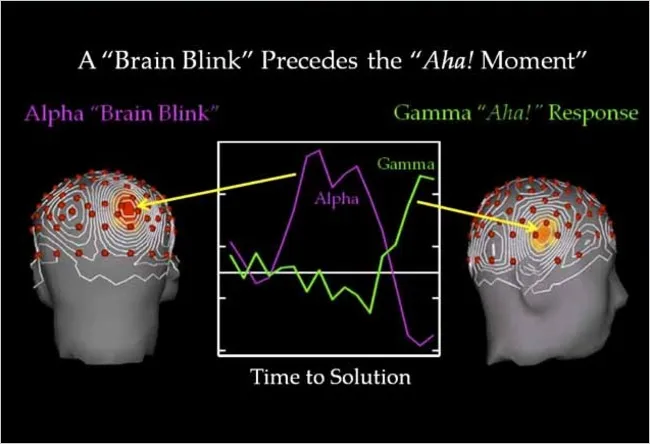
Credit: John Kounios, Drexel University
Aside from these "advances," I can't help but glimpse that, as in many other cases, the different disciplines still seem to be trying to understand the how, more than the why.
I'm not saying that's wrong. Knowing how rain occurs is very useful. We can know it if we go outside every time it rains and take notes of the possible variables (little birds, wind, humidity, temperature, presence of clouds). With many observations, we will find that whenever it rained, there were clouds (although not every time there are clouds, it rains). And also that every time it rained, it stopped! But that doesn't explain why it rains.
Why is someone creative and another not? Is it like that, or rather are we all creative, but in different circumstances and contexts?
Ultimately, human beings, also formed by quarks->nuclei->atoms->molecules, are not just the sum of the parts. Not by studying protons and their behavior will we be able to know how we decide and think.
But we do not cease to be, human beings, a physical system. I suppose both branches, of the "hard and soft" sciences, will have to contribute their part, without leaving aside, of course, evolutionary theories.
Although, when I start thinking about these matters, in which my knowledge barely allows me to glimpse something, I see my cat, sprawled on the bed, perhaps only trying to "just be happy." And I laugh. Because that is wise too. But, for some reason, I can't do it...
Sources and related links
Physicsworld: Physicists study how moral behaviour evolved, by Edwin Cartlidge
The future of social experimenting
Dirk Helbing and Wenjian Yu
The Walking Behaviour of Pedestrian Social Groups and Its Impact on Crowd Dynamics
Mehdi Moussaïd, Niriaska Perozo, Simon Garnier, Dirk Helbing, Guy Theraulaz
PLoS One. 2010; 5(4): e10047.
DOI:10.1371/journal.pone.0010047
NYT: Charting Creativity: Signposts of a Hazy Territory, by Patricia Cohen
The Aha! Moment: The Cognitive Neuroscience of Insight
John Kounios and Mark Beeman
Current Directions in Psychological Science
Volume 18 Issue 4, Pages 210 - 216
DOI: 10.1111/j.1467-8721.2009.01638.x
About the images
Simulation. Courtesy: PLoS Computational Biology
"Aha! moment". Credit: John Kounios, Drexel University
The initial image is a combination of images from stock.xchng