The colossal particle accelerators that monitor collisions at Fermilab's Tevatron and the Large Hadron Collider at CERN not only impose new challenges on physics, but also on data querying from their systems.
Scientists from the CMS and ATLAS experiments at CERN are using a system called FroNTier, originally designed by the computing division of Fermilab for the CDF experiment. The system helps researchers distribute the information needed to interpret collisions, at the speed of light.
The speed of queries is crucial, as is their updating. "Not even the fastest database servers can close the physical gap between geographically disparate sites," noted John DeStefano, an engineer for RHIC and ATLAS.
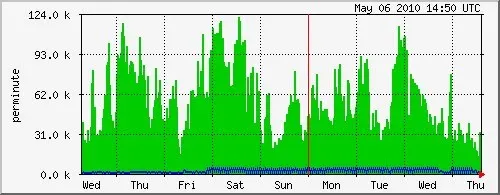
Fermilab scientists Jim Kowalkowski and Marc Paterno had the original idea for Frontier. And a group that had gained experience with a similar system designed for the DZero experiment worked to implement the ideas in CDF. Finally, another group contributed to testing the system.
The challenge is not minor. All scientists need to load the data to analyze the results of the collisions. The detectors are not monitored in each individual collision, but at intervals. In the CDF detector, the proton and antiproton beams cross paths 1.7 million times per second and it is planned to raise the number to 3 million per second for CMS and ATLAS when the LHC is at its peak.
The FroNTier server takes the information about changes in the detector's database data and sends it to other servers around the world that cache the information and share it with other computers. Thus, only FroNTier needs to request updates from the database's data map, as reported by iSGTW.
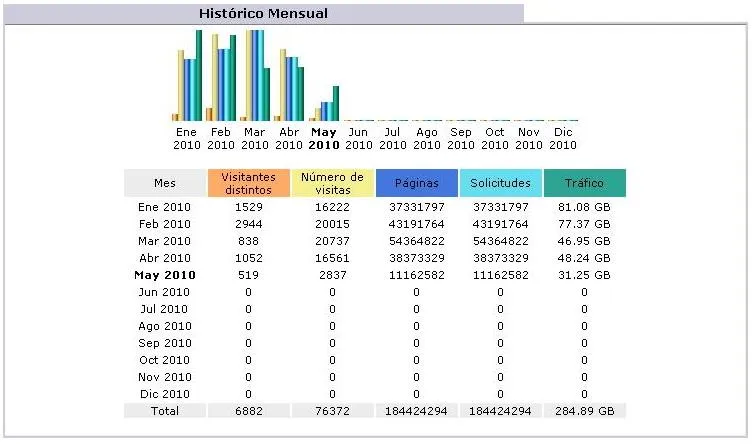
The FroNTier system uses HTTP, the same language this page uses to communicate with your web browser, to send requests to the database. This allows for a large number of users. It uses the REST architecture and Squid.
Thanks to a recent update by Dave Dykstra, a Fermilab engineer who now leads the FroNTier project, the system now wastes less time and computing power by skipping the step of reloading information if the detector's data map hasn't changed.
The name FroNTier comes from N Tier, where N is a number and Tier refers to what we could call Nodes. The central database is at Tier 0 which distributes the data to all Tier 1, 2, and 3, around the world.
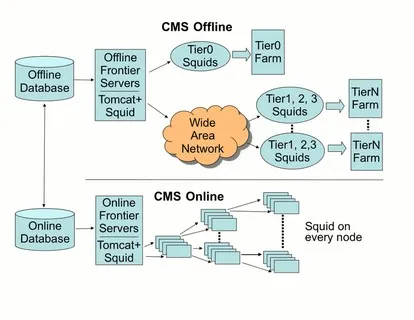
The FroNTier architecture in CMS.
Here is a diagram with an online part and an offline part. The first is the part of the system co-located with the CMS detector. The second starts at CERN and sends the data to the world.
Squid is the name of the http caching program and Tomcat is the name of the system on which FroNTier is built. The applications in the Tiers make queries to the database that are converted into http by the Frontier client. Then Squids returns the results immediately from its cache or sends the results to the Frontier servers that convert the http queries into database queries and the results into http.
Sources and related links
Frontier guides computing through the collision landscape, by Kathryn Grim
About the images
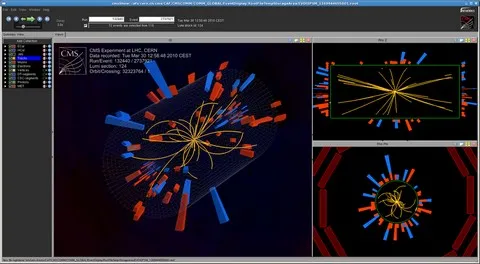
First CMS events at 7 TeV. Credit: CMS/CERN