Data from the Swift survey helped astronomers solve a decades-old mystery about why a small percentage of black holes emit large amounts of energy.
In what seems to be the week of black holes, a new study is added. These days we learned that a nearby black hole is weak and unpredictable and that the larger the black hole, the more globular clusters the galaxy has.
Only about one percent of supermassive black holes exhibit large amounts of energy. The new data confirm that these objects are activated by galaxy collisions, in a new study to be published in The Astrophysical Journal Letters, in the June 20 issue.
Active galactic nuclei or AGN, despite being very luminous objects, can be difficult to detect. AGN is the name for the central region of a galaxy where a considerable amount of energy is generated by processes other than those existing in normal stars.
Thick clouds of dust and gas surround the black holes in an active galaxy, which can block ultraviolet, optical, and low-energy X-ray light. Infrared radiation from the hot dust near the black hole can pass through that material, but it can be confused with emissions from star-forming regions. Higher-energy X-rays can help in this task. Since 2004, the BAT (Burst Alert Telescope) instrument aboard Swift has mapped the sky using those rays.
It is the most complete census of the sky at those energies, according to Neil Gehrels, a researcher at the Goddard Space Flight Center. This survey, sensitive to AGN as far away as 650 million light-years, discovered dozens of systems.
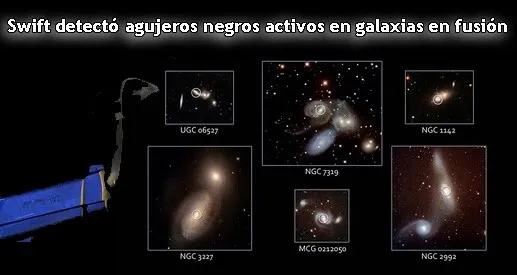
The team found that almost a quarter of the active galaxies detected by BAT are in close pairs or mergers. "Perhaps about 60 percent of these galaxies will merge completely in the next few billion years. We think we have found the 'smoking gun' that theorists had predicted about AGN activated by mergers," the scientist indicated.
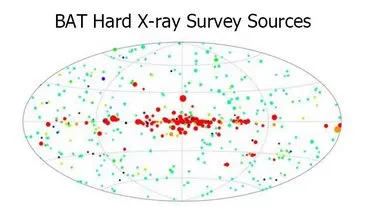
The information from the study was revealed today, May 26, in a press conference. The material used in it, which includes images like the ones used here, a presentation, and a pdf, is available on the Swift page at NASA.
In the team's presentation, they indicate that Swift detected 260 AGN with 25% in the process of merging with other galaxies, which is very different from the almost 2% found in other surveys.
A video was included, like the one that can be seen here, of a galaxy merger simulation published in due time by Tiziana Di Matteo, Volker Springel and Lars Hernquist in Nature and available both on the aforementioned NASA page and on Di Matteo's page.
Video: Galaxy collision simulation
http://www.youtube.com/watch?v=VFxyPeg1szk
Sources and related links
Optical Spectral Properties of Swift BAT Hard X-ray Selected Active Galactic Nuclei Sources arXiv:1001.0049v1
NASA's Swift Survey finds 'Smoking Gun' of Black Hole Activation
About the images
Credit: NASA/Swift/NOAO/Michael Koss and Richard Mushotzky (Univ. of Maryland)