Since its discovery 45 years ago, Cygnus X-1 has been one of the most intensely studied X-ray sources. A decade after its finding, Cygnus X-1 secured a place in the history of astronomy when a combination of optical and X-ray observations led to the conclusion that it was a black hole, the first time one was identified.
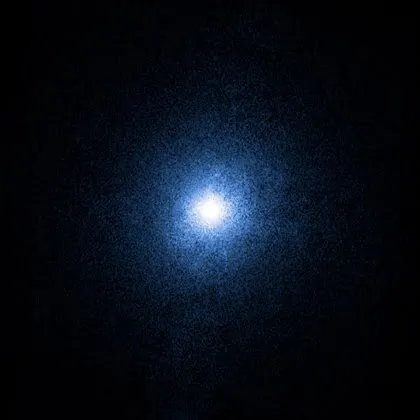
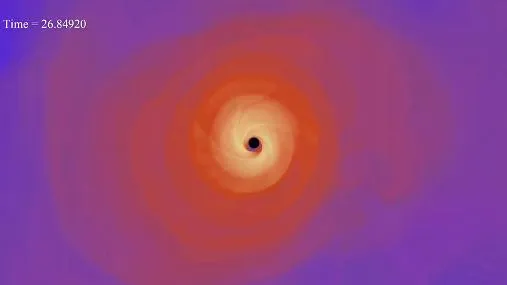
The Cygnus X-1 system consists of a black hole with a mass of about 10 times that of our Sun in a close orbit with a blue supergiant star with a mass of about 20 suns. Gas flowing from the supergiant in fast stellar winds is focused by the black hole and part of the gas forms a disk that falls into the black hole. The gravitational energy released by this infalling gas generates the X-ray emissions of Cygnus X-1.
Although more than a thousand scientific papers have been published on Cygnus X-1, its status as a bright and nearby black hole continues to attract the interest of scientists seeking to understand the nature of these objects and how they affect their surroundings. In this sense, Cygnus X-1 remains a "star", an object of fame and admiration.
Observations with the Chandra and XMM-Newton Observatories are especially valuable for studying the properties of the stellar winds that energize Cygnus X-1 and in determining its rotation rate.
The latest research revealed that Cygnus X-1 is rotating very slowly. The result is surprising and could indicate that Cygnus X-1 perhaps formed in an unusual type of supernova that, in some way, prevented the newly formed object from acquiring rotation as in other black holes.
Sources and related links
- Chandra x-ray spectroscopy of the focused wind in the cygnus x-1 system. I. The nondip spectrum in the low/hard state
Manfred Hanke et al
2009 ApJ 690 330-346
DOI: 10.1088/0004-637X/690/1/330
arXiv:0808.3771v2 - Cygnus X-1:Still a "Star" After All Those Years
- New technique to "weigh" black holes
About the images
- Cygnus X-1
Credit: NASA/CXC/SAO