KOSMOSLOGOS ARCHIVEAutomatic translation of the original Spanish post by Gerardo Blanco (KosmosLogos, CC BY-SA 3.0). Read the original in Spanish. /2010/06/articulos-argentinos-abril-mayo.html
New works by Argentine astronomers published in specialized journals, on a variety of topics: Globular clusters, microquasar, protostars, solar corona, variables, white dwarfs and radio galaxy.
As I repeat in this series of articles, the idea is to present at least some examples of the publications made by astronomers from Argentina in specialized journals. The goal is to learn who they are, what they research and at which institutions they work.
Articles usually have several authors. The identification of the institution where they work is indicated only for the Argentine authors. In this case we cover ten published works and a bonus.
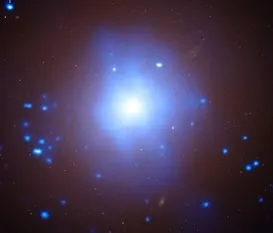
The globular cluster system of NGC 1399. V. dynamics of the cluster system out to 80 kpc Schuberth, Y.; Richtler, T.; Hilker, M.; Dirsch, B.; Bassino, L. P.; Romanowsky, A. J.; Infante, L A&A 513 (2010) A52 DOI: 10.1051/0004-6361/200912482 arXiv:0911.0420v1 Lila Patricia Bassino is part of the research group on Globular clusters and dwarf galaxies (CGGE) Facultad de Ciencias Astronómicas y Geofísicas, Universidad Nacional de La Plata, IALP (CONICET – UNLP).The researchers used Gemini South and VLT to study the largest set of globular cluster velocities obtained so far from an elliptical galaxy to review and extend previous works on the dynamics of NGC 1399, the dominant central galaxy of the nearby Fornax cluster, and its halo.
Long-term multi-wavelength studies of grs 1915+105. I. A high-energy and mid-infrared focus with RXTE/Integral and Spitzer F. Rahoui, S. Chaty, J. Rodriguez, Y. Fuchs, I. F. Mirabel (IAFE-CONICET) and G. G. Pooley. ApJ 715 1191 DOI: 10.1088/0004-637X/715/2/1191 arXiv:1004.3032v2They report a long-term study of the microquasar GRS 1915+105 to understand the origins of the mid-infrared emission and to search for correlation with radio and high-energy activities.
Combined analysis of images and spectral energy distributions of taurus protostars Luciana V. Gramajo, Barbara A. Whitney, Mercedes Gómez and Thomas P. Robitaille. Gramajo and Gómez are researchers at the Observatorio Astronómico, Universidad Nacional de Córdoba. The Astronomical Journal 139 2504 DOI: 10.1088/0004-6256/139/6/2504 They present an analysis of spectral energy distributions, near- and mid-infrared images and Spitzer spectra of eight ClassI/II objects in the Taurus-Auriga molecular cloud.
The solar minimum corona from differential emission measure tomography Alberto M. Vásquez (IAFE-CONICET-UBA), Richard A. Frazin and Ward B. Manchester The Astrophysical Journal, Volume 715, Number 2 DOI: 10.1088/0004-637X/715/2/1352 They present results from a tomographic reconstruction of the solar corona using data from STEREO A and B with which they performed an analysis of local measurements of differential emission measure of electron density and temperature.
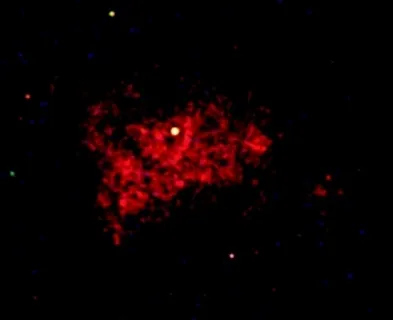
A ~ 40 year variability cycle in the luminous blue variable/wolf-rayet binary system hd 5980? Gloria Koenigsberger, Leonid Georgiev, D. John Hillier, Nidia Morrell (Las Campanas) , Rodolfo Barbá (ICATE-CONICET) and Roberto Gamen (FCAyG UNLP-IALP-CONICET). The Astronomical Journal 139 2600 DOI: 10.1088/0004-6256/139/6/2600The massive solar system HD 5980 in the Small Magellanic Cloud had a brief and sudden eruption in the mid-1990s, not well understood, but mechanisms similar to those of luminous blue variables are suspected. Using previous and recent data, the researchers find that the eruptions of 1993 and 1994 occurred during the beginning of an extended state of high activity and that another episode seems to have occurred between 1960 and 1965, suggesting a variability cycle of approximately 40 years. The characteristics suggest the possible classification of the system as an S-Doradus type variable. Reference: HD 5980: The Wolf-Rayet Binary that Became a Luminous Blue Variable
The discovery of binary white dwarfs that will merge within 500 myr Mukremin Kilic, Warren R. Brown, Carlos Allende Prieto, S. J. Kenyon, J. A. Panei (Facultad de Ciencias Astronómicas y Geofísicas, UNLP) ApJ 716 122 DOI: 10.1088/0004-637X/716/1/122 They present radial velocity observations of four very low-mass white dwarfs, presumably in binary systems composed of other carbon/oxygen core white dwarfs. From the angular momentum loss they estimate that three of the four systems will merge within 500 million years and the remaining one in a Hubble time.
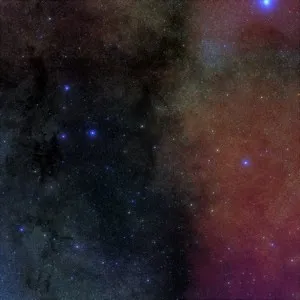
A white dwarf cooling age of 8 Gyr for NGC 6791 from physical separation processes p194 Enrique García-Berro, Santiago Torres, Leandro G. Althaus, Isabel Renedo, Pablo Lorén-Aguilar, Alejandro H. Córsico, René D. Rohrmann, Maurizio Salaris & Jordi Isern Nature 465, 194–196 (May 13, 2010) doi:10.1038/nature09045 arXiv:1005.2272v1 Leandro G. Althaus and Alejandro H. Córsico are from Facultad de Ciencias Astronómicas y Geofísicas, UNLP/IALP-CONICET. René D. Rohrmann, from Instituto de Ciencias Astronómicas, de la Tierra y del Espacio, CONICET. On the CONICET page: New model to measure the age of stars.NGC 6791 is a well-known, very nearby open cluster. Two different ages for the cluster were proposed, one based on the white dwarf luminosity function, and the other derived from its main sequence stars. The discrepancy appears to be resolved by finding that, as had been theoretically anticipated, there is a physical separation process in the core of white dwarfs.
Veritas 2008-2009 monitoring of the variable gamma-ray source m 87 V. A. Acciari et al. ApJ 716 819 DOI: 10.1088/0004-637X/716/1/819 arXiv:1005.0367v1 The list of authors is very long, but includes Ana Carolina Pinchel and Dr. Adrián Rovero from IAFE. M 87 is a nearby radio galaxy that has been studied by VERITAS in 2008 and 2009. VERITAS is a gamma-ray telescope. The name is an acronym for Very Energetic Radiation Imaging Telescope Array System. It consists of an array of four 12m reflectors for high-energy gamma-ray astronomy and is located in southern Arizona.
Fermi large area telescope first source catalog ApJS 188 405 DOI: 10.1088/0067-0049/188/2/405 arXiv:1002.2280v1 The long list of authors includes: Analía Cillis, from IAFE. This is a catalog of high-energy gamma-ray sources detected by the LAT instrument on Fermi during the first eleven months of the mission's science phase, which began in August 2008. This first Fermi catalog (1FGL) is available online in different formats.
Non-thermal radiation from Cygnus X-1 corona Florencia L. Vieyro, Gustavo E. Romero & Gabriela S. Vila Instituto Argentino de Radioastronomía (IAR, CCT La Plata - CONICET) arXiv:1005.5398v1 Presented as a poster at HEPRO II (October 26-30, 2009) Accepted for publication in International Journal of Modern Physics D (IJMPD) Cygnus X-1 was the first widely accepted X-ray source to be a black hole candidate. The detection of strong X-rays and gamma rays reveals that this type of object is capable of accelerating particles to very high energies. To explain these emissions, the team presents a black hole corona model and compare their model with data obtained with the COMPTEL instrument.