A review of some of the latest articles by Argentine astronomers.
Argentine astronomers research a great variety of topics from various institutions. Knowing a little more about their work is getting closer to them, knowing their names, identifying the institutions involved, ultimately, spreading a little more their existence, that of the organizations that group them, and the work done.
To end this wonderful year that has had astronomy as the "star" of the web and science outreach activities, it is worth at least mentioning some of the work done by Argentine professionals.
What follows is a very brief description of some of the latest articles made by astronomers in Argentina. Others have already been commented on, for example when we visited the IAFE.
With the aim of getting an idea of the topics of interest of the professionals and the number of articles published, we are preparing some lists of the papers in the most important specialized journals.
Binaries in Blanco 1
Victor Manuel Blanco is a Puerto Rican doctor in astronomy who in 1959 discovered the galaxy cluster that was later named Blanco 1. He was the second director of the Cerro Tololo Observatory. In his honor, the 4-meter Blanco telescope was named in 1995.
The discovery of the cluster occurred when V. Blanco noticed that in the area near the binary star zeta Sculptoris there was a concentration of AO-type stars.
This grouping deserved successive observations, from the photometric study of the region in 1985 (Abraham de Epstein, A. I., & Epstein, I. 1985, AJ, 90, 1211) to the most recent ones in X-rays by Cargile et al. (2009)
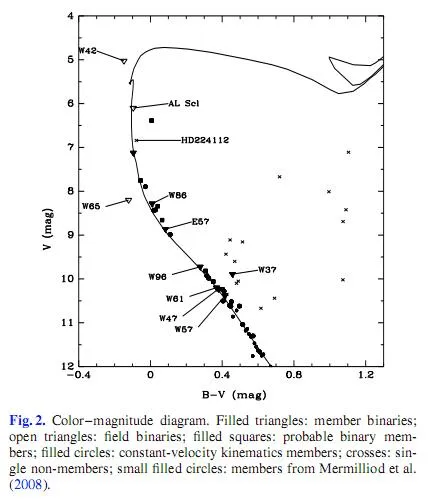
Jorge Federico González and Hugo Levato, from the Institute of Astronomical, Earth and Space Sciences in San Juan (ICATE), have just submitted to A&A an article in which they report the results of a long-term spectroscopic study carried out at CASLEO as part of a broader project that attempts to derive the frequency and properties of binaries in open clusters. Preliminary investigations were reported by both astronomers in 2004 and 2006.
The observations were made from June 2002 to September 2008. The primary sample contains all stars with a brightness of 10.5 within a radius of 1.5 degrees in the cluster whose location in the color-magnitude diagram is compatible with the main sequence of the cluster. This sample of 45 stars also included some fainter ones (down to 11.3 mag). In addition, another 24 bright stars were observed in a wider region, up to 4 degrees from the cluster center. The observations cover a wide range of spectral types on the main sequence, from B4 to F7. Among the cluster members they found 14 constant radial velocity variables, 9 single-line spectroscopic binaries (SB1), 3 candidate variables, and 3 whose variability was deduced by comparing the radial velocities with those obtained in previous publications.
A&A 507, 541-547 (2009)
DOI: 10.1051/0004-6361/200912772
Spectroscopic study of the open cluster Blanco 1
J. F. González and H. Levato
2009A&A...507..541G
The legacy of two supernovae
Four researchers from the Supernova Remnants and Interstellar Medium Group of IAFE (Elsa Giacani, Gloria Dubner, Gabriela Castelletti, and Sergio Parón) participated in an investigation together with M.Smith and N. Loiseau from the XMM-Newton Science Operations Center, Spain.
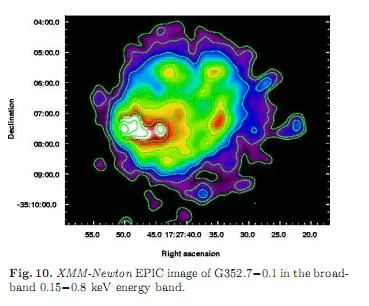
The study investigated the supernova remnants Kes 79 and G352.7-0.1 using reprocessed VLA observations and XMM-Newton archive data. The surrounding gas was investigated based on data extracted from different surveys.
Radio and X-ray study of two multi-shell supernova remnants: Kes 79 and G352.7-0.1
E. Giacani et al
A&A 507, 841-853 (2009)
DOI: 10.1051/0004-6361/200912253 arXiv:0907.2133v2
To be published
The effects of environment on galaxies and active nuclei
Diego García Lambas, from IATE, together with Nelson Padilla and Roberto Gonzáles, both from the Pontificia Universidad Católica de Chile, sign an article submitted to MNRAS.
They studied the properties of SDSS galaxies with and without detected active nuclei, as a function of the local and global environment. The properties include the color, luminosity, concentration, and mass of the galaxies, as well as the distance to massive clusters.
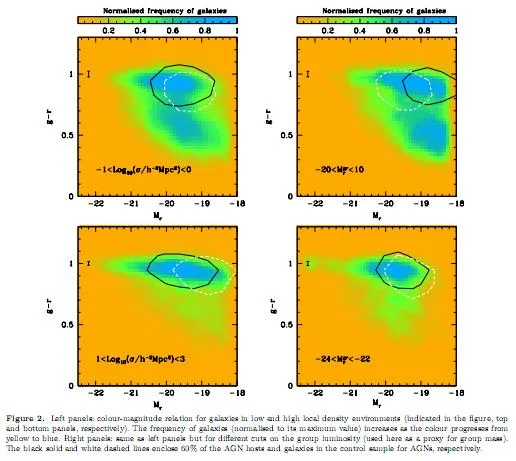
Environmental efects on galaxies and AGN
Nelson Padilla et al
Submitted to MNRAS arXiv:0911.5345v1
Astronomy books at the National Library
Dr. Alejandro Gangui, from IAFE, published an article about the exhibition of rare astronomy books at the National Library.
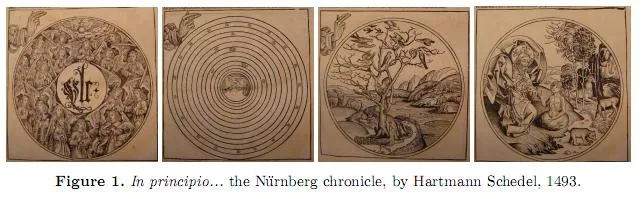
Cosmological and astronomical knowledge until the dawn of modern science was deeply embedded in myth, religion, and superstition. Many of the inventions of the human mind remain stored in different media: medieval engravings, manuscripts, and old and rare books.
The bibliographic-hemographic exhibition of the National Library is called "Lecturas del cielo", Astronomy books at the National Library and can be visited between November 16 and February 28 on the first floor, "Leopoldo Marechal" room, at Agüero 2502.
Gangui's article will be published in the Proceedings of the IAU Symposium 260 that took place between January 19 and 23 of this year under the title "The role of astronomy in society and culture".
The National Library of Argentina: exhibiting astronomy-related rare books
Alejandro Gangui
The Role of Astronomy in Society and Culture: Proceedings of the IAU Symposium 260, D. Valls-Gabaud and A. Boksenberg (eds), Cambridge: Cambridge University Press, IAU Symposia Series arXiv:0911.0298v1
In good faith, strong LBVs rotate rapidly
Optical observations of the luminous blue variable HR Carinae are reported showing that the star reached a visual minimum phase in 2009. The star appears to rotate at 150 (+/- 20) km/s, which implies a rotation of approximately 88% of its critical velocity.
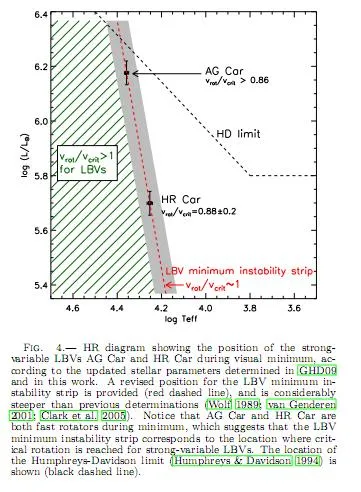
The study involved researchers from the Max Planck Institute in Germany, IAG-USP in Brazil, the University of Pittsburgh in the United States, the University of La Serena, Chile, and two Argentine researchers: Rodolfo Barbá and Eduardo Fernández Lajús, both from the Instituto de Astrofisica La Plata.
Bona-fide, strong-variable galactic Luminous Blue Variable stars are fast rotators: detection of a high rotational velocity in HR Carinae
Jose H. Groh et al
Accepted for publication in ApJ Letters arXiv:0909.4459v1
Other entries about Argentine astronomical research:
- What do Argentine astronomers research?
- Publications in Bulletin 52 of the AAA
- Argentine articles in A&A 2009
- Argentine articles in APJ and AJ 2009
- Argentine articles in SpringerLink
- New Argentine articles
- More Argentine articles (March-April)
- Argentine articles (April-May)
- Articles by Argentine astronomers (Jun-Sept 2010)
- New Argentine articles (October 2010)
- The universe in a banana
About the images
- The images were extracted from the articles and belong to the respective authors