A new analysis of the mass of dark matter particles, carried out by Argentine researchers abroad, suggests it is on the order of keV.
Researchers Héctor José de Vega and Norma Sánchez presented to Monthly Notices of the Royal Astronomical Society an analysis based on theory, observation of satellite galaxies of the Milky Way, and numerical simulations, in which they conclude that the mass of dark matter particles is on the order of keV. Furthermore, they point out that the temperature at which dark matter decoupled from ordinary matter and radiation during the evolution of the universe is at least 100 GeV.
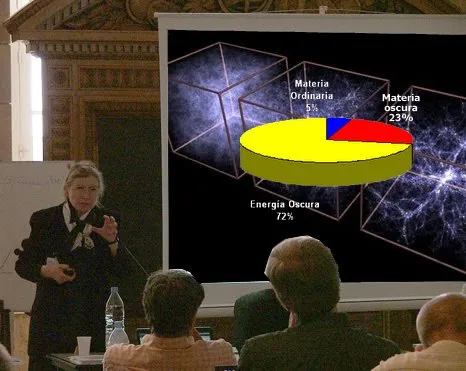
Although the missing mass problem was discovered sixty-five years ago (Zwicky 1933, Oort 1940), the nature of this mass is still unknown. Dark matter would account for 23% of the universe and would be composed of unknown particles, which do not emit or absorb light (hence the term "dark matter"), but are detected indirectly by their gravity.
The results, the researchers note, are independent of the particle model used to describe dark matter, as they consider different scenarios (both ultra-relativistic decoupling and non-relativistic decoupling, with both decoupling inside and outside local thermal equilibrium).
It happens that different possibilities about dark matter have been postulated. On one hand, MACHOs were considered, massive objects difficult to detect, but composed of normal (baryonic: protons, neutrons) matter.
On the other hand, non-baryonic dark matter is considered, and two large groups of candidates are postulated:
Hot dark matter (non-baryonic particles that move at the speed of light, like the neutrino) and cold (non-relativistic).
They also warn that the analysis refers to the mass of the particles and the number of degrees of freedom when they decoupled, without making assumptions about the nature of this matter.
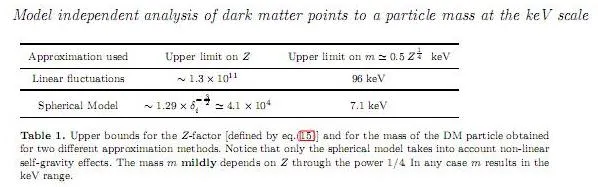
In case dark matter particles explain the formation of black holes at the centers of galaxies, those particles must be fermions with a mass within the keV scale, they indicate, pointing to the work of F. Munyaneza and P. L. Biermann.
The mass for these particles, in that range, is greater than the temperature during the Matter Dominated era, so dark matter is cold, they explain in their conclusions. A possible candidate then is a "sterile" neutrino and others could be the gravitino, the light neutralino, and the majoron.
The researchers are Research Directors of the CNRS of France, working with the Paris Observatory and Pierre and Marie Curie University.
The work will be presented at an international congress (CIAS) to be held at the Paris Observatory (Château de Meudon) from June 8 to 11, on dark matter in the universe and the properties of galaxies.
About the researchers
We had talked about Norma Graciela Sánchez and Héctor José de Vega in the article: "Two Argentines closer to the origin of the cosmos".
We had also cited them in: "Two Argentines limit the inflation of the Universe".
As we pointed out in those notes, they are two extremely prestigious researchers, making us Argentines look good abroad.
But they do not forget their homeland. Dr. Sánchez sponsored last month the creation of the School Science Laboratory at Primary School No. 2 "Hipólito Bouchard", in Ensenada.
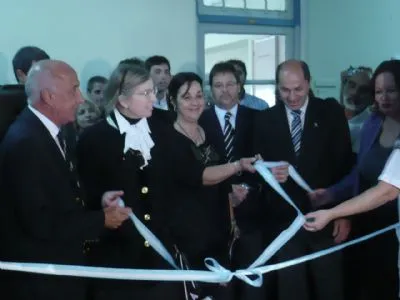
At the event, the distinguished scientist was present and stated that "Science is a contribution to the entire Community, local, provincial, national, international". Furthermore, "it is a cultural, intellectual, and technological contribution. It is a school of training, it is a nursery of competencies". She emphasized that "the values of Science are the search for truth, knowledge, originality, and creativity. Ethics, morality, and social responsibility must be a search and a constant accompaniment to Science". And she added that Science dignifies human activity, beyond all the material benefits it may provide us. Science is the production of new knowledge for progress, and the progress of peoples, individuals, all of humanity, must be a constant concern of those who do science".
Addressing the children, she stated that "I did not come here for the recognitions, which I humbly thank, my presence here is to support this project and to demonstrate that for me, you are valuable". It is my recognition towards you, towards the school".
Sources and related links
Model independent analysis of dark matter points to a particle mass at the keV scale
H. J. de Vega, N. G. Sanchez
Monthly Notices of the Royal Astronomical Society
Volume 404 Issue 2, Pages 885 - 894
DOI: 10.1111/j.1365-2966.2010.16319.x arXiv:0901.0922v3
La masse de la particule de matière noire: est-elle dans la gamme du keV?
More information: La Escuela Primaria nº 2 de Ensenada inauguró el Laboratorio de Ciencias Escolar.
About the images
Initial image: combination of Chalonge photo with infographic.
Photo of the laboratory inauguration event. Credit: Plusinformacion.com