Charles Steidel, professor of astronomy at the California Institute of Technology, is the recipient of this year's Cosmology Prize in recognition of his work on the most distant galaxies.
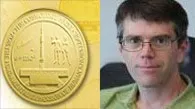
The official statement states that "Professor Steidel pioneered the techniques necessary to find the youngest galaxies and led the efforts that opened a direct observational window to a time when the universe was only a tenth of its current age". Charles Steidel will receive the not inconsiderable sum of half a million dollars, as well as a gold medal, in October at the University of Chicago, where he will also give a lecture.
About the medal and the Gruber Prize, we reported last year when informing about the 2009 winners.
Steidel and colleagues knew that the expansion of the universe would stretch the wavelength of the so-called Lyman limit (referring to the short-wavelength end of the Lyman series of hydrogen, at 91.2 nm) and their work led to the discovery, in 1995, of the first galaxies that broke that limit, by using the W.M. Keck telescope in Hawaii.
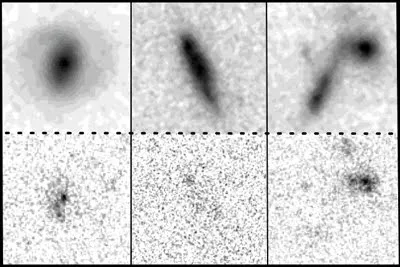
Normally, Lyman-alpha emission is in the ultraviolet part of the spectrum, but Lyman-alpha bubbles are so far away that their light is redshifted to optical wavelengths, as can be seen in the image of The Lyman Alpha Bubble.
"Chuck Steidel opened a new window into forming galaxies in the early universe," said Dr. Wendy Freedman, this year's chair of the prize's Selection Advisory Board, and who won it the previous year.
"It was a completely unexplored region," commented Steidel about his work. Currently Steidel continues researching galaxies of the early universe and this year is presenting his first paper on a new technique.
A 1996 Hubble image illustrates Steidel's work:
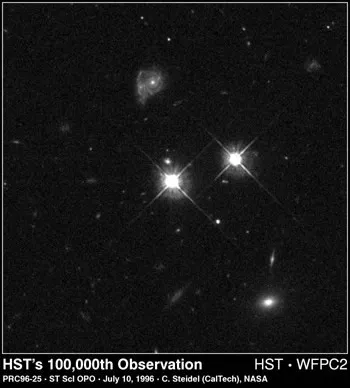
On June 22, 1996 the Hubble Telescope reached 100,000 exposures with a shot of a quasar about 9 billion light-years from Earth.
This is the bright object in the center of the photo. Just above, what is seen is an elliptical galaxy separated by 2 billion light-years from the central object, closer to our planet.
Astronomer Charles Steidel discovered the galaxy indirectly by examining the light from the quasar. The bright object to the right of the quasar is a background star, but the central object appears so bright due to the enormous amount of light it produces.
Further up a spiral galaxy is seen, also in the background.
Born in New York in 1962, he studied at Princeton and later at Caltech. He was an assistant professor at MIT, won the Helen B. Warner Prize in 1997, is a member of the U.S. National Academy of Sciences, and in 2008 received the medal of the Institut d'Astrophysique de Paris.
Since 2004 he has held the Lee A. DuBridge chair as a professor at Caltech.
Sources and related links
- The Hubble Space Telescope Quasar Absorption Line Key Project. V. Redshift Evolution of the Lyman Limit Absorption in the Spectra of a Large Sample of Quasars
Stengler-Larrea, E., A. Boksenberg, C. Steidel, et al 1995, Ap. J., 444, 64
1995ApJ...444...64S
DOI: 10.1086/175582 - Lyman Limit Imaging of High Redshift Galaxies. III: New Observations of 4 QSO Fields
C. C. Steidel, M. Pettini, D. Hamilton, 1995, AJ, 110, 2519
arXiv:astro-ph/9509089v1
DOI: 10.1086/117709 - Charles Steidel on Wikipedia (English)
- 2010 Gruber Cosmology Prize Press Release
About the images
- Gruber medal and Charles Steidel.
- Hubble photo. Credit: Charles Steidel (Caltech)/ NASA