Brazilian President Lula da Silva received one of the Galileoscopes that will be distributed in Brazilian schools.
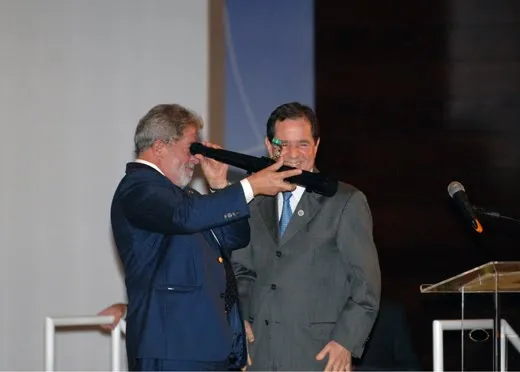
It happened during the opening session of Brazil's National Conference on Science, Technology and Innovation, in May.
Currently 20,000 Galileoscopes are being distributed in Brazil's public schools, a project of the 2009 International Year by the Brazilian Society of Astronomy, supported by the neighboring country's Ministry of Science.
It should be said that the current Minister of Science of Brazil is physicist Sergio Rezende, who, according to data from the Brazilian Academy of Sciences, studied at the Pontifical Catholic University of Rio de Janeiro (PUC), graduated as an electronic engineer and then pursued a doctorate in physics at MIT, Cambridge.
In the video that can be seen below, Lula speaks at the conference about his telescope (luneta) making a joke about the political reality of his country.
VIDEO: Galileoscope for Lula
http://www.youtube.com/watch?v=xnl9HlcK0o4&feature=player_embedded
"The minister gave me a telescope that doesn't work, because we are in an election year and someone will say: 'The minister gave a telescope to Lula. A telescope that was bought to give to the children.' Soon, Lula is already being prosecuted, the prosecutor is already after my telescope and the Court of Accounts looking for what crime I have committed. Since the opposition proposes the CPI of the telescope, and then everything freezes in this country," said Lula, to the laughter of the audience. I suppose the reference to CPI is about the Parliamentary Commission of Inquiry.
In another video you can see the moment when the Brazilian president receives the telescope.
Lula's involvement in astronomy recently generated some dust, due to the alleged pressure for the E-ELT selection to fall on Chile, to the detriment of Spain.
Astronomy, education and IYA2009
About the virtues of the Galileoscope in schools, it goes without saying that it is a good initiative, it surely adds and does not subtract, although most school-age students attend classes during the day. On the other hand, there are dozens of initiatives related to astronomy that would not require significant economic expense (books or other educational material, observing with the naked eye, star charts, software, knowledge). However, the Galileoscope is a very economically accessible instrument and, undoubtedly more impactful, due to its visual nature.
In Argentina there were similar initiatives last year. For example, the program "An observatory for my school" was developed, prepared by the Optics Laboratory of the Faculty of Astronomical and Geophysical Sciences of the National University of La Plata. For the ESB School No. 4, in Rawson, it was an enriching experience. (See: "An Observatory for my School" in Rawson, Bulletin 283, FCAyG UNLP).
There was also a similar contest by the Kepler Astronómica group, whose third prize (for primary school) went to School No. 15 in Barracas whose students created a blog for that purpose.
And also for IYA2009, the Astronomy in the school contest was held, whose results were recently announced.
The momentum of the International Year, despite initiatives that still persist, as demonstrated by the case of the Galileoscopes in Brazil, is losing strength, like in a Gaussian bell curve.
I believe, however, that if the global initiative loses massiveness, from each country programs can be carried out on a longer-term basis to sustain the promotion of this science that inevitably goes hand in hand with physics and mathematics.
Although in Argentina the great support from the State is being received by nanotechnology and bioinformatics, which I don't think is bad, it would be good for institutions linked to astronomy to unite in a more extensive, lasting, federal and organized project, to maintain and foster interest in astronomy.
The VII Science Week, which has just started, will be a new opportunity, with several activities related to astronomy.