The use of trigonometric parallax, Cepheids and supernovae as methods for measuring distances in the universe is very widespread. But there are other methods that, together, form a distance ladder.
In a previous post, we talked about units of measurement. There we discussed the use of trigonometric parallax. And, when talking about the Hubble Constant, we pointed out the use of supernovae and Cepheids as methods for estimating distances.
However, there are many other methods used. They are often classified as being absolute or relative. The former are those in which a direct measurement can be made, while the latter are those based on the existence of types of objects that have equal properties among themselves (be it luminosity or size).
Not every method is used for every object, as each technique has its limitations. Rather, some methods are used to calibrate others, in a true cosmic distance ladder.
For extragalactic measurements, it is often said that there are two types of indicators, again primary and secondary. The primary ones would be those that can be calibrated with our galaxy or with some theoretical consideration. The secondary ones are those that use distances previously established with primary indicators.
Among the primary indicators are trigonometric parallax, the moving cluster method (convergent point method), Cepheid and RR-Lyrae variable stars, and spectroscopic parallax.
Let's look at some:
Primary indicators
Moving cluster method
It is thought that stars born in an open cluster did so practically at the same time from the same molecular cloud. They are, therefore, the same age. Astronomers also think that these stars move with the same velocity vector. The distance d to the cluster is obtained from the radial velocity v of the cluster relative to us (by spectral observations), the angular size, and the variation of that size in a time t:
$d=\displaystyle \frac {vt \theta} {\Delta\theta}$
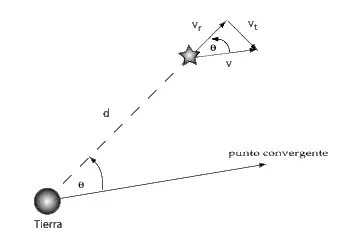
Thus, with a group of physically related stars that share a motion, like the Hyades, and given that due to perspective, the proper motions appear to be directed to a single point, called the convergent point, if the linear velocity of the cluster is known from radial velocity observations, the distance of each star can be estimated from the total proper motion.
More at: Moving cluster method
Moving cluster on Wikipedia
Distances Measures for Open Star Clusters
In a recent talk, physicist Alberto Rojo pointed out this method as a crossover between physics and art, since it uses the concept of perspective, which has been used so much in both branches of human activity.
Spectroscopic parallax
When the parallax to a star is not known, its Absolute Magnitude can be determined by analyzing the spectrum, looking for effects such as the one discovered by the Wilson-Bappu duo, which bears their name.
One of the first to formulate a system for classifying the luminosity of stars based on the H - R diagram were W. W. Morgan, P. C. Keenan and E. Kellman, in the year 1943. Later, in 1962, it was perfected by Morgan and Keenan in what is known as the MK System.
The idea is that some stars have specific characteristics in their spectra, which allow calculating their absolute magnitude and, therefore, their distance. For example, the K absorption line of calcium, which is wide and reaches a maximum in K0 stars.
once we have the spectral type and luminosity class of a star we can calculate its absolute magnitude and, therefore, its distance. This is the spectroscopic parallax method.
More at Spectroscopic parallax
Spectroscopic parallax at Astrocosmo
Fitting to the Hertzsprung-Russell diagram
Stars can be classified on a Hertzsprung-Russell diagram. The diagram is in luminosities or absolute magnitudes, while we observe the apparent magnitude of the stars.
The method consists of adjusting the average distance for all the stars so that the distribution fits the diagram.
For remote clusters, parallaxes cannot be measured but the spectra of their stars can be used to obtain the HR diagram. Such a diagram is a diagram of apparent magnitude versus spectral type. If we compare this diagram with the HR diagram calibrated by the Hyades, we find that the two are identical except for the vertical scale. The difference between the absolute and apparent magnitude determines the distance of the distant cluster.
A plot of apparent magnitude as a function of color index for an open cluster would be shifted relative to an HR diagram. The shift of the main sequence of the apparent magnitude versus color index plot relative to the main sequence of the HR diagram is the distance modulus, therefore by measuring this shift, the distance to the cluster can be determined. This method was developed by H.L.Johnson.
The distance modulus is the difference between the apparent magnitude m, corrected for stellar absorption, and its absolute magnitude M of an object. It is related to its distance d (expressed in parsecs) according to the relation:
$m - M = 5*log(d/10)$
More at HR Diagram Fitting
Determination of the distance to the open cluster NGC 3532 by the main sequence superposition method by L. Ciocci Brazzano; G. Acuña in Special Reports of Recreational Physics.
Secondary methods
The V4 relation for spiral and elliptical galaxies
The Tully-Fisher relation
It was published by astronomers R. Brent Tully and J. Richard Fisher in 1977 and allows estimating the distance at which a spiral galaxy is located from the width of the lines in its spectrum.
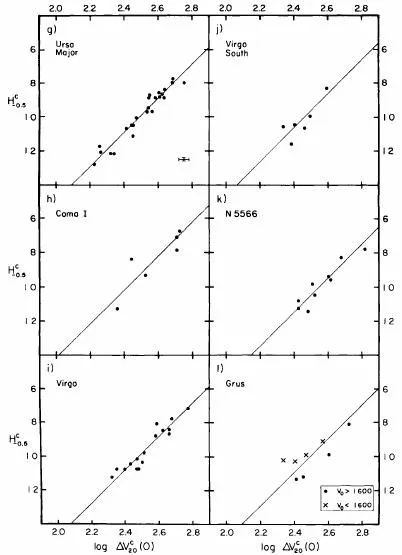
The relation, derived empirically, states that the luminosity of a spiral galaxy is proportional to the fourth power of its maximum rotation speed, which, in turn, is determined from the width of the spectral lines, in particular the 21cm line emitted by the neutral hydrogen of the galaxy. Once the luminosity L is known, the distance d can be determined by comparing the former with the apparent magnitude m.
The Tully-Fischer relation is calibrated with nearby galaxies whose distance is known from Cepheids.
The best bands for measuring the brightness of galaxies are the infrared ones, because:
The effect of extinction by dust internal and external to galaxies is lower and they better represent the mass of stellar populations (blue bands are heavily influenced by recent star formation).
More on the Tully-Fisher Relation
Tully-Fisher relation on Wikipedia
Faber-Jackson relation
Relation between the Luminosity of an elliptical galaxy and its velocity dispersion for calculating its distance discovered by Sandra Faber and Roger Jackson. It was later improved with the D-Sigma relation:
In elliptical galaxies there also exist relations between their size, velocity dispersion and luminosity. The greater the luminosity of an elliptical, the greater the velocity dispersion.
Cepheids are not found in ellipticals, and therefore they need other distance measurement methods to calibrate the relation.
It is usually used to determine distances to clusters, averaging the measurements obtained for each elliptical galaxy in it.
More at: Faber-Jackson relation on Wikipedia
D-Sigma: Improvement to the FJ relation
Surface brightness fluctuation method
In 1988, John L. Tonry and Donald P. Schneider proposed using the surface brightness fluctuation of a galaxy as a new means of determining its distance. The idea behind the method is that, although a telescope may not resolve a population of bright stars in a distant galaxy, the discrete nature of the stars causes fluctuations in the surface brightness of the galaxy. The degree of these fluctuations decreasing with distance, the appearance of a galaxy becomes smoother as distance increases.
More on Surface brightness fluctuation method
Luminosity functions
The brightest objects in a galaxy can also be used. For this, red supergiants, globular clusters, or giant HII regions can be used. For this astronomers use the luminosity function of a globular cluster of a galaxy, for example, and compare it with the relative and absolute magnitudes.
The average luminosity function of globular clusters around the Milky Way, the Large Magellanic Cloud and M31 appears to be the same. It is possible to assume, therefore, that the same occurs in other galaxies.
Thus astronomers can use the average luminosity function of globular clusters as a standard candle that allows calculating the distance to their parent galaxy.
More on Brightest object in a galaxy
Sunyaev-Zel'dovich effect
The Sunyaev-Zeldovich effect (SZ effect) is the result of the interaction of the background radiation with free electrons at a higher temperature. It was proposed by researchers Rashid Sunyaev and Yakov Zel'dovich in 1968. This interaction occurs in the large structures of the universe such as superclusters or galaxy clusters. Having as a net result a blue shift in the spectrum of the Cosmic Microwave Background.
More in interview with Matthias Bartelmann at IAC and in Sunyaev-Zeldovich effect by Lucia Guaita.
Gravitational lenses also help
The time delay in the light fluctuations observed in the multiple images of a quasar produced by a galaxy cluster can provide a distance scale. The best studied system so far is the quasar QSO 0957+561, with which a value for the Hubble constant of 70 km/s/Mpc has been determined.
More at La Bella Teoría and at Nueva Estimación de la Constante de Hubble.
The ladder
These different methods and others not mentioned here make up what is called the cosmic distance ladder. In David Darling's Encyclopedia of Science it is illustrated with the following image (edited):
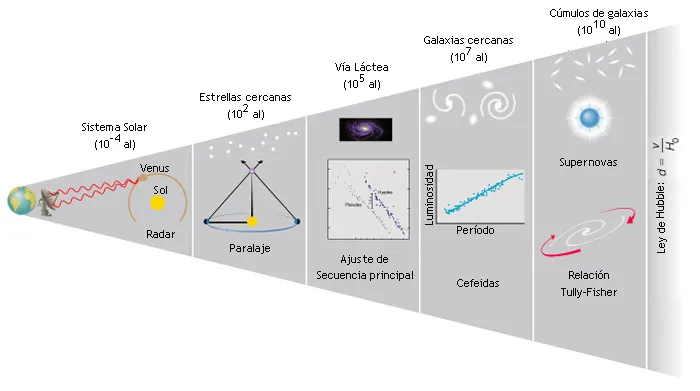
And here is another illustration of the ladder (from Cosmología Observacional by Beatriz Granados):
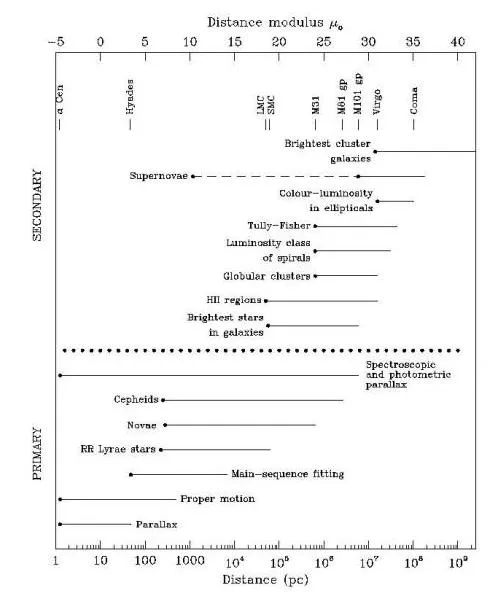
More at: Comparison of the different methods
Note written for the VIII Carnival of Physics, in this edition hosted by Pirulo cósmico. To join and read the entries there is a social network on Ning.
Sources and related links
- A permanent reference source for this entry was the online astrophysics course by Dr. Victor Migenes and Dr. Roger Coziol.
- Cosmologia observacional: Medidas de distancias cosmologicas by Beatriz Ruiz Granados PDF)
- The distance scale and expansion of the Universe, by José A. de Diego
About the images
- Image adapted from the one appearing in the Encyclopedia of Science online, by David Darling (cosmic distance ladder).
- Infrared Tully-Fisher relations for nearby groups of galaxies.(Aaronson & Mould 1983, ApJ, 265, 1) from Encyclopedia of Astrophysics online.
- Main image: Combination of ladder image by blikdsgn (http://www.sxc.hu/) with Hubble/NASA image of NGC 1850.