A review of the basic units astronomers use to measure distances in the universe is our contribution to the II Carnaval de la Física.

Scientists use these units routinely. Among the most common are the light-year, the parsec, and the astronomical unit.
Standardized measures
The International System of Units (SI) defines seven basic units or fundamental physical units, from which the others are derived.
Length is a scalar quantity whose basic unit is the meter (m), which, since 1983, has been defined as the distance light travels in a vacuum in 1/299,792,458 seconds.
We can use multiples of the meter to express greater or lesser distances. For greater ones, we can use from the kilometer (103 meters) to the yottameter (1024).
The Astronomical Unit
The International Astronomical Union is responsible for maintaining and approving a special set of units in astronomy, formally defined in 1976. One of the most important is the astronomical unit (AU), which is defined by the IAU as equivalent to the distance from the center of the Sun at which a particle of infinitesimal mass, in an unperturbed circular orbit, would have an orbital period of 365.2568983 days. It is, therefore, the average distance between Earth and the Sun, almost 150 million kilometers (149,597,870 km; 1.49·1011 m).
Originally the AU had been defined as the length of the semi-major axis of Earth's elliptical orbit around the Sun. In 1976, the IAU revised the definition for greater precision: the radius of a Newtonian circular orbit around the Sun of a particle with infinitesimal mass with a mean motion of 0.017 202 098 95 radians per day (Gaussian gravitational constant).
This definition accounts for Kepler's studies (his third law), Newton's reformulation, and Gauss's calculations.
Now, recently we reported on a warning a researcher made about this unit of length. It's that the Gaussian gravitational constant is related to the mass of the Sun and the star loses mass permanently. We covered it in "Proponen redefinir la Unidad Astronómica".
The Parsec
Beyond the Solar System distances are so great that using the AU becomes inconvenient. For studies of the structure of the Milky Way, the parsec is used.
The parsec is equivalent to 3.09×10¹³ km (about 206,265 AU, or 3.26 light-years). It is defined as the distance at which one Astronomical Unit subtends an angle of one arc second.
The term comes from parallax of one arc second, or parallax of one arc second. Therefore, to understand what a parsec is, we must first know what parallax is.
Parallax
This is the name for the apparent deviation in the position of an object, depending on the place from which it is observed. It is normally defined as: The angle formed by the direction of two lines of sight relative to the observation of the same object from two different points, sufficiently far apart and not aligned with it. In Spanish the term is feminine.
There are different kinds of parallax, such as annual, horizontal, solar, lunar, and trigonometric. The latter is defined as the angle under which the radius of Earth's orbit is seen, from a star at a normalized distance of one astronomical unit. It is expressed in arc seconds: In a circle that is divided into 360 degrees (360º), each degree is divided into 60 minutes (60'), also called "arc minutes" to distinguish them from minutes of time, and each minute contains 60 arc seconds (60").
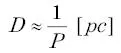
As we see, to estimate a parsec we must start from the definition of AU. The distance to the star is the inverse of the trigonometric parallax expressed in parsecs.
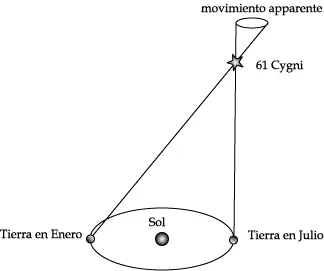
To establish the parallax to a star, we observe it at one time of the year and then six months later (when Earth has made half a revolution around the Sun and is at the opposite point of the orbit).
In both observations we will see an apparent position of the star, slightly different from the real one. But by combining the two observations we can establish the angle of the two lines of sight. And we know the distance from Earth to the Sun. With these data we can use trigonometry to derive the distance to the star.
From Earth, we measure the angle P subtended by this change in position.
Given this data, given the geometry of the situation, we obtain that the parallax corresponds to half of P. Now that we have P we can solve for D, which is the distance between the Sun and the required object. Assuming we know the Earth-Sun distance d (equal to 1 AU), we use trigonometry, since we have constructed a right triangle and:
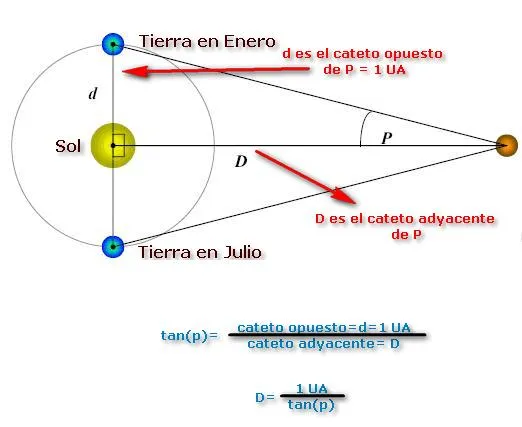
Finally, if we want the distance D in parsecs, we must convert P to arc seconds, and apply the formula:
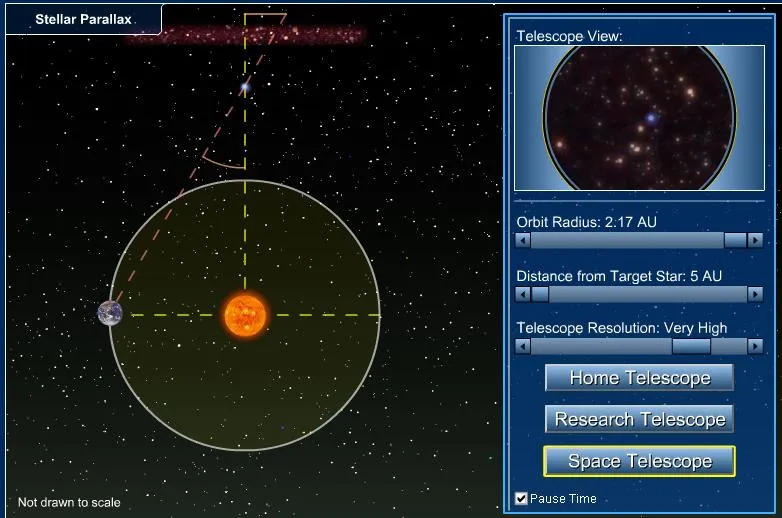
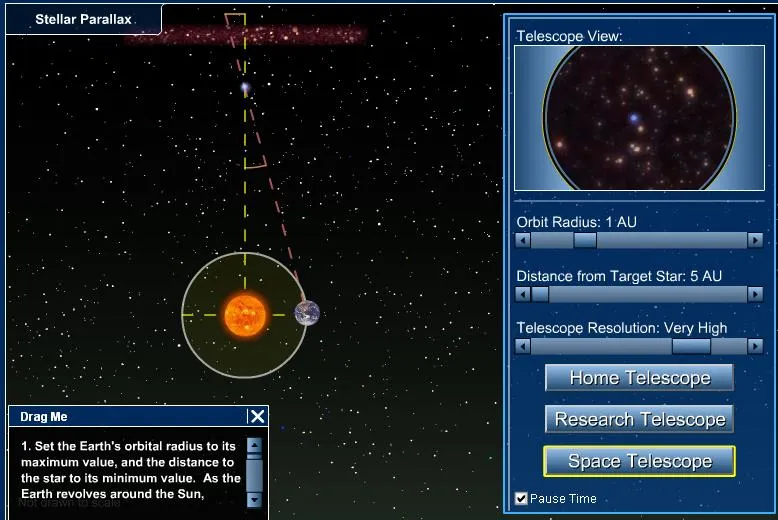
To be clearer we can use an interactive animation called Stellar parallax interactive:
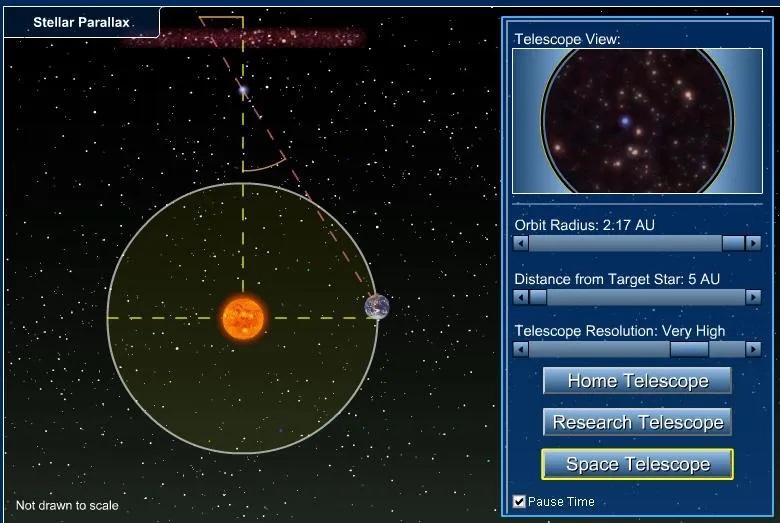
There we won't be able to calculate anything, but we can notice if there is any difference between the visualization of a star at one time and another. We will see Earth orbiting the Sun. We can set the distance of our planet to the Sun and the distance of our star to the star. Let's try, for example, with a maximum Earth orbit and a minimum distance to the star. We stop the animation at two moments, when the planet is at opposite points of the orbit, say in July and, in the upper right box we would see a difference, a "movement" in the brightest star:
and in January and we would see this other:
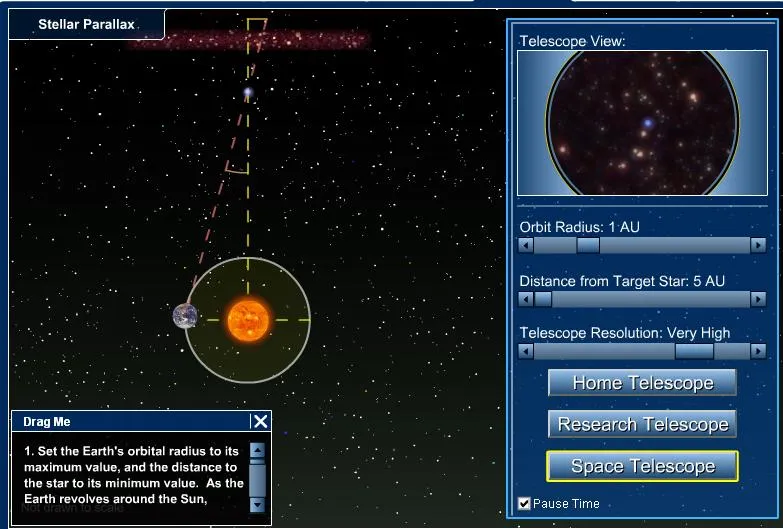
Now let's repeat the procedure but setting the Earth-Sun distance to 1 AU and leaving the distance to the star the same (5 AU)
And we would see this:
and this:
We can also change the telescope resolution and repeat the procedure.
Exercise: Proxima Centauri is at 1.31 pc. What is its parallax?
From the equation D=d/p, we know D and want to know p, we solve for p and the equation becomes p=d/D => p=1/1.31 => p=0.765 arcsec.
If we don't know the distance to the star, but we measure its parallax:
D=d/p => D=1/0.765 => D=1.31 pc
Exercise 2:
ESA will launch the Gaia satellite capable of measuring the parallax of stars at 180,000 light-years away. What angle will the satellite be able to measure?
Convert light-years to parsecs:
If 3.26 LY = 1 pc, then,
180,000 LY/3.26 pc = 55,214 pc
P=d/D
P=1/55.214
P=0.000018 arcseconds!!
We can visualize another animation, this time from Gaia, to understand parallax.
The Light-Year
The most common unit of measurement found in popular literature, newspaper articles, and science fiction works is the light-year. Contrary to what it may seem at first glance, it is a measure of length and not of time. It is the distance that light travels in one year. However, time gets involved here, since we say "in one year," which is in a Julian year (365.25 days of 86,400 seconds). The Julian year is the time it takes the Earth to orbit the Sun.
For greater precision, it is the distance a photon would travel in a vacuum at an infinite distance from any gravitational field or magnetic field, in one Julian year. This definition takes into account that light can be deflected by a gravitational field, such as that of a star, for example.
One light-year is equivalent to 9.46 × 10¹² km, that is, almost ten trillion meters (or 9.46 x 10¹⁵ m).
In some scientific works we can find references to Kly, Mly or Gly: The kilo light-year is equivalent to 1,000 light-years or 306.6 parsecs and is used to measure distances between parts of a galaxy.
The mega light-year is one million light-years, 306,600 parsecs and is used to measure distances between neighboring galaxies and clusters of galaxies.
The giga light-year is equivalent to one billion light-years (306.6 million parsecs). It is one of the largest measures typically used for supergalactic structures such as quasars.
Some equivalences
1 pc = 3.0857 × 10¹⁶ m.
1 pc = 3.26 light-years.
kiloparsec (kpc): one thousand parsecs, 3,260 light-years.
megaparsec (Mpc): one million parsecs, 3.26 million light-years.
1 ly = 63,241 AU
1 ly = 0.3066 pc
Note: the truth is that all these measurements are approximate, so all of them should be preceded by the symbol "~".
There are several online tools for converting units of measurement, for example at Convertworld.com.
Spat?
The Dictionary of Distances (*1) indicates the use of the Terameter (1012 meters), a unit that was formerly known as Spat, equivalent to 6.6846 AU. The origin of the term Spat is not clear, but it could have been as an acronym for "Space Unit" (*2).
The astronomical almanac
The Astronomical Almanac is an almanac published by the United States Naval Observatory. On its page we can find pdfs with some selected astronomical constants.
A break for programming
Astronomers build their own computer programs to analyze and filter the data generated by the instruments and to generate models, visualizations, etc. In those programs they usually have to convert units of measurement and use the stipulated standards for the different quantities (not just length).
IAU created a library of algorithms to establish and maintain a set of constants and procedures for use by professionals. It is called SOFA (Standards Of Fundamental Astronomy) and contains a variety of routines that facilitate the creation of programs in the Fortran and C languages.
Sources and related links
- Astrophysics blog
Practical activity a: Parallax - The IAU and astronomical units
- Improving measurements of space and time
- Distances of the Stars
Prof. Richard Pogge - Units for Stellar Distances
- (*1) Dictionary of distances
Elena Deza and Michel Marie Deza, Ed. Elsevier, Netherlands, 2006, p. 348.
ISBN-13:978-0-444-52087-6
ISBN-10: 0-444-52087-2 - (*2) A Dictionary of Units of Measurement
© Russ Rowlett and the University of North Carolina at Chapel Hill - Scrib: Trigonometry, by Francisco de Asís Fernández Díaz
About the images
- Screenshots from Stellar parallax interactive