The already famous "Time Capsule" in Buenos Aires is being promoted, a means of storing present-day information for 200 years. Does it make sense? Is it a catch-all drawer or a junk drawer?
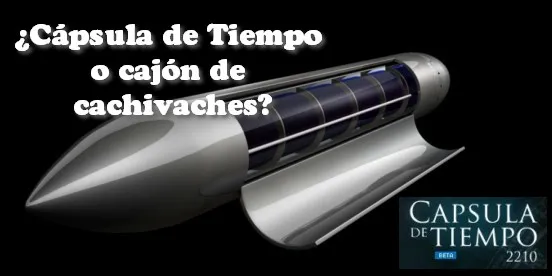
The Time Capsule 2210 is a titanium cylinder almost 3 meters long and weighing 250 kilograms where 500 high-resistance Blu-ray discs containing copies of the files uploaded to the website will be stored. Subsequently, the titanium cylinder will be deposited in a public place in Buenos Aires.
This is an official project developed in the Bicentennial year by the Government of the City of Buenos Aires. It has the sponsorship of Telefónica de Argentina, Clarín and Taringa.
It is a website where users can register and upload content as varied as photos from their Facebook or conduct an interactive interview, for which, in addition to having a PC and web connection, it is necessary to have a webcam and microphone.
The page says: "There are no more important users here than others nor more representative content than others. Capsule 2210 is only a facilitator, a means to communicate with the future".
How long do I have to save my photos and videos?
100 days, approximately. From Monday, August 9 until Sunday, November 8, or earlier, if the figure of 12,000 GB is reached.
And then what will happen?
From November 8, no more files can be uploaded, edited, or deleted within the capsule. The process will then begin in which all the content will be copied onto the Blu-ray discs for subsequent sealing.
The idea is then to save content until May 25, 2210. The site's FAQ indicates it is for two centuries and not one because "The idea is to reach a time range in which all our projections and assumptions no longer make sense (singularity). No one can imagine the world in 200 years."
When Singularity is mentioned, it refers to the concept of technological singularity.
Will a technological singularity be reached in just two centuries?
Will the information contained in this capsule be of any use?
I would like to make some reflections here that, while they may seem contrary to the project, aim to generate thoughts, to ask ourselves questions, more than to answer them.
Allow me to say, first of all, that safeguarding data, however it's done, is better than not keeping anything. What would we know about those who revolutionized our May, back in 1810, if no records from that time had survived?
Certainly, a femur, a skull, can provide a great set of data to know what those inhabitants of Argentine soil were like back then. But it is very insufficient. What did they think, how did they behave?
Some of the historical documents from then or before, from here or there, are often letters. Written paper, epistles that people exchanged. In that sense, today, it seems logical that a time capsule could then contain digital content. We no longer use the Correo Argentino like before, but Gmail!
However, I cannot help but wonder:
Is registering our Facebook photos enough to know, in the future, what we are like today?
Is it possible, currently, to make a truly thorough and effective record of our days?
Is this somewhat random form the best way?
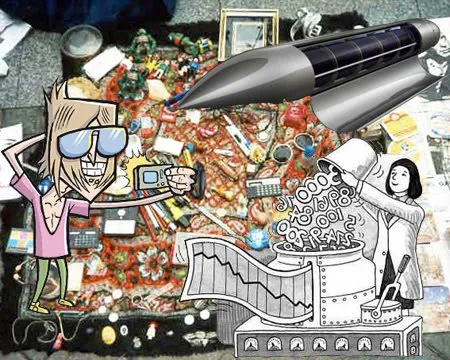
Let's say you want to know who the inhabitants of the Federal Capital will vote for in the next elections (yes, it's a long way off, but it's an example). Do you think the best way to know that is to stand on Florida Street and ask anyone passing by?
Of course, that's better than having no data, but there are better ways. Statistics allows the use of various sampling techniques. Let's say, for example, that we could establish variables we consider appropriate and relate the population or universe (all inhabitants of the Capital, say so many million) with a much smaller and feasible sample, of say, five thousand people. But that this second, smaller group is related, through the variables, to the first, in a relative way.
If the Capital's population is composed of 60% women, our sample should also have that proportion, even if the quantity is smaller.
The variables can be many, but not all. In this example, if a candidate makes promises linked to education or job creation, we will undoubtedly take into account the variables educational level and employment status, but not hair color.
Of course, if a candidate promised to increase taxes for blondes with blue eyes, that variable would become relevant. It's an example, a bit hilarious, but just that, it's not xenophobia.
Thus, our sample will be a small universe and the conclusions we draw we could project onto the entire population.
Does that happen with the Time Capsule? No, I don't think so. Anyone (I put an asterisk) leaves their message, their photo, their interview. Perhaps 75% of men do it, which may not be the appropriate proportion of current Argentines.
Right from the start there is a bias (I take back the asterisk): those who have a PC and web connection participate, not EVERYONE, nor a sample proportional to the whole.
Will this heap of disconnected data, therefore, be useful in the future to know what we are like today?
Don't we currently have the technology and knowledge to truly build our pyramids, our legacy, in a scientific, methodical, constructive way?
Works of art, humor, current passions, soccer, the use (or destruction) of merry-go-rounds, are they in the capsule?
It seems more like a junk drawer than a serious compilation of our sociocultural heritage. I know the term seems derogatory, but I use it in the sense of something whose purpose is not well understood, not necessarily something useless.
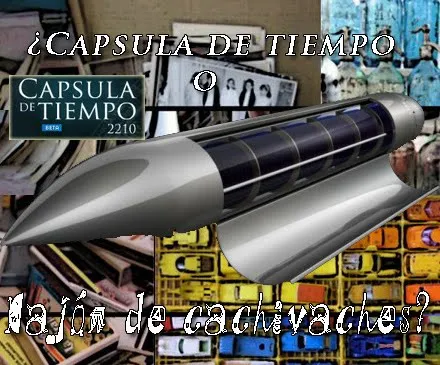
A tailor's drawer can be a disaster for someone who doesn't need needles and threads, but very useful for the textile worker.
There are archaeologists, sociologists, historians, and other experts who can get an idea of what kind of catch-all drawer to build to bequeath to future generations. One that allows us to make clear what, who we are.
But this, like other time capsules, from today, from yesterday, from here and other latitudes, seems to be a Batman album that we try to fill with any sticker at hand. In the 21st century. With systems analysts, with databases, with scientists, couldn't we do something better?
The symbol
Perhaps this time capsule is nothing more than a symbol. And perhaps that is where it begins to give it meaning and value. Like when the end of the year arrives and one asks oneself what one achieved, what one wants to achieve during the next year, this capsule, for those who participate, can be a kind of mirror in which to look at oneself.
Comparisons are odious, they say, but often unavoidable. Let's navigate the Time Capsule 2210 and we will find stories from various known and anonymous personalities, answering about their present and their expectations.
What would we like to leave to our children, grandchildren, and great-grandchildren, to humanity? Whatever we want to leave, we must do it today. Are we on that path?
If we wanted to leave equality, justice, and truth, what do we do in our own little life, the one each of us (separately and together) leads?
If we want to leave knowledge and education; equity and distribution of wealth; work and opportunities for all, what are we doing about it?
The Time Capsule 2210 is promoted as an attempt to "Save objects and documents representative of a given era for future generations," as explicitly stated on the website. The bold is mine because, based on what has been said, I believe it is not correctly representative. At least not as much as it could be with current knowledge and technologies.
But if instead of being promoted that way, it were said that it is more of a symbol, a way to look at our own navel, and then raise our gaze, perhaps the idea would convince me more.
Is it a journey to the future so that in two centuries the future inhabitants can travel to the past?
We can travel to the past all the time. The Pyramids of Egypt are a journey to the past. The Pirámide de Mayo, too. In observing the stars we travel to the past. Is this box of knick-knacks the pyramid we want to leave as a legacy?
I hope not. It seems to me it does not represent us. Are the indigenous peoples there, are the poor and helpless there, are the rich and powerful? I don't think so.
Is there, somewhere in the world, a project that truly allows us to preserve who we are?
And, ultimately, do we know who we are? Soon a census will be conducted in our country. There we have a somewhat more systematic way of getting to know ourselves better. Insufficient, but very valuable.
The Capsule is also a census, not methodical, rather random. Perhaps, maybe, we are really that. A group of people who act by chance.
Despite all that has been expressed, I do not think the idea is useless. I repeat that it is better to save data than to save nothing. In fact, in exploring the current material, we can find thoughts, words, ideas that are well worth it. For example...
Interview with Alejandro Dolina: Time Capsule 2210
Interactive interview by Alejandro Dolina //
Other projects
There have been other time capsules before, both in Argentina and in the rest of the world. But I would like to point out a project that, at least in terms of time, is much more ambitious. What will we human beings be like not in two centuries but in 50 thousand years?
The KEO satellite is a time capsule based on space satellites that will be launched in the year 2010 or 2011 carrying messages from current Earth citizens to humanity, in 50,000 years, when the satellite's orbit returns to Earth.
The KEO project page also has an FAQ.
The project, however, has been on hold for years. The delays are alluded to on the page itself.
There, as we see, although the period is much longer, the method (random) is the same. I repeat, beyond the meanings and symbols, can't we do it seriously, for real?
While finishing writing these lines I found an article from ABC, linked below, that deserves to be read in this context...
Sources and related links
- Time Capsule 2210
- ABC: Is a time capsule good for anything?
About the images
- Photograph: Cachivaches, by José Morán
- For the composition Cajón o Cachivaches I used the header of the blog Colección de Cachivaches.