The deadly asteroid and the Goldilocks planet
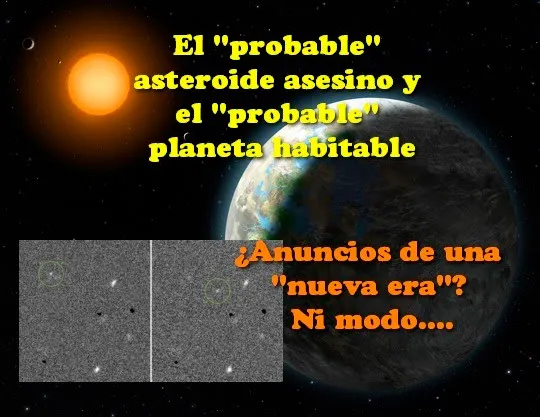
We have learned of two recent discoveries that seem to upset many people: a potentially hazardous asteroid and a supposed first potentially habitable planet. What does all this mean? It is a "probable" change of Era. It's stupidity. Not "probable", certain.
The killer asteroid
On one hand, the PS1 telescope of the Panoramic Survey Telescope and Rapid Response System (or, more easily, Pan-STARRS) detected an asteroid that would pass within 6.5 million kilometers of Earth in mid-October. This is an object that, according to current data, would be 50 meters in diameter and is located about 32 million kilometers away (as of September 16, when they found it).
It has been labeled a "Potentially Hazardous Object" (PHO) and designated as "2010 ST3".
Well, let's separate the wheat from the chaff.
This is an impressive discovery, due to the technology used and the difficulty of making the find. The large telescope has a "little camera" of (suspenseful music) 1.4 gigapixels, about one billion four hundred million pixels is outrageous!
The incredible thing is that an object so small can be detected at such a distance. That is news.
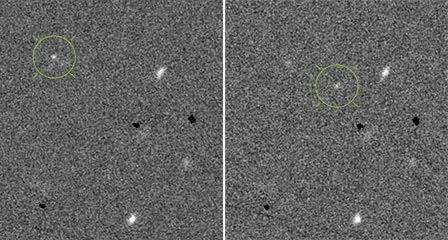
But there is no need to be alarmed. Nothing will happen in October. The planet is not going to be destroyed, don't panic. The press release notes that objects of this size usually break into several pieces in Earth's atmosphere, although the shock wave on the surface would be devastating for hundreds of square kilometers. However, the possibility of ST3 colliding with Earth could only occur in 2098.
Phil Plait points out that when astronomers map an object's orbit, there is some uncertainty in the measurements. It is very difficult to obtain the exact position of the object and its movement over one or two days is not enough to get an idea of its trajectory. Thus, with few data, it is still possible to make a projection, but the error margin is large.
However, since the discovery was made well in advance of the projected closest approach, if the object were to have an orbit that is indeed dangerous, a deflection mission could be mounted. With more data, in the near future, we could know how dangerous the object's trajectory really is. But the current data do not seem to be concerning.
The "first habitable exoplanet"
A team of planet hunters from the University of California, Santa Cruz and the Carnegie Institution in Washington announced the discovery of a planet three to four times the size of ours, orbiting a star at a distance that places it in the "habitable zone," where liquid water could exist on the surface. If confirmed, experts say, it would be the exoplanet most similar to Earth, the first strong case of a potentially habitable planet.
Let's say it now: for astronomers, a "potentially habitable planet" is one that could sustain life, not necessarily one that humans might consider a nice place to live. Habitability would depend on several factors, in which water would play a necessary, but not sufficient, role.
On the other hand, although the definition of "life" is controversial, as it can be defined in several ways, it is clear that human beings are a form of life and that bacteria are too.
It is not at all clear that the discovery of bacteria on a planet necessarily implies the future evolution of those organisms into intelligent beings. Although, again, we are dealing there with another controversial definition: intelligence.
I once read (sorry for not citing, but I don't remember where) that intelligence could be defined, among other ways, as the human capacity to distinguish between things that are the same and things that are different. Now that I think about it, I believe I read it in "Gödel, Escher, Bach," a book I am still reading.
The discovery report also announces another exoplanet in the same Gliese 581 system. The star is already popular among exoplanet hunters. In December 2007 we reported here on two papers about the exoplanets Gliese 581c and 581d. Even back then it was said that one of the planets could be habitable.
As Carlos, from La Singularidad Desnuda, pointed out in the comments of that note published here (see "Gliese 581: a planet could be habitable"), they were planets gravitationally "tidally locked" to their star, which could make the climate very extreme, very hot on one side and very dark on the other. "Day" and "night" on such a planet would not be determined by the planet's rotation, but would be a phenomenon experienced when traveling across the surface from one side to the other.
In the press releases about this discovery, it is called the "Goldilocks" planet. This is a popular tale about a girl named Goldilocks, for her curly blonde hair, who went into the forest and finds a cabin of three bears, uninhabited. Thus, the very indecisive girl tried the milk from the three bowls, one too hot, another too cold, and only the last one was just right. The same with three chairs and three beds.
Since this planet is neither too far at one extreme nor the other of the so-called "habitable zone" (like the previously discovered planets c and d) the allusion to the fable is obvious.
The planet orbits a red dwarf star, "less hot" than the Sun, so the habitable zone is closer to the star. The exoplanet 581g and the star are gravitationally "tidally locked" like the Moon and Earth. The most "habitable" region, according to human standards, so to speak, is the edge between the night zone and the day zone.
But does it have water and an atmosphere? It is not known. It is possible. Its mass indicates it is likely (but not certain) to be a rocky planet and that its gravity is sufficient to hold an atmosphere.
The impressive thing is that it is possible to detect planets like this, orbiting another star, in this case 20 light-years away. The level of precision of the measurements in itself is already dazzling.
A tour of the Gliese 581 system
The star is a red dwarf 20.5 light-years from Earth in the constellation Libra.
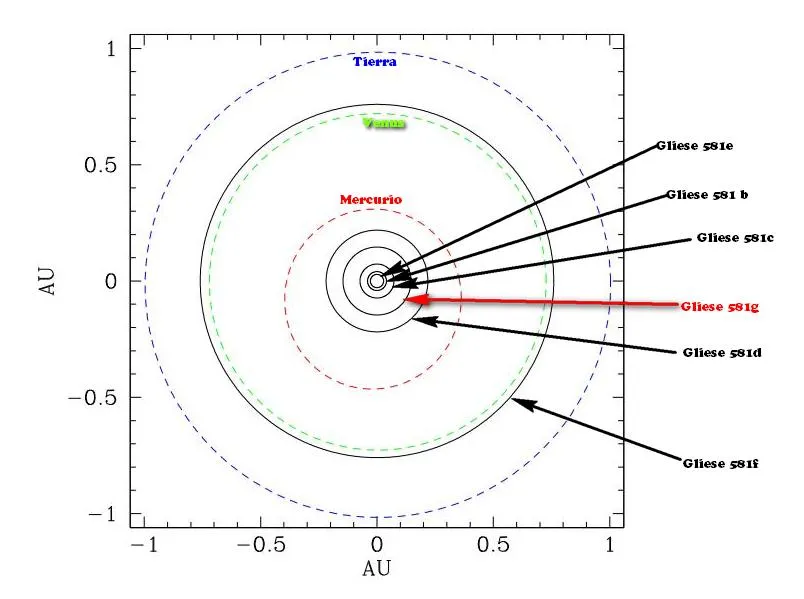
The planet closest to the star is Gliese 581e. It is thought to be a rocky world with a mass twice that of our own world.
It completes an orbit every 3.15 days (the years fly by!) and is located 0.033 astronomical units from the star. It is, possibly, the "lightest" planet found so far.
The second planet in the system is 581b, of a size similar to Neptune, about 16 times larger than Earth, which completes an orbit in 5.4 days.
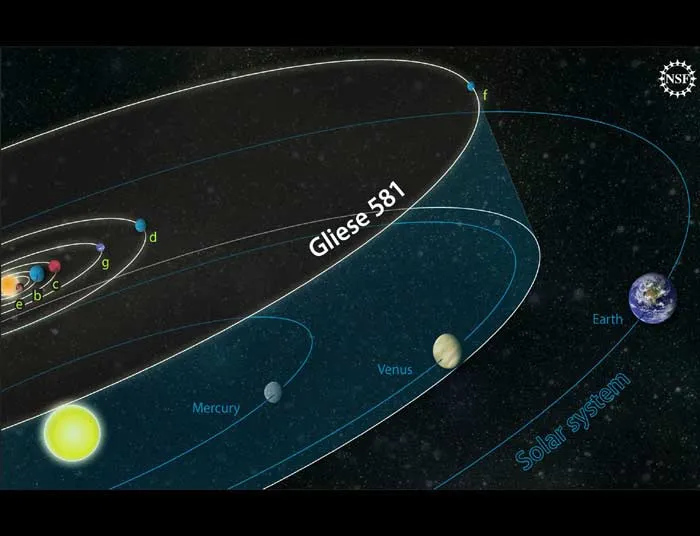
The third planet is 581c, about five times the mass of Earth at about 0.073 AU. It was announced that it could be in the habitable zone, but subsequent research seems to suggest it is too hot for liquid water.
The fourth planet is the recently discovered 581g at 0.146 AU from the star and with a 37-day orbit.
The fifth planet is 581d, between seven and eight times more massive than Earth and with a 67-day orbit at about 0.22 AU. Mercury is at 0.38 AU from the Sun, for comparison.
We continue moving away from the star and find the sixth planet, 581f at 0.76 AU. Venus is at 0.72 AU from the Sun.
This means that within the Sun-Mercury distance in the Gliese 581 system lie five of the six discovered planets.
And the stupidity?
Two things. On the one hand, in both cases, these are findings worth following up on, but more data will be needed to reach more concrete conclusions.
And also in both cases, the mere act of taking the measurements implies a precision and meticulous work, in one case over several years, that are well worth the publicity.
On a side note, I have noticed that many people who usually don't pay much attention to scientific discoveries found one of these two news items interesting. In fact, in some cases, this happened with people who usually tend to believe in pseudoscience. I find it striking that the same person believes the Earth will be destroyed in 2012 by some supposed Mayan prophecy and that an asteroid will destroy us in 2098. Or that one thinks the Egyptian Pyramids were built by extraterrestrial beings and that life exists on another planet.
In the original press releases of the astronomical news in question, as well as in several of the Spanish translations done by media and blogs, they account for the scientific process by which measurements were obtained to finally reach conclusions that are NOT necessary. That is, the conclusions do not HAVE to be exactly as presented, no matter what. Rather, they point to a path, which may not be exactly the correct one. This is science.
But, there are those who seem to be waiting for "something big to happen".
Doing cheap philosophy, one might think these people are dissatisfied with their life (who isn't?) and perhaps they are seduced by some ideas that often float around about a supposed "change of Era". Who knows what that means.
400 years ago, a "change of Era" did begin, so to speak. What we now know as "science" began to make its way through observations and experiments. It is that science that allows us to have greater knowledge of Nature, and in many cases a better quality of life, as well as generating technology that does not necessarily improve us (but rather, in some cases, we use it for our self-destruction).
I don't know what is expected from the supposed pseudoscientific "change of Era", but one hears and reads a lot of nonsense, poorly written and intellectually horrifying, such as that the Earth is going to be destroyed (the killer asteroid), so we can keep doing whatever we want with the planet (pollution), because there is a replacement (Gliese 581g).
And, as if that weren't enough, the "habitability" of an exoplanet is celebrated as if it were the announcement of a new era of peace, justice and purity, while the same people ignore the destitute they have beside them. Those who have no more "habitability" than a sheet of metal as a roof. And the height of it is that they use science for these pretexts.
And don't tell me that's not stupidity.
Sources and related links
- Newly discovered planet may be first truly habitable exoplanet
- The Lick-Carnegie Exoplanet Survey: A 3.1 M_Earth Planet in the Habitable Zone of the Nearby M3V Star Gliese 581
Steven S. Vogt, R. Paul Butler, Eugenio J. Rivera, Nader Haghighipour, Gregory W. Henry, Michael H. Williamson
arXiv:1009.5733v1 - The Pan-STARRS PS1 telescope discovers a potentially hazardous asteroid
- Alien World Tour: The Exoplanets Around Star Gliese 581
About the images
- Gliese 581. Illustration by Lynette Cook.
- Illustration of the Gliese 581 system and the inner solar system. Credit: National Science Foundation/Zina Deretsky.
- Diagram of the Gliese System with the inner solar system. Credit: Vogt et al. 2010