During the next few days, once the Moon has left the region near the constellation Cetus (the Whale), we will be able to enjoy observing comet 10P/Tempel through telescopes from Buenos Aires.
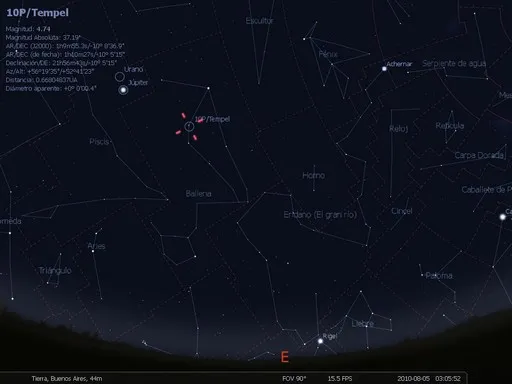
This minor body of the solar system, also known as Tempel 2, is located in the morning sky, towards the east, and reaches about 50° in altitude by 3:00 h (HL), according to information provided by the Asociación Argentina Amigos de la Astronomía.
The comet was discovered by Ernst Wilhelm Liebrecht Tempel at the Brera Observatory in Milan, Italy, in 1873, and has an orbital period of slightly more than five years. From the sky of Buenos Aires, through a medium-sized telescope, it will have a diffuse and very faint appearance. Logically, one will have to get away from the city's light pollution to appreciate it better.
For those who wish to consult ephemerides for the comet, you can visit the Minor Planet Center site detailed below:
Elements and Ephemeris for 10P/Tempel
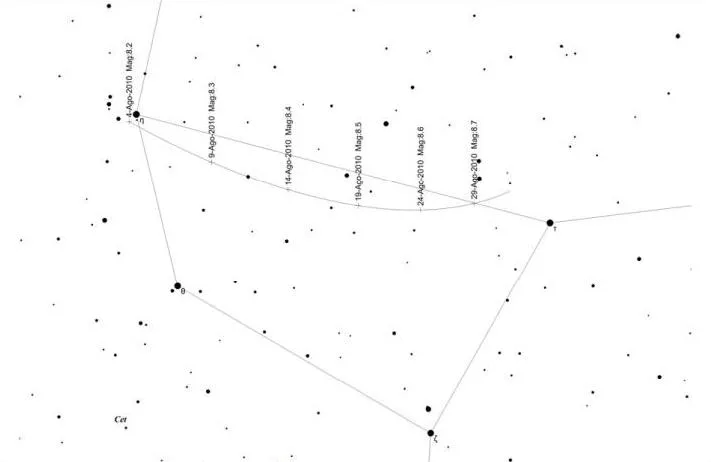
We can add the data for 10P/Tempel to Stellarium to see something like this:
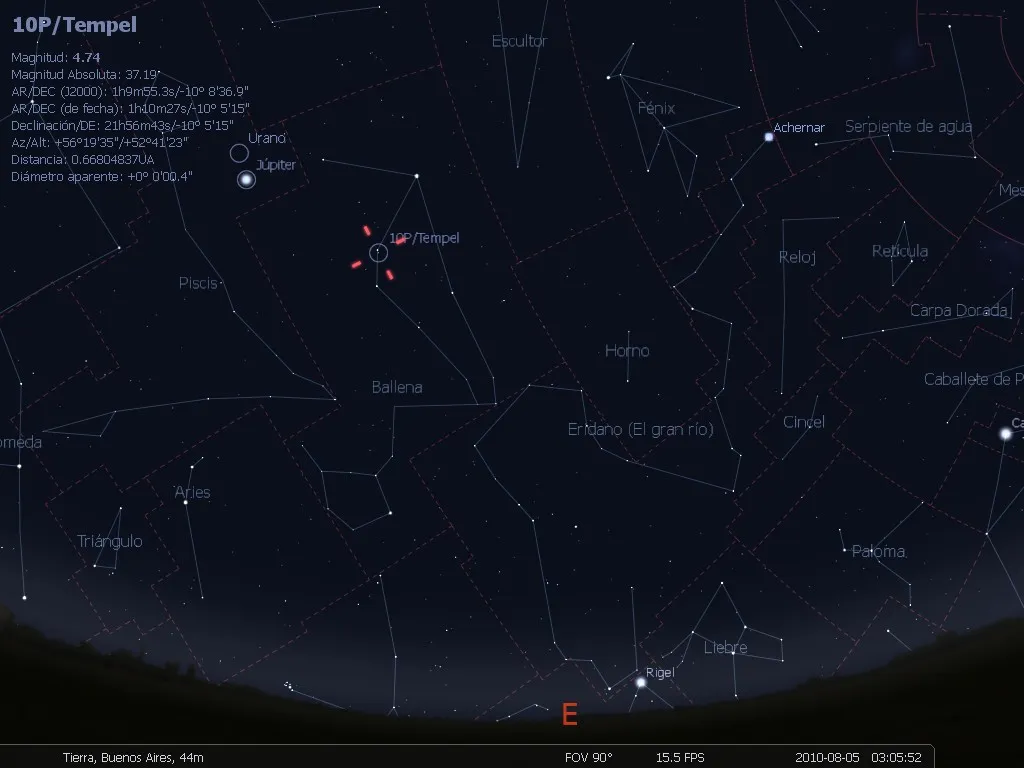
To achieve this, we can take the data from the 12 Dimensional String page, which contains it in the appropriate format. We will see a drop-down list. We choose 10P/Tempel and in the text field below the data will be displayed. We copy it and go to the Stellarium directory where we will look for the file ssystem.ini inside the Data directory. We open the file, go to the end of it, and paste this data. We save the changes and open the program.
It should be noted that the file to be edited is essential for the program's operation, so it would be a good practice to first make a copy of that file, ssystem.ini, just in case.
The parameter radius, which appears as 10, we can change to 100, so that it looks bigger.
Sources and related links
- A.A.A.A.:Comet 10P / Tempel
- JPL Small-Body Database Browser: 10P/Tempel
About the images
- Image provided by the Asociación Argentina Amigos de la Astronomía.
- Screenshot with Stellarium 0.10.3.