Almost like a cycle of terror, at this time of year we usually receive the false email chain about the supposed approach of Mars. For the new unbelievers we repeat: it is false.
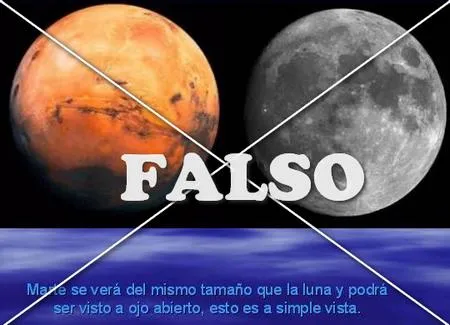
It seems this damned habit has been repeating since 2003. We receive a chain "alerting" about a supposed maximum approach of Mars so that it would look as large as the Moon next August 27.
The chain may have the text included or an attached file with some presentation that includes texts like this:
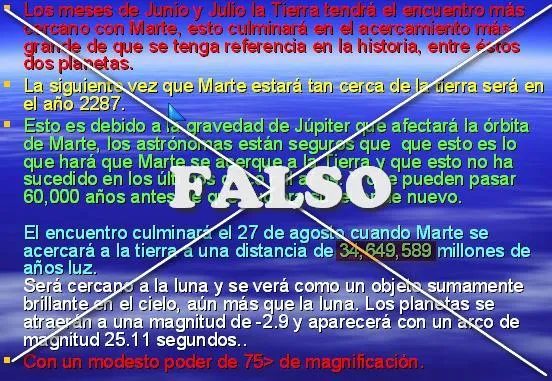
It is not the first time we talk about this deceptive email about Mars here. We did it back in 2007 in "Mars is approaching".
In the following years the email continued to spread around this date and different astronomy blogs and websites dedicated themselves to explaining why it is a hoax. Due to inquiries from blog readers and from our Facebook page, I thought it appropriate to talk about the subject again.
Where does the "confusion" come from?
In 2003 a true approach of the Red Planet and Earth occurred around that date. With a telescope, Mars could be seen larger than usual, but NEVER as large as the Moon.
That was an event known as Opposition and, in that 2003 case, it was an Opposition at Perihelion.
Perihelion is the point of maximum approach of a planet to the Sun. The opposite is Aphelion, the point farthest from a planet with respect to the Sun. It is called Opposition because Mars and the Sun are on each side, on opposite sides, of the Earth. That is, the Earth is in the middle of the red planet and the star with the three objects aligned.
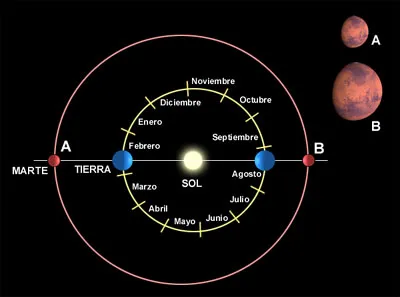
When Mars is in opposition and at perihelion, it is very close to our planet. August 27, 2003 was one of the best oppositions of Mars in history. By a very small margin, because there were others almost as close, at almost 56 million kilometers.
Why isn't it true, then?
It was not true that in 2003 Mars looked as large as the Moon nor will it ever be true, unless something unforeseen for now occurs. If it happened, it would have serious consequences for life on Earth. Let's see why.
We all already know something about perspective. Let's imagine two things of the same height on the same line, that is, they are at the same distance from us. We will see the two figures of the same size. Of course, they are the same size.
But if we then move a figure away, without modifying its size, we will begin to see it smaller. And if we bring a figure closer, we will see it larger.
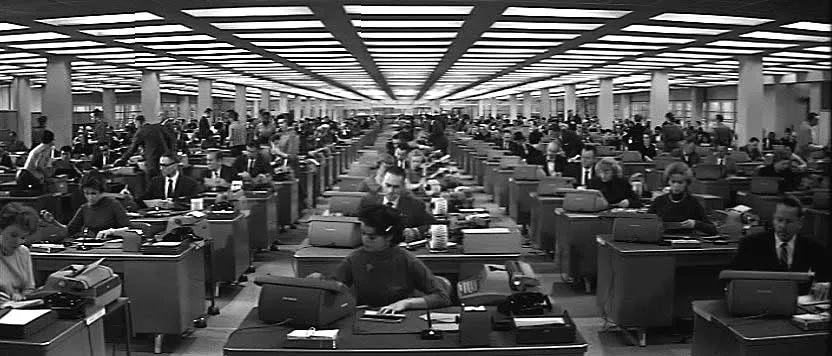
In the film The Apartment (Billy Wilder, 1960) we are made to believe that an office is much larger than it really is. The desks are supposed to be the same size, but the ones farther away look much smaller. (Careful, in art optical effects like anamorphosis are used).
Another example is an illustration by artist Tadahiro Uesugi called Futami in which a woman is seen and, farther away, a man leaning on his car. Unless the woman is a giant and the man a pygmy, the logical thing is that they are more or less the same height, but the car is farther away from the viewpoint than the woman.
Now let's imagine the same with two figures of different sizes. For example, a figure that is twice the size of the other. On the same line, we will see both objects one twice the size of the other. But if we move the larger object far enough away, we could see both figures the same size. This if we move it the appropriate distance. Because if we move it much farther, the larger figure will already look smaller than the other, since it will be too far away.
Now, the Moon is at almost 385 thousand kilometers, on average, from Earth. On August 27 of this year, however, it will be a little farther away.
Let's round to 400 thousand kilometers.
Mars is almost almost twice the size of the Moon. For it to look the same size it would have to be at twice the distance, that is, at 800 thousand kilometers.
Mars, on the other hand, will be at more than 300 million kilometers, which is why it is impossible to see it the same size as the Moon, even though it is much larger.
But if, due to some orbital perturbation, Mars were at twice the distance of the Moon, it would exert on our planet a gravitational and tidal force much larger than our natural satellite, causing real tragedies in our world. Therefore, it would not be any wonderful spectacle for Mars to look as large as the Moon. And, fortunately, it is not going to happen.
I said "fortunately" and, actually, chance has little to do here. Planetary orbits are perfectly predictable thanks to Kepler's Laws and Newton's, so it is known that, unless something new occurs, Mars will not be closer than 55 million kilometers from Earth.
The next opposition of Mars will occur on March 3, 2012 and it will be at more than 100 million kilometers.
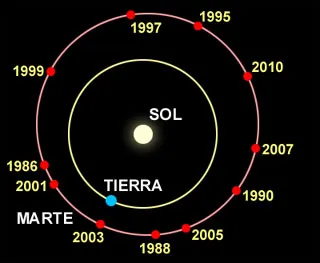
How to know, for certain, where Mars will be?
In the case of Mars we can consult the tables from the book The Mars Planet, by William Sheenan, on the web.
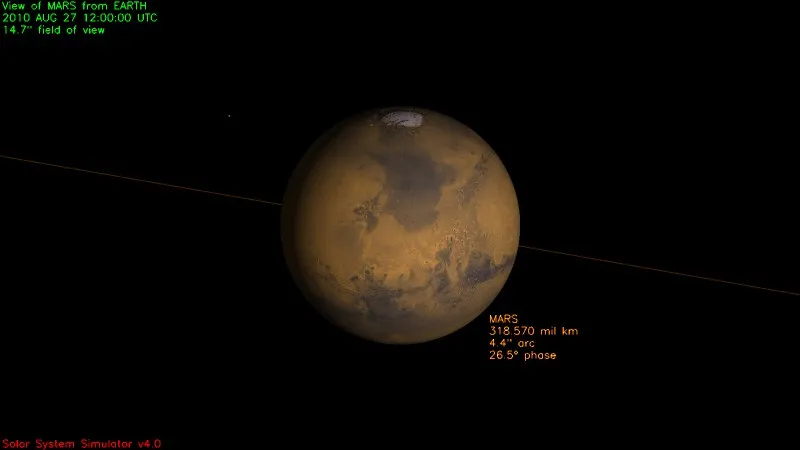
We can also consult NASA's Solar System Simulator at http://space.jpl.nasa.gov/ and obtain an image like this one that contains the date and the distance, among other data. The image is of Mars on 8/27/2010 seen from Earth:
And it is also possible to use a small, but very useful and beautiful piece of software called gSky Digest. It is an application for the Windows taskbar that presents events calculated for our location.
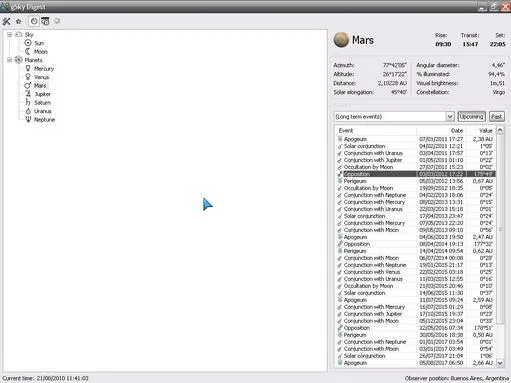
We can select an object and see short- and long-term events.
There, we should look for when an Opposition or a Perigeum will occur. The latter is Perigee. Just as Perihelion is the point in a planet's orbit when it is closest to the Sun, Perigee (as its name indicates) is the same with respect to Earth. That is, the point in an object's orbit when it is closest to home. The opposite is called Apogee.
Sources and related links
- FOED: The Great Opposition of Mars in 2003
- Astroseti: Approach to Mars
- NASA: 2003 -Mars Approaching
About the images
- Illustrations of Mars oppositions from FOED, Fundació Observatori Esteve Duran.
- Screenshot of gSky Digest.