A new optical flash or "flash" has been observed on the gas giant. It was detected by an amateur astronomer from Japan.
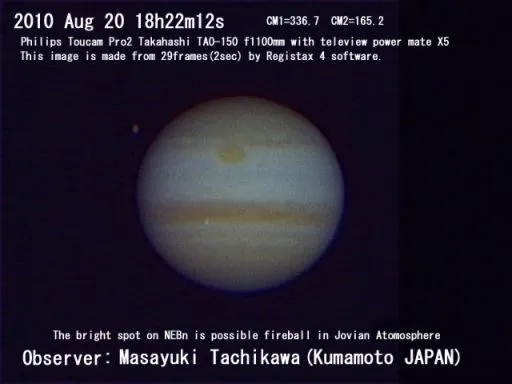
Masayuki Tachikawa had the fortune of capturing video images of the impact that occurred on August 20 at 18h22m12s (Universal Time).
Tachikawa, who lives in Kumamato City on the island of Kyushu, was observing with his Takahashi TAO-150 f1100mm telescope telescope with a Philips Toucam Pro2 camera, when he captured the shots.
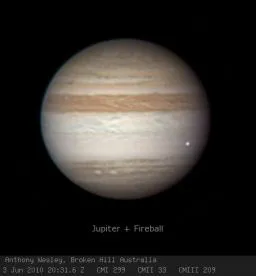
Previously, on June 3 of this year, Anthony Wesley, an amateur astronomer from Australia became famous for capturing an impact on Jupiter.
Last year, on July 19 a giant impact was observed on the surface of that planet that could be associated with a comet or an asteroid. That event was also observed by the very "lucky" Australian amateur astronomer. (See the article published here on Serendipity to understand the quotes).
Another popular impact was that of the fragmented comet Shoemaker-Levy 9 on which there was a global observation campaign.
Video: Jupiter impact flash Aug 20 2010 by Masayuki Tachikawa, Japan
http://www.youtube.com/watch?v=jIkr86xKcwQ
Is it this common?
Let's say that the recent impacts, the one on August 20 and the one on June 3 of this year, might well not be impacts at all. The observations of the 1994 comet, as well as the 2009 impact, left "marks" on the gas giant.
But in the case of June 3 there are no traces, and as has been pointed out so far, in the case of two days ago, neither. The Association of Lunar and Planetary Observers of Japan (ALPO), has images of the event (at the bottom of the ALPO link you can read in English).
In the NASA press release about the observation two months ago, it is noted that it is possible that it was an atmospheric phenomenon, some kind of mega lightning. However, from JPL they doubt something like that because "NASA spacecraft have seen lightning on Jupiter many times before, but only on the dark side of the planet. This event on the day side should have been unimaginably more powerful than any seen before. Jupiter does not produce lightning that large."
Could it have been some rare atmospheric anomaly on Earth that just happened in the line of observation of Jupiter's disk? That seems to be even more unlikely since the June 3 event was observed not only by Wesley from Australia, but also by an amateur astronomer, Christopher Go, in the Philippines.
Perhaps it is a phenomenon associated with the recent disappearance of the SEB (South Equatorial Belt).
The possibility maintained by scientists is that perhaps an impact occurred, but the object was large enough to generate an optical flash observable from Earth, but not so large as to leave a visible mark.
Franck Marchis, an astronomer at the University of California and principal investigator at the SETI Institute, and blogger at Cosmic Diary, wrote about the June 3 impact that it is difficult to know how frequent these phenomena are.
There he pointed out that it is evident that amateur astronomers are equipped with cameras that current technology allows to detect these events more often. The planetary scientific community does not conduct surveys dedicated to the observation of planets, just as the same can be said for supernovae, asteroid light curves, variables, etc. So it is possible that we are missing a lot.
Glenn Orton, from JPL, noted that "perhaps it is time to establish a network of Jupiter monitoring telescopes so the planet is observed 24/7."
The future will tell us the nature of these phenomena and their frequency. Meanwhile, these events motivate amateur astronomers around the planet to continue contributing to science with their invaluable observations.
Sources and related links
- Yet another Jupiter impact!? August 20, seen from Japan
- Another flash on Jupiter
- Jupiter got a bruise.. only one but a large one.
- Optical flash on Jupiter
About the images
- Photo by Masayuki Tachikawa of the "flash" of 20/2010.