Why do astronomers propose that "dark matter" exists? An interactive helps us understand this, interact, and do exercises. I add the video of a TED talk on the subject.
The so-called "Dark matter" attracts the attention of ordinary people, as well as astronomers.
But what is that? So that the general public can at least have an idea of what is called dark matter, there is a good interactive resource for us to put ourselves in the shoes of an astronomer who studies the galaxy and the matter it contains. For that, we will have to observe and understand the interactions that occur between this material.
The interactive, from McGraw-Hill, includes an introduction to understand the basic issue, an explanation of how to use the interactive, a series of exercises to finish understanding the topic, and the solutions to the proposed exercises.
Since everything is in English, I translate everything here, except the interactive itself. To complete, we can read The Story of Dark Matter.
What we will find here is basically that the answer to what is dark matter? is, in fact, another question or several. Astronomers do not know for sure what it is, which is why they try to decipher the mystery with experiments like AMS, which is about to depart for the International Space Station.
Introduction
In 1687 Isaac Newton explained his Law of Universal Gravitation in his book "Philosophiae Naturalis Principia Mathematica". He stated that the gravitational force between two objects depends on the product of their masses and the inverse square of the distance between them. Scientists around the world tested Newton's theory for years, in laboratories on the Earth's surface and through observations of bodies in the solar system. In our Solar System, for example, the Sun contains almost all the mass and the planets orbit around it. Newton's theory predicts that planets close to the Sun (like Mercury) must orbit more quickly, while the more distant ones (like Pluto) must move more slowly. And that is exactly what the observations showed.
In the 1970s and 1980s, developments in astronomy brought the question of gravity back into consideration. Measurements of the speed at which stars and gas orbited in the outer parts of the galaxy -"rotation curves"- made no sense. Photographs of galaxies showed that most of their light, and therefore most of their stars, was concentrated near the center. That implied that most of the mass of galaxies was also concentrated near the center. Just like the Solar System, which has almost all its mass concentrated in the Sun, galaxies concentrate most of their mass in the center. Just as the inner planets orbit more quickly than the outer ones, stars near the center of galaxies should move more quickly than those farther away, astronomers thought. But the measurements indicated that the orbital speed of the stars was almost the same, no matter how far from the center they were.
How is this possible? One way to explain the problem was to postulate that galaxies contain not only the stars and gas we can observe, but large amounts of material we cannot see: the so-called "dark matter". If that matter is scattered almost uniformly through a galaxy, then stars far from the center will "feel" the gravitational pull of not only the central material, but all the other matter between them and the center. The extra force due to "dark matter" can accelerate them to almost the same speed as the stars near the center.
This interactive allows you to vary the amount of dark matter in a galaxy and see how it affects the orbital speed of the stars. Another way to see it is that the extra gravitational force from dark matter is necessary to keep the stars in their fast orbits in the outer parts of the galaxy.
Tab "How the Interactive Works"
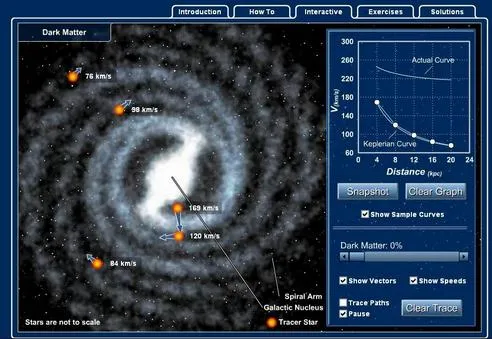
When starting the interactive we will see a main panel on the left with a view of a spiral galaxy from above. Orbiting the galaxy are five representative stars, shown in orange. The stars circle the galaxy due to the gravitational force that the matter in their orbits exerts on them. If we click the box "Show Speeds", a label will appear near each star indicating its orbital speed.
In the upper right corner there is a graph illustrating the orbital speed (on the vertical axis) as a function of the distance from the center of the galaxy (on the horizontal axis). Astronomers call this graph the "rotation curve" of a galaxy. If we click the "Snapshot" button, a marker will appear for each star. The "Clear Graph" button erases all markers.
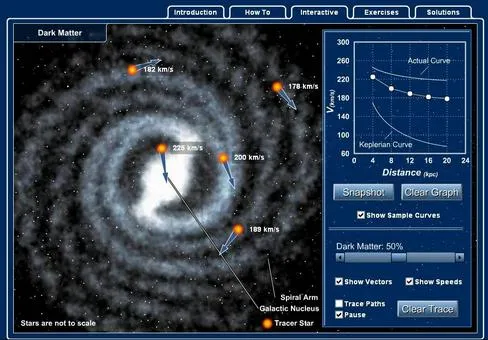
In the lower right corner of the screen there is a control panel. The "Dark Matter" slider adds material to the galaxy in a special way. When it is at zero, the only matter in the galaxy is in its stars and gas. We will see that most of the stars and gas are near the center, so most of the mass is concentrated there too. If we increase the value of the slider, we add dark matter relatively uniformly in the galaxy, a little near the center, some in the middle, some near the edges. Note that 100% Dark Matter means there will be as much matter of that class as normal matter.
The "Show Vectors" box shows the speeds graphically, with vectors: the larger the arrow, the faster the star is moving. We can stop the action with the "Pause" button.
Note that clicking "Show Sample Curves" brings two curves on the graph illustrating the two extremes of constant rotational speed and rotation speed due to a central mass.
In the lower right corner there is also an option called Trace Paths which, when selected, will show with dots the orbit that the stars follow.
Go to the interactive on Dark Matter
Exercises
1-Set the Dark Matter slider to zero. Take a "Snapshot" of the movements. What shape are the points in the diagram in the upper right corner?
2-How fast does the star closest to the center move and what is its distance to the center?
3-How far from the center is the next star closest to the center? How fast does it move?
4-Newton's Law of Universal Gravitation says that, for systems in which all the mass is concentrated near the center, orbital velocities should decrease with the square of the distance. That is, if we double the distance, the speed should fall to 1/square root of its original value. Do the data we obtained earlier follow this relationship?
5-Let's press the "Show Speeds" indicator to show the speeds. Let's increase the dark matter slider to 50%. That adds 50% extra matter to the galaxy's mass, scattered uniformly. What is the speed of the star closest to the center now? What is the speed of the next closest star?
6-Do these speeds now obey the 1/square root relationship?
7-Graph (with the Snapshot button) the rotation curve. Describe how the pattern of the graph changes.
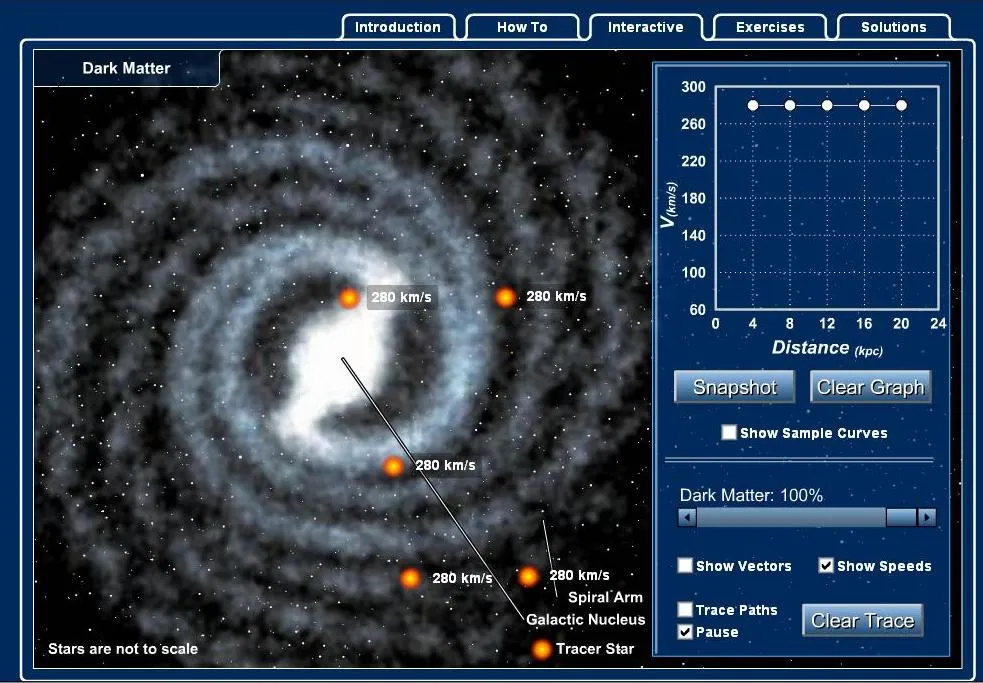
8-Let's do the same exercise, with the speeds shown, but with dark matter at 100% and note the speed of the two stars closest to the center.
9-Let's graph again and see what graph we get. What is the design now?
Answers:
1-We see a curve that falls to the right, somewhat abruptly at first and less so later far from the center. As the distance (illustrated in kpc) increases, the speed (km/s) decreases.
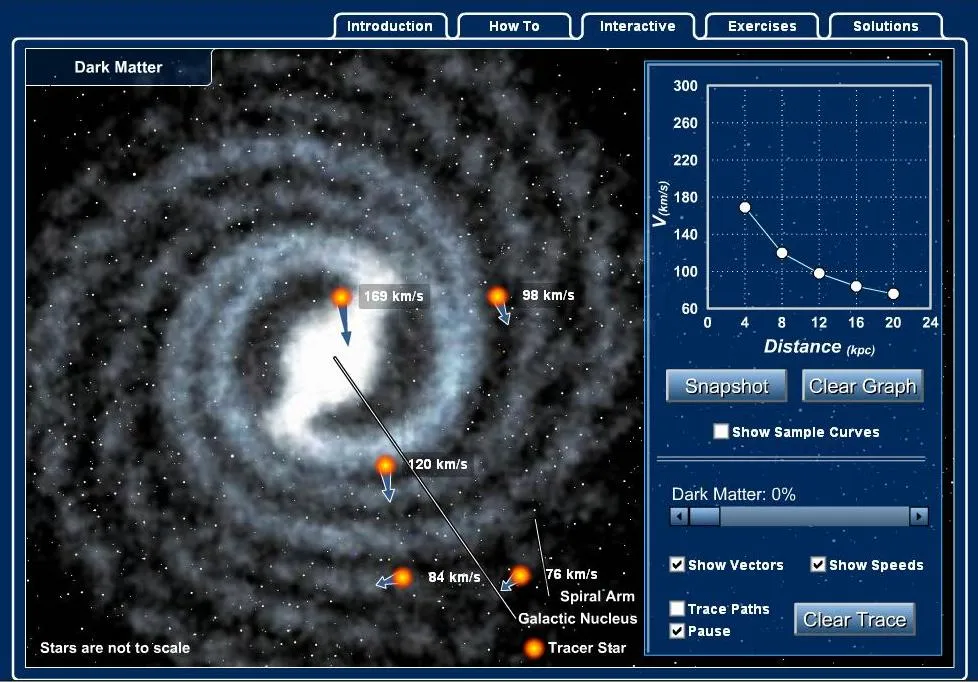
2-The star closest to the center has a speed of 169 km/s and is at 4 kpc (we see it clearly in the graph).
3-The next star closest to the center is at 8 kpc and moves at 120 km/s.
4- Let's see: 169 km/s * (1/sqrt(2))=119.5.
Yes, when only visible matter is present, stellar dynamics follow Newton's laws.
Note=Why does it do "sqrt(2)"?
5-With 50% dark matter the star closest to the center (which is still at 4 kpc) moves at 225 km/s and the next one at 200 km/s.
6-This time, 225 km/s * (1/sqrt(2))=160 km/s. Therefore, no, the next closest star is moving faster (200 km/s) than what the relationship predicts. Why? Because some of the dark matter we added falls between the innermost star and the next one. That matter does not affect the motion of the inner star, but provides an additional force to the next star.
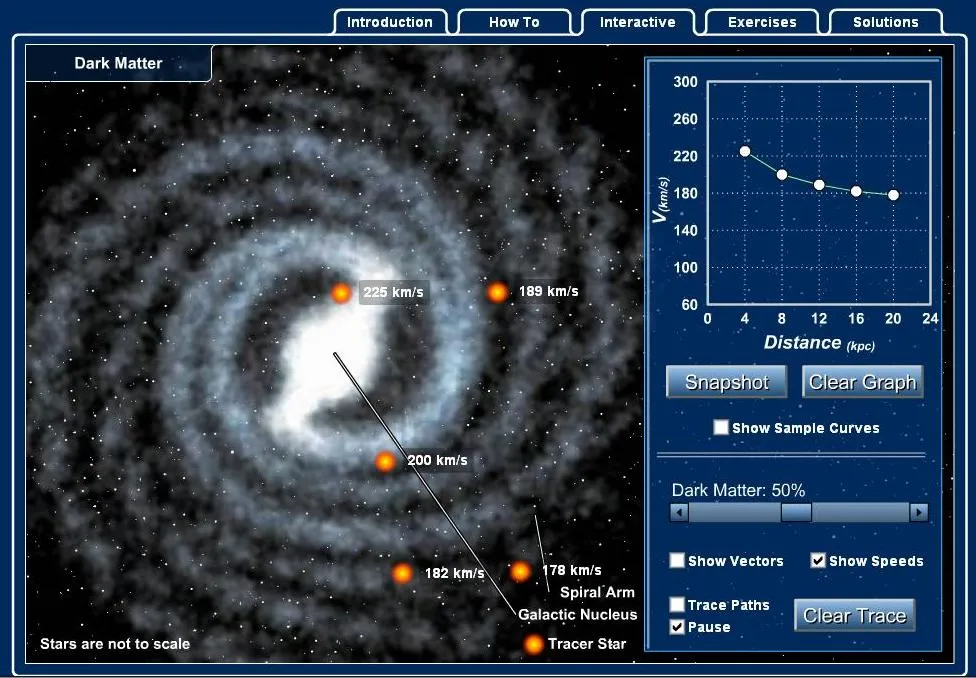
7-The design of the points on the graph is now less curved and the speeds are higher.
8-With 100% dark matter (which means there is as much matter of that class as normal matter), the two stars move at 280 km/s.
9-The graph shows a flat line all the stars move at the same speed.
Why does it do "sqrt (2)"?
Let's see:
The inverse square law applies in Newton's law of gravity.
What is that law? Precisely the inverse square. It may be simpler to understand if we first know how to calculate a proportionality to the square. Then it will be simple to understand what the inverse implies.
Let's take two variables whose values we don't know, it doesn't matter. But we know that if the value of x increases, that of y will do so in relation to the square of the increase in x.
Thus, if when x=1, y=4; then when x=4, y=42=16.
Let's take as an example the surface area of a sphere, which is calculated:
4*PI*r2, where r is the radius.
Let's look at table 1: It reflects the radius of a sphere and its surface area, calculated with the formula indicated before.
With the formula it is easy to calculate what the surface area will be for a sphere of different radii: 4, 8, etc.
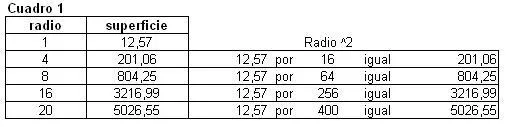
Now imagine we don't know the formula, but we do know that the surface area is proportional to the square and we also know the surface area for radius 1.
Then, we maintain the proportion and arrive at the same result, without knowing the formula:
When the radius increases by 4, the surface area should be 42, relative to that of radius 1;
When the radius increases by 8, the surface area should be 82, relative to that of radius 1; etc.
Now let's go back to the stars in the interactive.
If we use it, without dark matter, the values, if there were proportionality to the square (not inverse), would be:
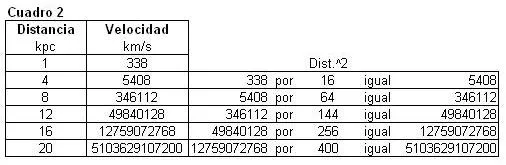
Instead, they are the following:
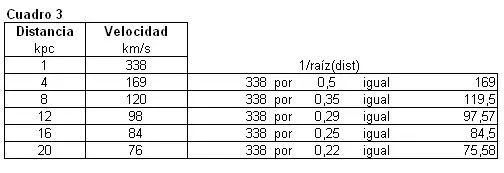
We see in table 3 that, instead of calculating the proportion as the distance squared, we do it with the square root, which is the inverse operation.
By doing so, the values will decrease instead of grow.
To know the speed at 4 kpc distance, we multiply the speed at 1 kpc by 1 over the square root of the distance (4). Thus, 1/sqrt(4) is 1/2 (0.5).
In the same way:
1/sqrt(8)=0.35; 1/sqrt(12)=0.29; etc.
At this point and seeing table 3, you may notice that I am not doing sqrt(2) in any case, but sqrt(4); sqrt(8); etc.
Why then in the previous answer was sqrt(2) used?
Because in the first three tables, the calculations as can be seen are made in relation to the value of 1. In table 3, the value of 1 (which is 338) is maintained to calculate the rest. That's why I put it in bold when saying "relative to that of radius 1".
But what if I don't know what the speed is for the distance of 1 kpc?
Well, it's not very difficult. We can do two things:
a-What the author of the interactive did, which was:
Instead of doing 1/sqrt(dist), that is 1 over square root of the distance; what he did was 1/sqrt(dist/dist.ant), that is, 1 over square root of the distance divided by the previous distance.
Let's take rows two and three of table 4:
I know that at 4 kpc, the speed is 169 km/s. What will the speed be for 8 kpc?
8/4=2
169*(1/sqrt(2))=120, which is what the author of the interactive did in the corresponding answer.
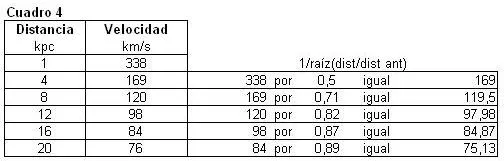
b.But we can also do the following: we calculate the value for 1 and then do the same as in the first three tables:
If we follow the idea from point a, then we can deduce what the speed would be for the distance of 1 kpc, like this:
x, is the speed at 1 kpc, that is, the unknown:
x*(1/sqrt(distance/previous distance))=169 x*(1/sqrt(4/1))=169 x*(1/sqrt(4))=169 x*(1/2)=169 x=169*2 x=338
If I already know that a star at 1 kpc will have a velocity of 338 km/s and I know that the proportion is inverse to the square of the distance, then I can do the same as in box 1, that is, maintain the proportion over the unit value, which is what is seen in box 3.
To further complete the topic, we add a video of a TED talk, which has Spanish subtitles, by Patricia Burchat.
Video: Patricia Burchat sheds light on dark matter
Written for the X Carnival of Physics, in this edition hosted by Cienciamia. To join and read the entries there is a social network on Ning.
Sources and related links
- Playing with Dark Matter, by Adam Frank.
About the images
- Screenshots of the interactive. Credit: McGraw-Hill.