It is a new instrument on one of the world's largest optical telescopes, the LBT, which allows astronomers to observe the most distant objects in the universe.
On April 21 it was announced that a new instrument for the LBT was available for scientific observations on Mount Graham, in southeastern Arizona.
After more than a decade of design, construction, and testing, the new instrument, nicknamed LUCIFER 1, will be a powerful tool for observing from the Milky Way to the most distant galaxies. A twin instrument will be installed next year.
LUCIFER 1 is a camera/spectrograph, mounted on the 8.4-meter telescopes. The LBT is sometimes named as the world's largest optical telescope, because even though the Gran Telescopio Canarias has a segmented mirror of 10.4 meters, the LBT combines the light from its two 8.4-meter twin mirrors to act as a single 11.8-meter observatory.
The instrument is kept cooled to -213º Celsius to be able to observe in the infrared wavelength range, essential for understanding the formation of stars and planets.
The instrument was being tested in what is called "Science Demonstration Time" and is now available for astronomical use.
The name LUCIFER comes from the acronym for "Large binocular telescope near-infrared Utility with Camera and Integral Field unit for Extragalactic Research", which in Spanish would be something similar to "Unidad en el infrarrojo cercano del Gran Telescopio Binocular con cámara y unidad de campo integral para la investigación extragaláctica".
It seems the people at LBT have a special sense of humor for naming their instruments. An Echelle spectrograph on the telescope was nicknamed "PEPSI".
Sources and related links
LUCIFER Allows Astronomers to Watch Stars Being Born
LUCIFER @ LBT Website
About the images
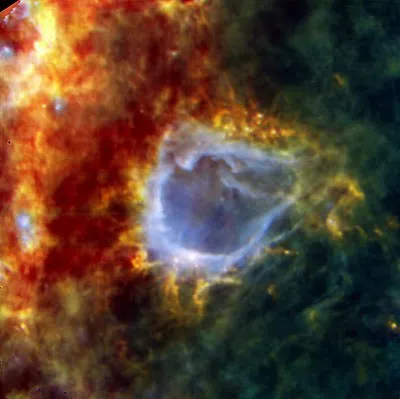
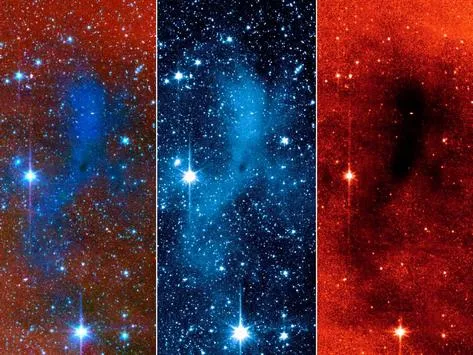
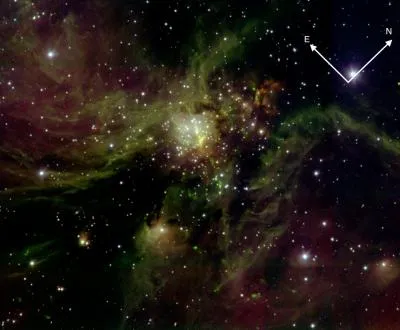
The first LUCIFER images of star-forming regions give scientists an idea of the new instrument's potential. The top image shows a stellar nursery in the Milky Way, 8,000 light-years from Earth. Credit: Arjan Bik
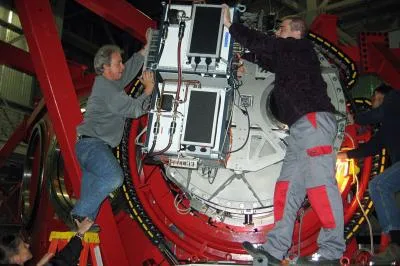
Image of the installation of LUCIFER 1. Credit: LBT