What are the greatest challenges ahead? What place does the search for life outside the planet occupy among those challenges? Are some topics more important than others? Is any one more useful?
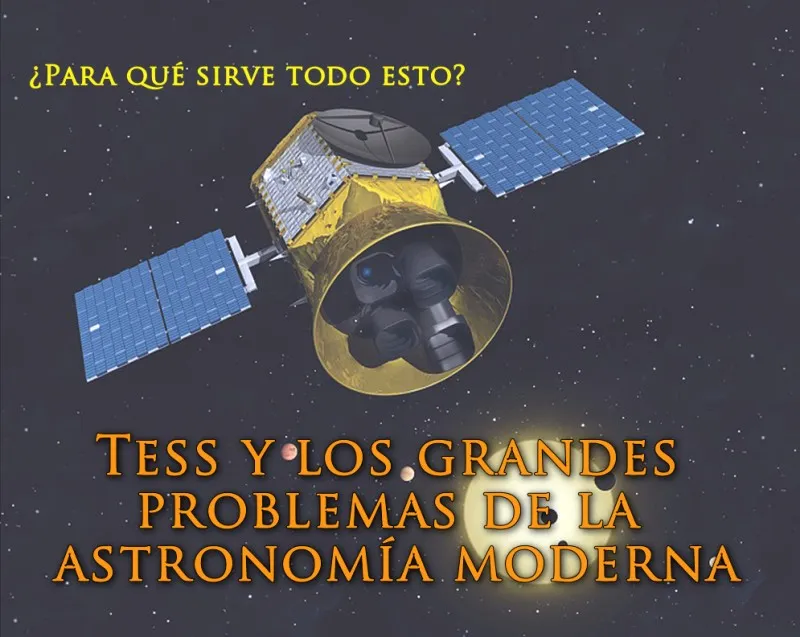
NASA has finally launched the TESS satellite to search for exoplanets. Let's play a game, as if we were children. And why do they search for exoplanets? To find a planet similar to Earth. And why do they want to find a similar planet? To search for life. And why do they search for life? Because it's important. And why is it important? Uh... because it will be very useful. And why will it be very useful?
Even if we are not children, it is valid to ask these questions. More so, if one considers that all this is not free. TESS cost USD 337 million.
Here, some answers.
MAJOR TOPICS OF CONTEMPORARY ASTRONOMY
Astronomers not only search for exoplanets, but also ask other questions. Some of the topics that could be considered more important are the following:
1-Dark Matter: Dark matter emerged as a set of hypotheses to explain a difference between the observation of galaxies and Newton's Laws. One hypothesis is that the Theory of gravity changes with scale, which is why some physicists try to develop a modified Theory (MOND Theories). Another hypothesis is that in galaxies there is something that, due to gravity, makes stars move faster. One possibility considered was that it was common matter that does not emit light, like planets or black holes, but those forms of matter are relatively easy to find and an enormous amount would be required, so this option has been ruled out. The one that remains is that there is a certain type of matter that interacts with gravity, but not with light, neither absorbing nor emitting light, as if light passed through those particles without consequences. That type of hypothetical particles, called Dark Matter, has not been found until now.
2-Dark energy: In 1998 it was discovered that the Universe not only expands, but that expansion accelerated, as if a mysterious repulsive force made things separate more, an additional force to the "initial push." It is not just the mere possible existence of this kind of energy that puzzles astronomers, but also explaining how or due to what that force changes.
This force was associated with the energy of the vacuum, so perhaps it is related to the shape of the universe as a whole.
3-Quantum gravity: The current Cosmological Model implies that the early universe was very compact and hot, without atoms, but only with elementary particles (which quantum physics studies) moving at speeds close to the speed of light (Relativity), but both theoretical frameworks are incompatible. Hence the need to be able to interweave them into a theory that thinks of gravity in a quantum way, through exchange particles.
In a certain sense, this seems to be the biggest problem, as it is the greatest underlying problem: What is space-time? What is it made of? Believe it or not, we still don't have the slightest idea what space is made of. We can't even say it's made of... matter!
4-Inflation: The Big Bang theory had some problems, among them the homogeneity problem: it proposes that in the past the universe was very different from today, but what astronomical research shows is that the universe seems quite similar. In the 1980s, the inflationary hypothesis was developed, which assumes one or several periods in the early universe of accelerated expansion, so that different areas of the universe separated and that's why what we see is similar, since we only see a part. However, there is not enough evidence yet of periods of inflation. Since this inflation could also be considered as an additional force to the "initial push," then its greater understanding could be related to dark energy and vice versa.
It is not very difficult to notice that these four topics are related. The fifth issue is notably different.
5-Exobiology: It is, broadly speaking, the possibility of finding life outside Earth. And it has two flavors: within the Solar System, it is possible that some form of microbial life exists; or outside the Sun's influence, the possibility that microbial or intelligent life exists on other worlds, that is, exoplanets.
In either case, such discoveries would be extraordinary. Discovering life, even if only microbial, would prove, empirically, the theoretical probability that life exists outside this world. It would have consequences of all kinds, even philosophical.
The probability that intelligent life exists outside our home, it has been pointed out, is very great, since the universe is enormous. But that is so when looking at half of the matter. Thinking about the other side of the coin is realizing that precisely because of that it will be very difficult to discover intelligent life: it's like finding a needle in a haystack.
One way to do it is by searching for planets similar to Earth, outside the Solar System, which would imply that the conditions of early Earth are conditions that are reproduced many times in the cosmos and that we are not "unique" in that sense. However, finding a planet almost identical to Earth in another stellar system does not prove that there is life there. To know if there is life or not, probes will have to be sent, perhaps unmanned, but the trip will have to be made. And there is an important little technical problem.
Hence the fifth point includes the development of propulsion systems in space exploration.
THE PROBLEM OF IMPORTANCE
That said, which of these topics seems more important to you?
If the issue were exclusive (you choose one or the other), that is, disjunctive, perhaps you consider that discovering life is more important than discovering how galaxies develop or what space-time is made of.
But there is no disjunction: both things can be done at the same time.
The importance of something points to its utility and necessity. Will it be more useful to understand the structure of S-T or will it be more useful to discover microbial or intelligent life outside the planet?
NASA has just launched the TESS satellite to search for exoplanets. Other missions, like that of the Hubble Space Telescope, serve to collect data that, among other things, are useful for better understanding large-scale structures.

THE USES OF ASTRONOMY
The main driver of the sciences is to try to better understand reality. As if we were kids we could ask ourselves, and why do we want to know that?
There are two possible answers:
1-Because.
2-Because understanding how reality is allows us to later change reality.
Understanding reality better is the goal, driven by the engine of curiosity. Why are we curious? Because we can. Because we have the cognitive abilities to be so. Hence, it is possible to say that the main driver of the sciences is finalistic, not utilitarian. That is, one is not initially thinking about what subsequent utility a fundamental discovery might have, but rather knowledge is an end in itself, an end that satisfies the need to know.
In an analogous way, the poet satisfies his desire for expression at the very moment he writes the poem. That does not mean that the publication of the poem and its mere writing also have other consequences.
What is history for? First of all, history is the greatest of all sciences, since it is possible to study the history of each of them. Do you find it valuable to know the history of astronomy? We want to know history because... we want to know. And because we can. Furthermore, knowing the past can be useful in the present and future in similar situations. When we learn something about history because we feel like it, we are not thinking about what other utility that knowledge will have in the future. It may have it, but at the moment of learning we are giving it another utility, which is not instrumental, which is not for any particular other thing, but rather satisfies our desire to know.
Astronomy then has these two uses: The first, which is foundational, is to try to understand the universe. Because. Because we can. Because we ask questions and feel the need to satisfy that curiosity. Is it not amazing that beings as fragile as we humans are, who can be swept away by water and wind, are capable of thinking about the universe?
Furthermore, obtaining better answers has other consequences: one of those consequences is philosophical, linked to our "place" in the universe, connected to a certain "meaning of life," which will be, in any case, a philosophy based on scientific data.
And on the other hand, there are more tangible and instrumental consequences like technology transfers.
If point 1 is a theoretical, abstract, general utility, removed from daily life, and point 2 is an instrumental, concrete utility, improving daily life, then astronomy is perhaps the least "useful" science compared to the rest, since only some aspects of astronomy fulfill point 2 (for now). With the development of better propulsion systems, bases will be established on other worlds that we can now only see from afar, in which case, astronomy will become more "concrete."
In the meantime, it is not far-fetched to say and think that astronomy is the most useless science of all, in the sense we have just elaborated. The "flip side" is mathematics, since there things are the other way around.
Think about this: mathematics does not try to understand how natural or social reality is, therefore, what is valid in mathematics is proven logically, not empirically. It does not matter if the square root of 2 or the root of -1 "exists" in nature because mathematics is not a natural science, nor a social one. This does not negate the fact that it is THE scientific tool par excellence, both in the natural sciences and in the social sciences, thus it has enormous instrumental utility.
But mathematicians do not try to solve everyday life problems. At least, not always. In very many cases, problems in mathematics are not known whether they will or will not be useful (in an instrumental way), but they are approached from a finalistic utility, of knowing because we ask questions.
In fact, it is difficult or impossible in some cases to know in advance the utility something will have. Did Mendeleev know the practical consequences of the periodic table of the elements?
Why do people create symphonies and orchestras; run 100-meter flat races and hold Olympic Games or Soccer World Cups? What is the practical utility, what is the improvement in quality of life generated by these actions?
We do not know what practical consequences better understanding the structure of space-time could have. Does that make it less important?
Do we know for sure what practical consequences discovering microbial life could have?

However, we can do all this because we have life, unlike stars which are objects without biological life, inert. And we can do it because we are not simple living beings, like tadpoles. We can do it because we have a brain, but much better or very different from that of octopuses, whales, and apes. What characterizes us, what differentiates us from everything else is the type of brain we have.
It makes no sense to think of the sciences only as a form of useless data collection; but obtaining this information is, in itself, a form of "pleasure" insofar as it satisfies the need arising from curiosity.
Since there are simultaneously unsatisfied basic needs, it is worth asking whether instead of searching for exoplanets, that money should be used for more urgent matters. It's logical. But it must be considered that the money for these matters, although it seems like a lot, is only a small part of the U.S. budget. Secondly, one of the basic needs is work and these missions generate many jobs. And, finally, the immediate practical consequences are rather innocuous in these cases, in relation to the manufacture of weapons, for example.
In the Olympic Games, enormous amounts of money are spent to build facilities that later fall into disuse. Isn't that a waste? However, it is very useful for some who make their lucrative businesses. In astronomy, there are also those who do business, like the companies that build the parts of the spacecraft.
But there remains a non-economic, intellectual benefit. Think about this: galaxies were discovered around 1925. For thousands of years our predecessors did not know that galaxies existed. Until four centuries ago it was thought that the Earth was still and was the center of the universe.
The past is full of "ignorance," as well as enormous, lasting efforts to overcome it. Those efforts are work, and work costs. I would pay a fortune to know what spacetime is made of or if there is life outside Earth. And, in fact, we do pay for it, since scientific research is largely carried out by States. And the State does it for the same reason bridges and hospitals are built: they are not things for one person, but for the whole. Hence, being in favor of cuts to science is going back to the past. The great challenge of humanity is to surpass itself. That is why poems and symphonies are written, races are run, and what seems impossible is sought. That is why science is done. No more, no less.
Sources and related links
- NYT: Meet TESS, Seeker of Alien Worlds
https://www.nytimes.com/2018/03/26/science/tess-nasa-exoplanets.html - TN: NASA launches satellite into space to find life on other planets
https://tn.com.ar/internacional/la-nasa-lanza-al-espacio-un-satelite-para-encontrar-vida-en-otros-planetas_862966 - Nasa to launch $337-million mission to find new PLANETS beyond our solar system
https://www.express.co.uk/news/science/939109/Nasa-mission-new-planets-solar-system - What is astronomy for?
http://www.noticiasdelcosmos.com/2013/11/para-que-sirve-la-astronomia.html
About the images
NASA TESS. Credit: MIT https://www.nasa.gov/content/about-tess