October 2010 - August 2012
NASA announced the "Year of the Solar System," between this month and August 2012, as it will be a busy period in terms of encounters and launches in our cosmic neighborhood.
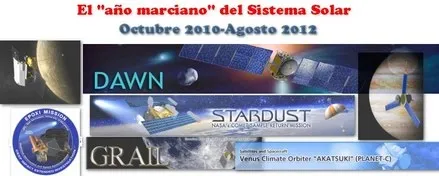
The period will be a "Martian year," of 23 months, which will begin this October 2010 until August 2012, said Jim Green, director of Planetary Science at NASA.
While Earth requires 365 days to orbit the Sun (orbital period), Mars needs 687 days, meaning its "year" is about 23 months (687/30).
The actions of this "Martian period" will begin on the 20th of this month with the visit to comet Hartley 2 which will have a close encounter with our planet at only 17.7 million kilometers, barely visible to the naked eye and a good target for amateur astronomers.
On November 4, the EPOXI spacecraft will fly 700 km from the nucleus to map the surface.
In November, the agency's astrobiologists will launch O/OREOS, which, far from being a box of cookies, is a satellite designed to test the durability of life in space. It is an acronym for Organism/ORganic Exposure to Orbital Stresses. A collection of molecules and microbes will be exposed to cosmic and solar radiation.
On December 7, the Japanese Venus Climate Orbiter, Akatsuki, will enter the orbit of our neighboring morning star.
Next year Stardust NExT will encounter comet Tempel 1 (February 14), MESSENGER will enter Mercury's orbit (March 18), and Dawn will begin its approach to Vesta (May).
Then Juno will be launched to Jupiter (August), GRAIL (in September) will map the Moon's gravitational field, and in November the Curiosity rover will be launched to Mars.
In 2012, Opportunity will run a Martian marathon, across the Endeavour crater.
Then Dawn will prepare to leave Vesta behind to visit Ceres.
In August, Curiosity will arrive at the red planet, so the end of the "Year of the Solar System" will actually be the beginning.
I was just talking about humanity's exploratory eagerness. In the next 23 months, there will be much to discover...
Sources and related links
- The Year of the Solar System
About the images
- Logo credits: NASA.