In a recent article, scientists from the Observatories of Paris and Rome developed new methods to restrict the nature of dark matter using observations of distant galaxies obtained with Hubble.
The words "restrictions" and "limitations" can have negative nuances in social semiosis. But from a scientific point of view, they can be very valuable. If a noise is produced in my house and I don't know where it comes from, I can imagine that there are multiple possibilities. By discarding some of those possibilities, I would be "restricting" the cause, thus getting closer to solving a mystery.
Let's see in this case how the possibilities regarding dark matter have been restricted and how these scientific processes could in a short time bring us closer to solving a mystery.
Since Vera Rubin detected that in certain galaxies stars moved somewhat differently than predicted by theory (Newton's), one hypothesis has been that in those galaxies there was something that was not observed. Since then, the idea of dark matter has gained increasing "weight," to the point of considering that without that dark matter galaxies would not exist.
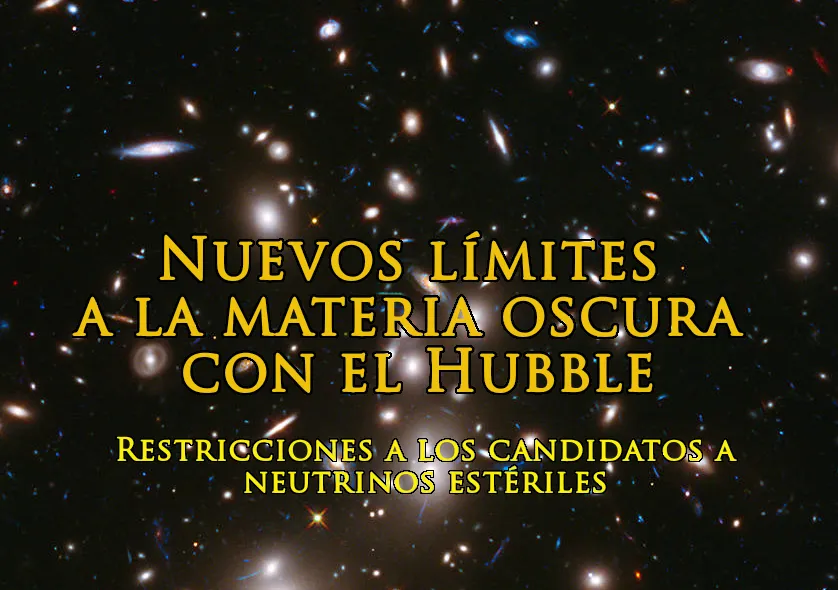
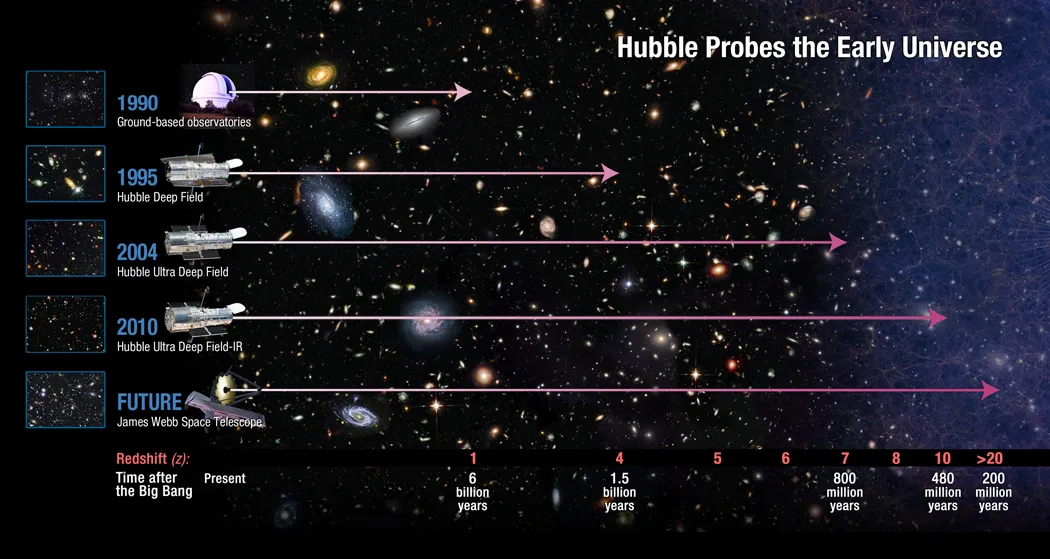
Galaxy clusters are one of the massive objects observed especially with the Hubble Space Telescope in what are known as "Deep Fields." Let's review this idea that we now consider brilliant: observing for several days a place in the sky where apparently there was nothing. With long exposures, where there seemed to be nothing, we discovered that there was a lot. Very diffuse, very faint objects because they are very, very distant objects.
Another brilliant discovery (which we owe to Einstein) is gravitational lenses. The gravitational force of galaxy clusters distorts and magnifies the light from more distant galaxies. Perhaps with the upcoming James Webb telescope the same thing can be done even better.
Thanks to the power of the instrument and the theory, the very powerful gravitational force of massive galaxy clusters allows the observation of much more distant and diffuse objects, which in turn allows us to know the density, number and distribution of primitive galaxies, the earliest universe.
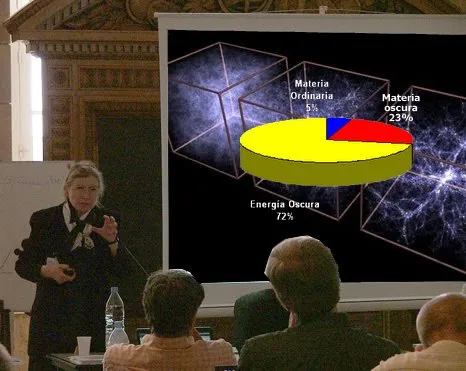
So far it seems that dark matter forms most of the mass of the universe. It is different from ordinary matter formed by atoms and manifests itself mainly through gravity. Both dark matter and gravity then play decisive roles in the formation and structure of galaxies.
Recently, deep field observations of the Abell 2744 cluster and the MACS 0416 cluster were used to study distant galaxies with very low magnitudes at epochs between 600 million and 900 million years after the Big Bang (which corresponds to cosmological redshift, z, between 10 and 6). Such measurements provide constraints on the evolutionary stages of the universe, on star formation and on the processes involving ordinary matter in distant galaxies.
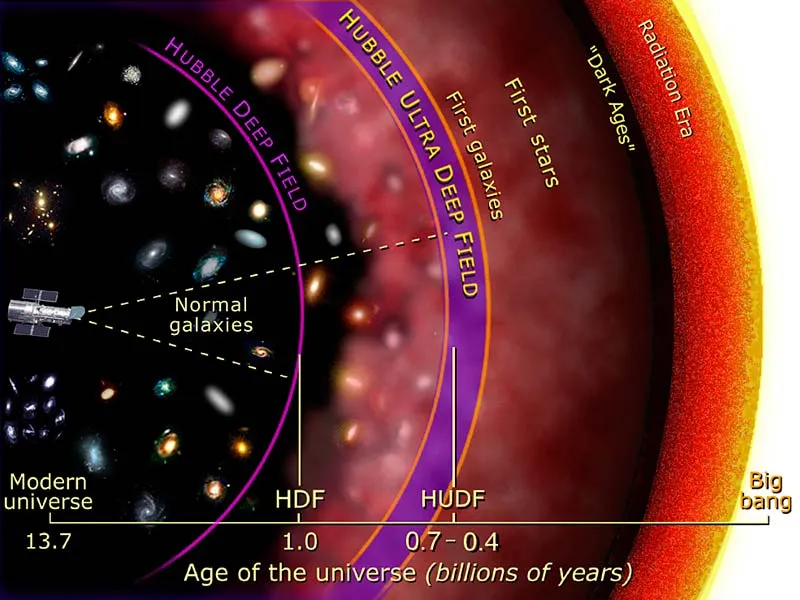
However, the power of those observations to restrict the nature of dark matter had not been used before. That was the task recently achieved by scientists from a collaboration between the Rome Observatory and the Paris Observatory. The team showed that those observations provide an unprecedented opportunity to obtain robust constraints on the masses of dark matter particles. Using that data, the team combined their knowledge in theory and skills in numerical calculations to restrict and discriminate dark matter candidates independently of the processes involving the formation of galaxies with ordinary matter.
Comparing the predictions computed by the team with the observed abundance of ultra-diffuse galaxies yielded very strict constraints.
Dark matter and "sterile" neutrinos
In particular, the highest density of galaxies observed at z=6 (900 million years after the Big Bang) has a very important impact on galaxy formation models for candidate dark matter particles with masses on the order of thousands of electron volts (one kilo electron volt, keV, corresponding to 10-36gr. For comparison, an electron has a mass of 511 keV).
Dark matter composed of particles with masses on the order of keV is called "warm" in opposition to so-called cold dark matter where the particles are heavier and slower. (Let's consider that the concept of temperature is given by the average speed of particles or molecules in a medium)
The most studied candidate particles for warm dark matter are hypothetical "sterile" neutrinos. The term "sterile" is used to distinguish them from the known active neutrino of the Standard Model of elementary particles which has an electric charge and interacts via the weak force. Sterile neutrinos do not interact (or their interaction is negligible) with Standard Model particles, they only do so through gravity and can decay via the usual quantum mechanism into active neutrinos.
The mass of dark matter particles determines the initial spectrum of the density of structures. Therefore, the different spectra are named according to the mass of the particles.
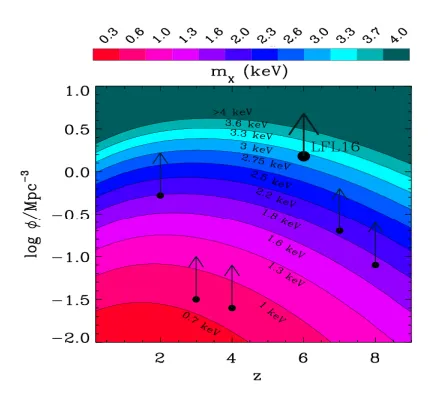
Comparing the measured abundance of galaxies with the calculated abundance allows distinguishing dark matter candidates: the warm dark matter model is one of those that best matches the observations and the team found that the lower limit for the reference particle mass is between m=2.1 keV (for three confidence levels) and 2.4 keV (for two confidence levels). These constraints, in turn, translate to the mass of sterile neutrino candidates.
The corresponding constraints on the mass of sterile neutrinos depend on the production mechanisms of those neutrinos, and in all cases studied, for the best-known mechanisms, those constraints place the mass of those particles in an interval between 6 keV and 10 keV.
In the future these results could be improved through better statistics in the Hubble deep fields (going from the 167 galaxies in this study to 450 galaxies with z ~ 6). These results can also be combined with observations of galaxy clusters in the X-ray domain and pave the way for what could be revealed with Hubble's successor, the James Webb telescope whose expected launch would be in 2018.
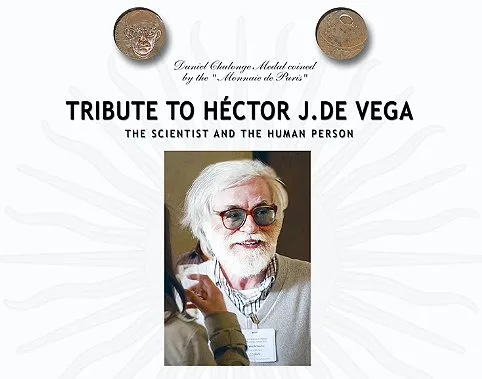
A new medal, in honor of Héctor de Vega
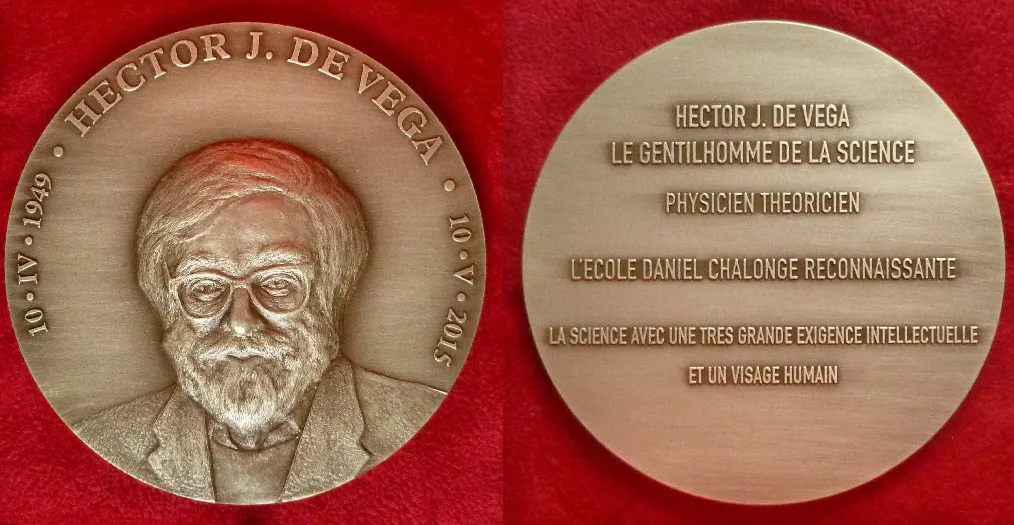
Dr. Norma Sánchez reports that in honor of Héctor de Vega a medal has been minted with the portrait of the recently deceased physicist, under the motto "The scientist and the human person. Science with great intellectual demand and a human face".
One side of the medal shows the name, dates and the artistic portrait of Héctor de Vega inspired by a photograph taken by Nadia Charbit Blumenfeld. The reverse includes the text "The gentleman of science. Theoretical physicist. Recognition of the Chalonge School".
In 2016 a year is being held in his honor.
On March 26 - in the session "Latest news from the Universe" - the recognition with the first medal was for Dr. Alba Zanini, INFN Turin.
The second medal was presented on May 19 to Dr. Nadia CHARBIT BLUMENFELD; the third (on June 15) to Professor Peter L. BIERMANN (Max-Planck Institute -Bonn and University of Alabama-Tuscaloosa, astrophysicist, Chalonge Medal).
Then, between July 20-22 the recognition was for Professor Gerard F. GILMORE (Institute of Astronomy, University of Cambridge, Fellow of the Royal Society UK, Chalonge Medal) and Professor Anthony LASENBY (Cavendish Laboratory-Astrophysics and Cosmology, University of Cambridge, UK, Chalonge Medal).
More about Héctor de Vega at http://chalonge.obspm.fr/HdeV.html
Sources and related links
- A Stringent Limit on the Warm Dark Matter Particle Masses from the Abundance of z=6 Galaxies in the Hubble Frontier Fields
N. Menci, A. Grazian, M. Castellano, N. G. Sanchez.
The Astrophysical Journal Letters, Volume 825, Issue 1, article id. L1, pp. (2016).
arXiv:1606.02530 [astro-ph.CO]
http://arxiv.org/abs/1606.02530
DOI: 10.3847/2041-8205/825/1/L1 - Constraining the Warm Dark Matter Particle Mass through Ultra-deep UV Luminosity
Functions at z=2
N. Menci, N.G. Sanchez, M. Castellano, A. Grazian,
The Astrophysical Journal 818, 90 (2016)
arXiv:1601.01820 [astro-ph.CO]
http://arxiv.org/abs/1601.01820
DOI: 10.3847/0004-637X/818/1/90
About the images
Fig. 1: Hubble deep field image of the massive galaxy cluster Abell 2744.
Credit: NASA/ESA http://www.nasa.gov/content/hubble-frontier-field-abell-2744
Fig. 2:
Hubble Deep and Ultra Deep Fields by NASA.gov [Public domain], via Wikimedia Commons https://en.wikipedia.org/wiki/Hubble_Deep_Field
Fig. 3:
Evolution of telescopes http://www.nasa.gov/mission_pages/hubble/science/farthest-galaxy.html
Fig. 4: Credit: N. Menci et al (2016)
Fig. 5: Medal photo. Chalonge School.