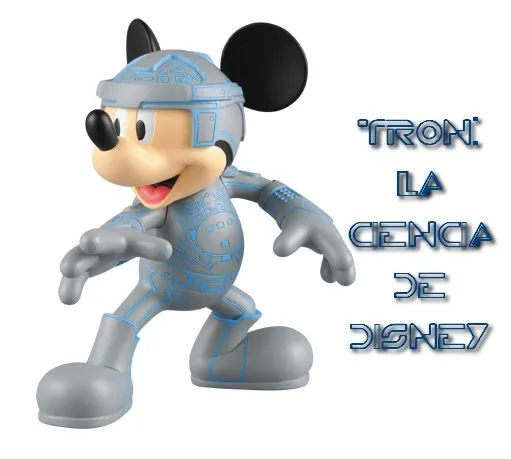
No, I'm not talking about the science in Donald Duck or Mickey Mouse, but what about TRON and the upcoming The Black Abyss?
Last week I went to see TRON: Legacy. When the original was released I was less than a decade old, but later, in my adolescence, TRON became one of my favorite movies.
The first thing that strikes you in the new (and the old) version is the aesthetic, the settings and the illuminated clothing are ideal for cinema. In the new version, the protagonist also strikes you, with an indescribable beauty -sorry for the drool- :)
But, is there science in TRON?
Some, but it's not the first thing one might notice.
The director, Joe Kosinki, pointed out that they were not interested in making a movie about technology, but in talking about technology through the relationships between characters. "You won't hear about gigabytes, Twitter and Google, because any technical jargon would go out of style in five years," he explained, while describing the film as "a Western, but with different rules."
Ultimately, it's a movie and not a documentary, but one expects to find a certain verisimilitude. The world of TRON includes the possibility of digitizing human beings, to later return them to "this world." It includes teleportation and quantum computing.
Although the film does not delve into how it is possible, with what exact mechanisms, there are elements that make it minimally plausible.
In this sense, the Science & Entertainment Exchange program of the U.S. National Academy of Sciences had its participation.
One of those consulted was the popular physicist Sean Carrol, from Cosmic Variance, as he tells it on his blog and on the Science & Entertainment Exchange page.
As Carrol tells it, the consultation was made after having the initial script, so the influence was not notable, although he assures that if there were a sequel, the ideas that emerged would surely have a more significant role.
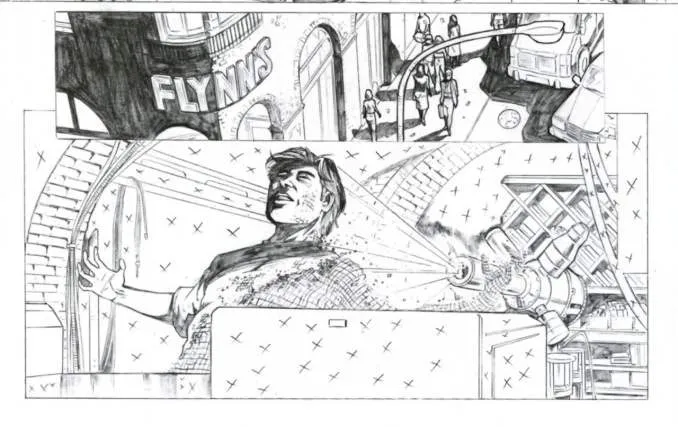
In the talks they discussed how to teleport a human body to the Grid. They talked about conservation of mass and finally it appears on screen that the laser that miraculously does the task is equipped with tubes of oxygen, carbon, etc., although it's not very noticeable, but they are there, to give greater credibility to a process that science cannot solve today. It is assumed that these elements are not digitized and enable the reverse process, of rematerializing previously digitized people.
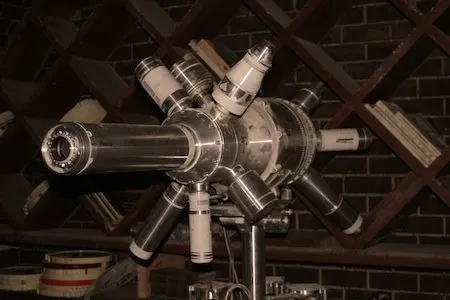
Quantum teleportation is an idea that arises from the fact of the well-known entanglement of quantum states.
Physicists from Caltech announced a teleportation (of one meter) already in 1998.
The idea that these quantum states are entangled despite the distance and that a change in one causes a change in the other instantaneously displeased Einstein himself.
In 2007 a team from ESA announced the results of an experiment in which this entanglement had been successful over a distance of 144 kilometers.
Quantum entanglement is a counter-intuitive idea from quantum mechanics. If two photons (the particles of light) can interact with each other, they can become entangled. It is possible to create pairs of photons using a process called Spontaneous Parametric Down Conversion (SPDC) or Spontaneous Parametric Down Conversion.
Those two photons can be separated, but when one interacts with a third particle, the other photon will change its quantum state instantaneously. The idea that the European Space Agency conducts these tests is related to the possibility of encrypting satellite messages, making them more secure.
Another experiment was done at Roque de los Muchachos and La palma.
The fact that this transmission of information (not energy) is instantaneous seems to go against the maximum speed in the universe being that of light, despite some studies suggesting this is not the case.
Let's think that, as far as is known, this instantaneity is not useful, it cannot be used to transmit messages.
Video: TRON: LEGACY - Daft Punk's "Derezzed"
http://www.youtube.com/watch?v=k-T7vGdH_ek&feature=channel
TRON is a game
This film, like other science fiction novels, allows us to 'play' with the present and the future. We can allow ourselves, thanks to imagination, to explore unknown worlds or fantastic realities. But it is also a wonderful opportunity to explore more deeply where we are, where we are heading, who we are.
Science fiction allows, like a magnifying glass, to magnify our present actions, projected plausibly into the future. Are we in some way like Sam Flynn, physical people who have largely transformed ourselves into digital characters? Aren't we often 'inside' an invisible grid of ones and zeros?
Don't we create 'alter egos' of ourselves on the net?
Aren't we concerned with keeping a backup of our digital data, as if it were a representation of ourselves that is very important to keep safe, like the identity discs?
The ISOs
I've been reading GEB for a while. Hofstadter alludes many times to isoformisms, as well as drawing parallels between our physical and digital life (hard and soft), especially regarding meanings.
I don't know if it will be possible (or desirable) for programs not created by users to self-generate spontaneously, as TRON proposes. But the replication of content does have a parallel with our daily life, with our freedom (or not) to access it and the importance this can have. On the other hand, I can't stop thinking that our actions are often isoform...
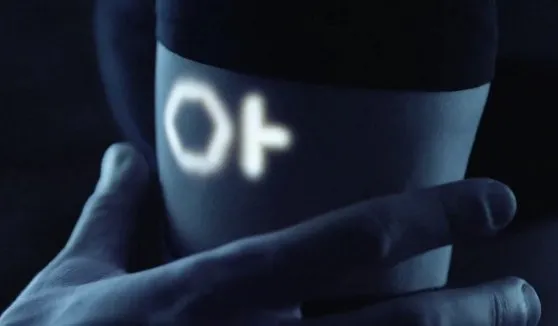
And what is the meaning of TRON?
Communication is a dynamic process in which the messages emitted are encoded to be decoded in the receiver. In between, it is possible that there is an enormous amount of 'noise,' among them, personal subjectivity when interpreting the decoding. I don't know if there was a clear message the producers wanted to convey. And we receivers can interpret multiple things from the same message to our liking, because of this thing that each one finds what they are looking for.
What is possible to find, among many other interpretations, is an interaction between the digital world and the physical world. Something that happens today, on a different scale and magnitude, of course. In TRON there is activism and a struggle of dichotomous ideas (the obvious conflict between good and evil) and there is an interesting concept: that the ideal world should not be perfect, because we humans are not.
Technology can influence (does influence) all this, but ultimately, they are the same old human conflicts, with colored lights and electronic music.
Not just a game of mirrors
Although I said earlier that it is a kind of game of mirrors in which we could see ourselves reflected, TRON also gave rise to video games. It is not my specialty nor my intention to review the existing ones, but I can recommend GLTRON by Andreas Umbach created under a GNU license. The free world of TRON, in a video game free from authorial constraints, based on the idea of other multiple games of the style with light-cycle battles in an arena.
The Disney TRON: Legacy page also allows you to play online and drive these cycles in search of light 'things' in a scenario where we can head to different points of interest. Also, there is interesting downloadable material there.
Another possibility, when looking for more information, is the TRON Wiki.
What's coming: black holes
In 1979 Disney released The Black Hole. Now a readaptation of that film is being considered. "Astronomers have made tremendous advances in understanding supermassive black holes that are thought to lurk at the center of the largest galaxies, since 1979 when Disney released that movie. Hard science will drive the film, the reality of what happens at the boundaries of black holes, what they look like," said the director, the same one from TRON: Legacy.
You can watch a trailer of the 1979 version on YouTube.
Of ducks and science
At the beginning I said that when I would talk about Disney's science I wouldn't do it about Donald Duck. Various things have been written on the subject, for example the well-known book by Ariel Dorfman, How to Read Donald Duck. But also something that was left out of that work in "How to Reread Donald Duck" by Luis Javier Plata Rosas, an article that indicates examples of the use of science in some chapters of the famous Duck.
Sources and related links
- Quantum Entanglement
- Quantum teleportation (in Spanish)
- Science of TRON: Getting Up to Speed with Teleportation and Quantum Computing
- Tron:Legacy And Isomorphisms
- Science of TRON
- 'Tron Legacy' illuminates cinema's science story
- New Details About Disney's 'Black Hole' Remake
About the images
- Mickey Mouse TRON. Credit: Tibetienda/Lapapa
- Laser image from iheart comix
- TRON, the betrayal image from foros Atomix
- Quorra's symbol: Image from TRON Wiki