The Ibero-American Network of Science and Technology Indicators (RICYT) announces that the 2010 edition of its traditional annual publication is now available: The State of Science - Main Science and Technology Indicators - Ibero-American / Inter-American.
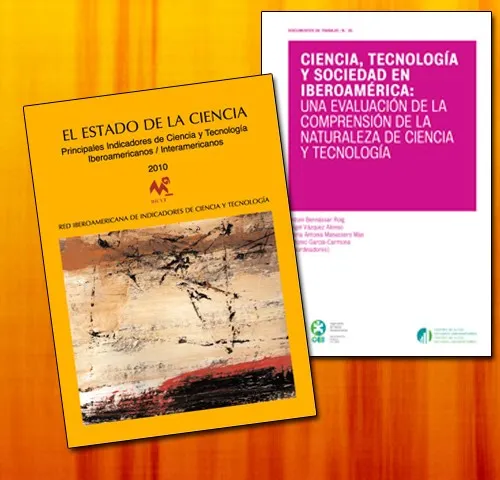
The purpose of this publication is to provide, through an agile and dynamic format, useful tools for the analysis of the problems of science, technology and innovation in the countries of our region. As in the last editions, this volume is composed of reviews of the main aspects of the institutional science and technology systems of the countries in the region that participate in RICYT. Various special reports dedicated to current topics of indicator production in Ibero-America can also be found among its pages.
This report was prepared by the technical team responsible for RICYT's activities, with the support of collaborators specialized in the different topics presented. Among the various authors of the section dedicated to articles, the signatures of Guillermo Anlló, Carmelo Polino, Guillermina D'Onofrio, Rodolfo Barrere and Facundo Albornoz can be highlighted. The volume includes results from the activities of the Ibero-American Observatory of Science, Technology and Society (OCTS). For the editing of this book, resources contributed by the Spanish Agency for International Development Cooperation (AECID), through the Center for Higher University Studies of the Organization of Ibero-American States (CAEU/OEI), were also used.
The 120-page document can be downloaded from: RICYT.
On the same page you will find the possibility to generate tables with specific data.
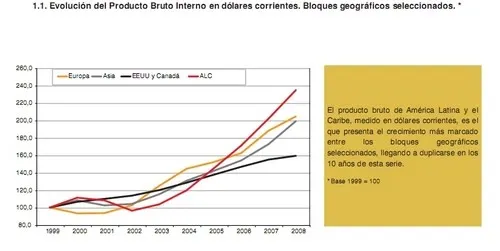
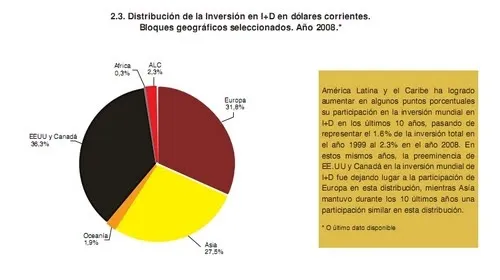
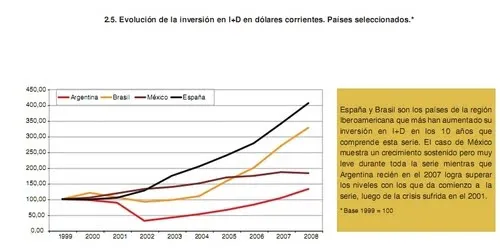
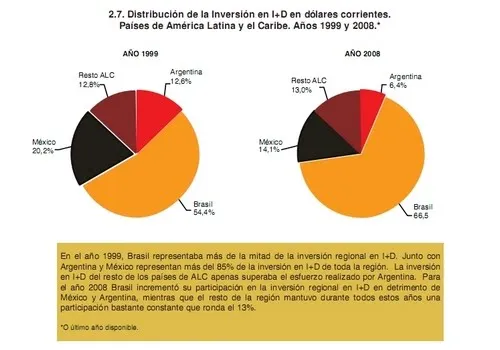
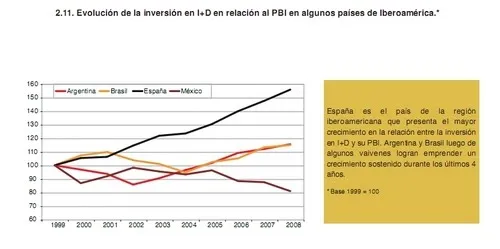
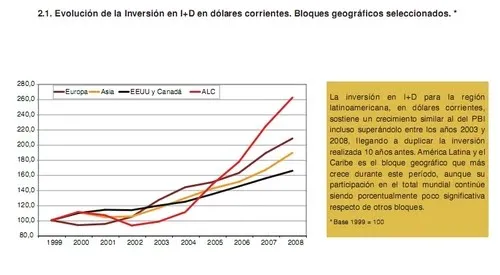
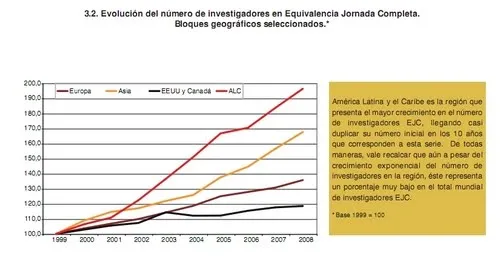
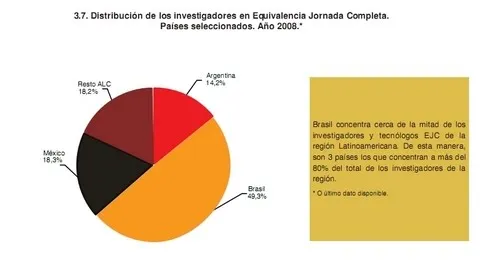
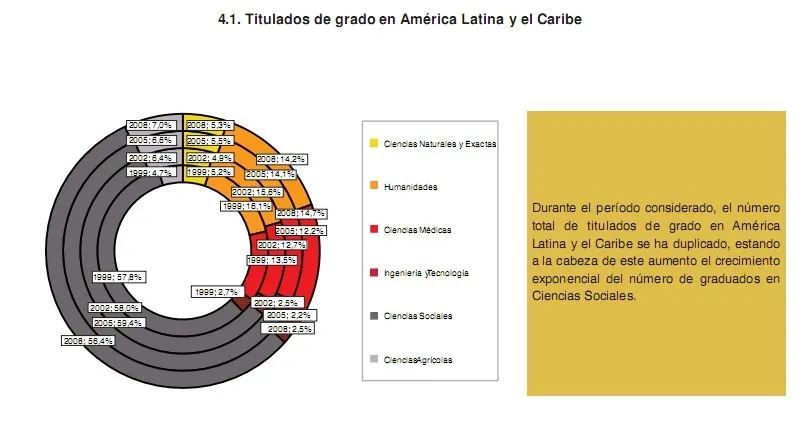
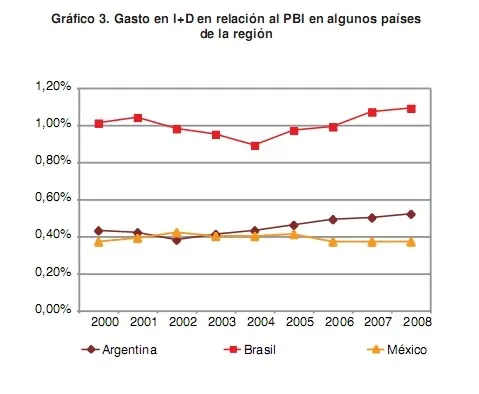
The State of Science 2010 begins with a summary in graphs, related to GDP and investment in R&D in blocks.
As an example, I show some graphs (all graphs open separately):
The document continues with a chapter dedicated to social structure and international insertion in Latin America, 2000-2008.
Then there is a chapter dedicated to food technology. It is followed by a chapter on The problems of measuring innovation in primary activities and then one on Social perception of science and technology.
I stop at that chapter, whose introduction begins like this:
"The perception of risk and citizen participation are two key topics for contemporary science and technology policies.
The politicization of science, its visibility, and social impact, which includes unintended consequences of technology implementation, have sharpened conflicts in relation to scientific and technological development and its political management. As exponents of these profound changes in the relationship between science, technology and society during the last quarter of the 20th century, proposals for participatory democratization are reaching scientific institutions".
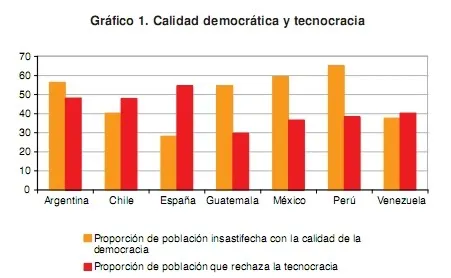
Among the conclusions pointed out about this perception, it is indicated (the bold is mine):
"First, citizens are shown, with exceptions, particularly critical regarding democratic quality in their countries.
Secondly, it is a fact that citizens demand the opening of channels of expression and participation, although, at the same time, this does not imply the exhaustion of technocratic forms of management of public affairs nor the withdrawal of support for expert systems as a source of legitimacy for policies.
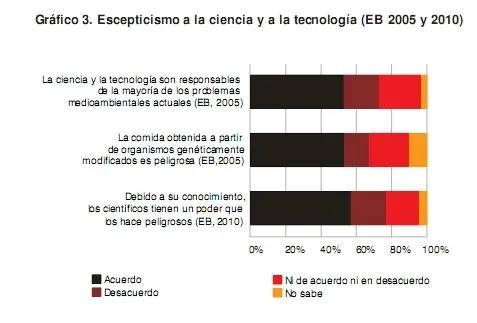
This is accompanied by a high valuation of the contribution of science and technology to concrete improvements in quality of life and of the role of scientists in society.
However, as has also been shown in this article, there is no naive optimism regarding the consequences of technoscientific development.
On the contrary, awareness of risks indicates that citizens have sufficient capacity to discriminate between benefits and risks.
This is equivalent to saying that positive visions have not been replaced by apocalyptic stances but by more balanced and critical considerations".
The document concludes with a chapter on Indicators of trajectories of Ibero-American researchers.
Notions of Science and Technology
Today I learn about the publication by OEI titled "Science, Technology and Society in Ibero-America: An assessment of the understanding of the nature of science and technology."
The authors of this work were: Bennássar, Antoni; Vázquez, Ángel; Manassero, María Antonia and García-Carmona, Antonio (coordinators)
This publication offers answers to these questions, based on the empirical data of a research project that evaluates the attitudes related to science, technology and society of students and teachers in several Ibero-American countries.
The detail of the content can be known on the OIE page, as well as download the 246-page document.
The first chapter is focused on the Notions of Science and Technique (NdCyT), followed by the methodology of the Ibero-American Project for the Evaluation of attitudes related to science, technology and society (PIEARCTS):
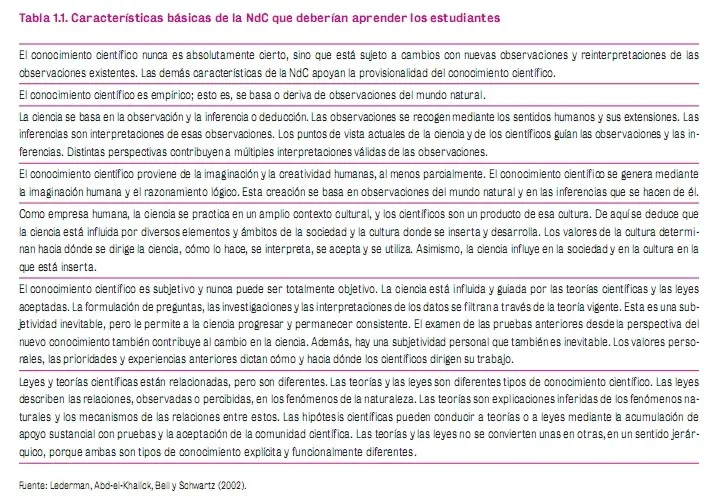
The sample object of this study is formed by three main groups:
1. A first sample group comprising students in their last year of upper secondary education (baccalaureate or similar) or their first year of university or higher education (18 to 19 years old), both from S&T studies and humanities (for comparison and contrast).
2. A second group of students from the last year of university or higher education, or postgraduate courses, with special attention to those enrolled in initial training to be teachers (22 or 23 years old, or more), both from S&T specialties and humanities (for comparison and contrast).
3. A third group formed by practicing teachers from both primary and secondary education, of various ages and various specialties, sciences and humanities (for comparison and contrast).
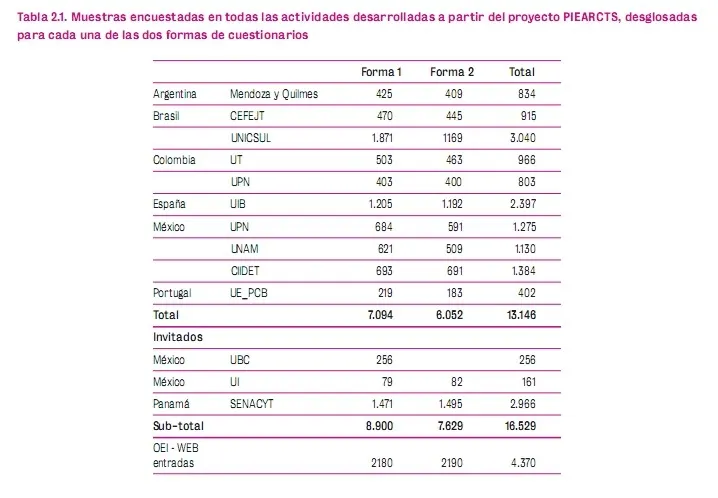
For its application, a selection of 30 questions is made, articulated in two questionnaires, questionnaire 1 (F1) and questionnaire 2 (F2), which participants answer anonymously.
What I have just indicated is only a brief extract of the methodology. Many variables were analyzed and it is difficult to present the methodology and its results in a simple and straightforward way. Interested parties can download the document which, at the end, shows the forms with the questions asked.
A very interesting chapter is the one that addresses the troubling question:
Do undergraduate university studies contribute anything to the understanding of NdCyT?
"The objective of this study is to verify the effectiveness of undergraduate university studies for improving the understanding of NdCyT among graduates from a representative Ibero-American sample and, more specifically, to evaluate the specific aspects of NdCyT that undergraduate studies contribute to improving. For this, the responses to each of the 30 items applied through two questionnaires, F1 and F2, are compared between students beginning or finishing science and engineering degrees using an analysis of variance (ANOVA).
The results of the comparison should decide on the established hypothesis about whether final-year undergraduate students achieve a better understanding than students beginning the degree. If affirmative, it would be verified that undergraduate studies are a positive factor in improving students' understanding".
It is noted that (the bold is mine):
"The analysis presented contrasts the results of understanding about NdCyT of students at the beginning and end of undergraduate studies at a university in a country. Overall, both groups possess moderately informed beliefs (neutral, on average), and furthermore there are no topics towards which it can be said that students' attitudes are very negative.
On the other hand, the comparative analysis of the results between both groups indicates that senior students tend to present global beliefs about NdCyT barely better than young students, so it can be stated that the differences obtained are not relevant.
Considering the large number of variables contrasted between both groups, belonging to both F1 and F2, the relevant differences detected affect very few variables, so it can be stated that there are no appreciable differences or, said in other words, that the groups of science and engineering students who begin and finish their university studies are more alike than different from the perspective of understanding NdCyT.
It can be said that the starting hypothesis, established as a guide, is barely supported in light of these results, so that undergraduate university studies in S&T do not seem to contribute to a substantial improvement in the understanding of NdCyT.
This prompts a call for university science and technology studies to have a greater impact on the teaching of topics related to NdCyT, and that it be done in an explicit way, through the proposal of specific objectives and content along with their corresponding evaluation, and in a reflective way, through the proposal in class of activities that promote discussion and critical analysis, debates, etc., around situations related to NdCyT".
The attitudes of teachers and students in Ibero-America towards the relationship between women and science
Here the results obtained in 2 items are analyzed, related to the internal Sociology of science, and more specifically to the characteristics of scientists, whose statements and responses to be rated (sentences) by the respondents are described below:
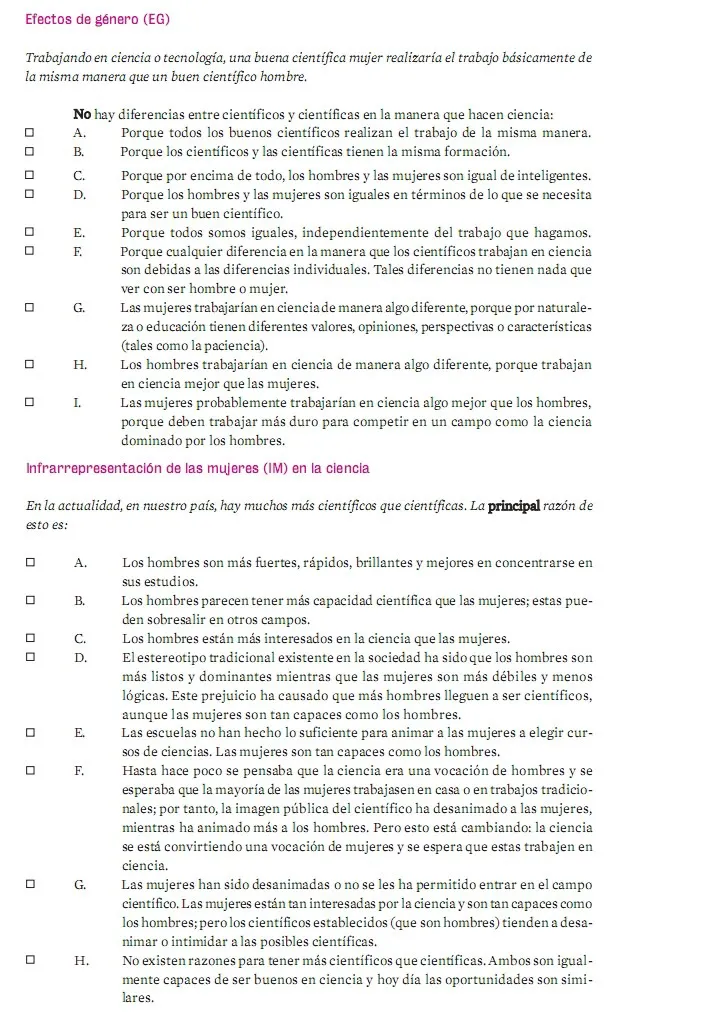
In the total samples from the different countries, the EG issue as a whole appears among those presenting the most positive attitudes in almost all countries (except Mexico).
In contrast, the IM issue appears among those with the most positive attitudes in Spain and Colombia, while it is among the most negative in Brazil. However, the sentences corresponding to these topics appear both among the most positive and the most negative.
Exact and Natural Sciences (CEyN) "vs" Humanities and Social Sciences
"We present the responses obtained for each country, regarding the mean attitudinal index and the standard deviation of the two items, for the groups of Exact and Natural Sciences (CEyN) and Humanities and Social Sciences (CHyS), with the significance corresponding to the differences between them.
(...) Only in Spain are significant differences (p < 0.01) found for the EG issue between CEyN and CHyS. Furthermore, CEyN is the one that has shown the most appropriate attitude, not only in Spain but also in the rest of the countries.
Regarding the IM issue, only in Portugal are there significant differences between the complete samples of CEyN and CHyS, with the latter being the one that has shown the most appropriate attitude. In this issue, CEyN from Spain showed the most appropriate attitude.
Then it is added:
"Considering in both the opinion of both men and women, there seem to be variations between countries:
1. In Argentina and Portugal no differences are observed on this topic between both.
2. In Spain and Colombia the most appropriate attitudes are found in CEyN.
3. In Brazil and Mexico, the most appropriate attitudes are divided between the two samples, depending on the sentence and the groups. But it is important to highlight that in the total samples of both countries it is CHyS that has a more appropriate attitude in sentence B, which expresses N No or there are differences between male and female scientists in the way they do science because male and female scientists have the same training. However, from the total sample of Mexico, it is CEyN that has a more appropriate attitude in sentence F, which indicates that this is because any differences in the way scientists work in science are due to individual differences. Such differences have nothing to do with being male or female".
The importance of the figures
The value of both works is that they are tools for diagnosis. This does not imply that to know the situation of science in a country and/or the public's perception of it, these indices are sufficient. They may not be. However, it is necessary to somehow evaluate what happens with science by weighing different variables, making comparisons and measurements over time.
We recently said here that certainly recognizing the problem is not enough to find the solution. Actions are also required, but these will arise after a diagnosis and not before, which makes the diagnosis foundational, essential.
Then we will have to try to answer a rather complex question: where do we invest the money?
If you were in a position to decide, do you have a clear idea of where and how to invest your country's economic resources to achieve better science?
When I ask myself, I'm left thinking...
NOTE: Do not rely solely on the data from the graphs shown here to draw any conclusion, as they are excerpts from much more extensive documents and these graphs appear here out of their original context. Both documents, as noted above, can be downloaded for free in pdf format.
Sources and related links
- "The State of Science 2010" is now available
- Science, Technology and Society in Ibero-America: An assessment of the understanding of the nature of science and technology.
About the images
- The graphs belong to the cited books and were used only as representative samples. The rights belong to their respective authors.