A competition to improve image analysis tries to find the best algorithms to solve cosmological problems.
Although it is a project open to the community, it is not exactly citizen science in the sense that not just anyone can participate because advanced knowledge is required.
However, it is indeed a project somewhat similar to those proposed by Galaxy Zoo (which has a new project I will talk about below).
Ultimately, it is about using the power of the masses to solve problems in digital data linked to astrophysics. The project is called GREAT 10, but before continuing, allow me an introduction.
A great problem demands a GREAT solution
A gravitational lens is formed when light coming from distant objects like quasars curves around a massive object (like a massive galaxy) located between the emitting object and the receiver.
This has a correlation in the images collected with telescopes.
That is, far away there is a quasar (a very, very distant galaxy with an active nucleus). Here we are on the Earth's surface or observing from orbit with a space telescope. In between there is a massive galaxy.
When observing in that direction, the images obtained are "distorted." The light from the quasar passes by the massive galaxy. The light is curved by the galactic mass and "distorts" the images.
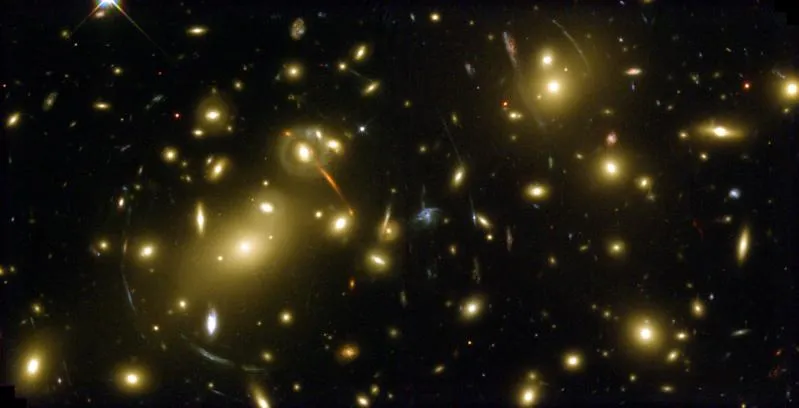
In a way, the massive galaxy acts as a lens. But there are some problems: this effect can occur for multiple reasons.
How to distinguish in an image if there is a lens or not?
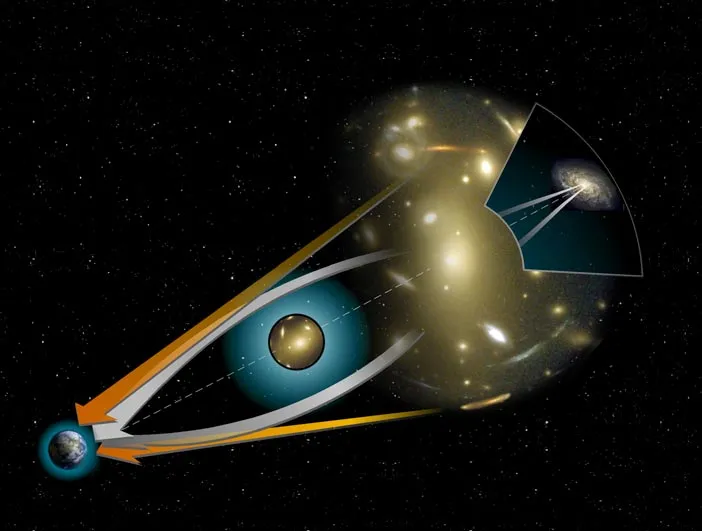
It is possible to perform mathematical processing on the images to try to "correct" them.
A term used in these cases is extended point function, which in English is called Point Spread Function (PSF).
This function describes the response of an imaging system to a point source. A more general term for the PSF is an impulse response of a system.
The PSF will thus be the impulse response of a focused optical system.
That is, recapping up to here: in the observation of the cosmos, a gravitational lensing effect occurs, which allows obtaining images of very, very distant objects, but distorts the images.
On the other hand, the distortion can be generated by other reasons that are not the presence of a quasar or other distant object, but by the atmosphere and the instrumentation.
How to distinguish between one thing and the other?
The answer may not be pleasing, but here it goes: the images are falsified.
What do you say?
Yes, data is created. Not data from instruments, "real" data, but created by humans, but which supposedly contains the full range of complications that are indeed seen when observing real images. With one difference. Among the "fake" images, the one who created them knows which ones have a distortion from a distant source and which have a distortion from other reasons.
If we make all those images available to the public so they can create algorithms capable of recognizing the true from the false, we will be able to know if they are good or bad by comparing the results obtained with the created data.
Let's give an example: images x and y are created by me. One has a distortion generated solely by the lens effect. The other has a distortion from atmospheric effects or other reasons. I do NOT tell this to anyone. I put those two images out to the public and ask them to tell me which image is distorted by lensing.
For that, the public will have to create an algorithm capable of recognizing the source of the distortion. They tell me that image y is the one sought. Since I know, because I made the file, that it is not so, the answer is bad.
But if they tell me the answer is x, the algorithm may be useful.
If we do this with thousands of images, the result will be much better.
On the other hand, if we do this with real images, obtained from instruments, we cannot be sure which ones are "good" or "bad."
Do you understand?
The GREAT answer
GREAT 10 is the name of this year's project, which actually exists since 2008. It is an acronym for GRavitational lEnsing Accuracy Testing, that is, Gravitational Lensing Accuracy Testing.
But GREAT, in English, is also a word with several meanings: Great, Good or Awesome, etc.
This image analysis competition makes two challenges available to the public. The first is about galaxies. It consists of 26 image sets, each with 200 and each image with 10,000 galaxies.
I do not recommend the curious to download without caution because the total "weight" of the data is 894 Gb, about 88 MB per image in FITS format.
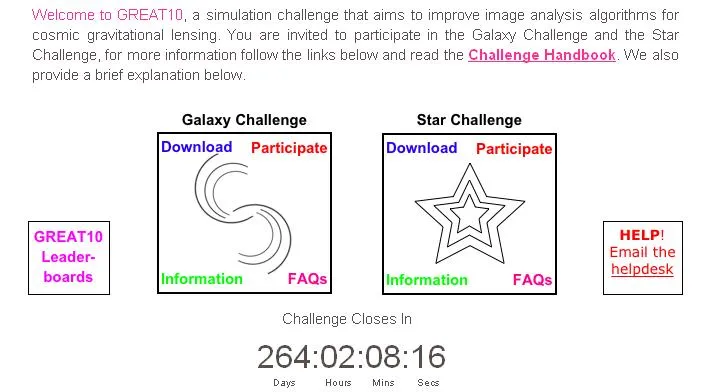
Developers will be able to test their algorithms before submitting them thanks to training data that contains the "true" files.
The challenge will conclude on September 2, 2011.
The winners will be able to attend a JPL workshop plus an iPad or iPod or an object of similar value.
The other challenge is similar, with stars.
Understanding the Milky Way
Since we are talking about something similar to citizen science, the people from Galaxy Zoo, who already have a ZooUniverse with several projects, started a new one about our galaxy: http://www.milkywayproject.org/
The idea is to sort and measure the Milky Way. Initially, you are asked to draw bubbles in beautiful infrared data images from the Spitzer Space Telescope.
Understanding the cold, dusty material seen in those images will help scientists understand how stars form and how our galaxy changes and evolves over time.
The Milky Way Project - Getting Started from The Zooniverse on Vimeo.
If we already have a user account on some ZooUniverse project, we can use the same one to log into MilkyWay. Then we'll follow a brief tutorial. The idea is that the infrared images taken by Spitzer have gas "bubbles." It's also possible to find other interesting objects in the images like galaxies, clusters, red objects, green knots, etc.
The user, who doesn't need any prior knowledge, will see an image and must indicate on the web interface where there are bubbles and other interesting objects.
How do we know if we're doing it right? It doesn't matter.
The idea is that what we have to look for is easy for humans to recognize (and not for computers). But even if we don't see the bubbles or other objects, someone else will.
Our data won't be taken as true just like that. The power of the masses makes it possible, instead, to take into account the data that repeats. The images we are going to classify will be shown to many people. If we don't mark a bubble, but the rest do, that data will be taken into account.
This doesn't mean we should do things poorly. To find the bubbles we must look at the images carefully. In the tutorial there are several samples that will help us realize what we should find.
Furthermore, the tools allow editing, either removing something marked or modifying its shape or location.
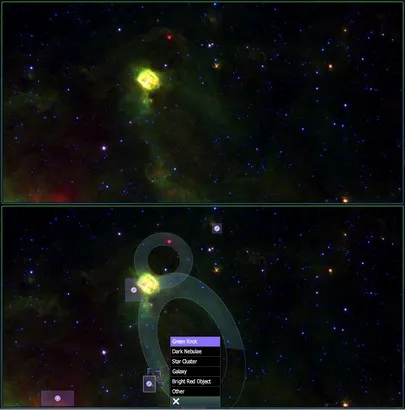
With a little practice we will more easily recognize the bubbles that may or may not be present in the images, as well as different objects of interest.
It may be important to adjust the brightness/contrast of our monitor, as many gas bubbles are diffuse.
A couple more projects where science is done communist. Sorry, communitarian :)
Of course, in these cases, those of us who have less (knowledge) are helping those who have more, but ultimately it's about lending a hand and feeling like participants, even in a small way, in scientific development.
In other aspects of society there should be greater interaction between people, but the other way around. Those of us who have more should help those who have less.
Perhaps society also has to look for good algorithms. Especially when we witness a present that is sometimes truly mean-spirited. Sorry for that last bit, but the recent social events in Buenos Aires don't leave me indifferent. Surely the blame is shared. Writing about topics that have nothing to do with it makes me feel a bit at fault too. Apologies for this. But it's just that sometimes we do things so poorly...
Sources and related links
- Gravitational Lensing Accuracy Testing 2010 (GREAT10) Challenge Handbook
Thomas Kitching et al
arXiv:1009.0779v1 [astro-ph.CO] - So you Think you can Solve a Cosmology Puzzle?
- The Milky Way Project
About the images
- Image of Abell and illustration. Credit: Hubble.
Hubble Reopens Its Eye on the Universe
NASA, Andrew Fruchter and the ERO Team [Sylvia Baggett (STScI), Richard Hook (ST-ECF), Zoltan Levay (STScI)] (STScI) - Logo and images of GREAT10 and MilkyWay Project.