The creators of Astrometry.net used images of Comet 17P/Holmes taken by astrophotographers and accessible through Yahoo! to infer the object's orbit. And they find a very good match. A different citizen science project.
On the internet we can find countless images of astronomical objects. The vast majority are useless for scientific purposes, but not all is lost.
A picture, they say, is worth a thousand words. However, a phone number or a first and last name can be much more useful than a photo. But one does not necessarily take away from the other. Images can contain data. Since that data does not represent the object in question, they are not pixels, they are called metadata.
The use of metadata in photography has increased in recent years and today, services like Flickr can read that data from our digital cameras. For example, date, time, and camera type are some of the data included in photographs. With the use of GPS devices it is also possible to add geographic coordinates.
But, what is the situation with astronomical images? So far there are no massive and unified agreements on the matter, although there are projects, in particular VAMP, which we have talked about on other occasions (The DNA of astronomical images).
It would be fabulous if the vast majority of astronomical images available on the web contained this data IN the image: object designation, coordinates, date, exposure time, camera, etc.
Dustin Lang, from Princeton University and David Hogg, Center for Cosmology at New York University and the Max Planck Institute, addressed this issue in a recently known paper (not published, it's a draft).
There, in addition to pointing out the panorama narrated before, they include as a good current alternative the Astrometry.net project and its relationship with Flickr. There, an image of an astronomical object, of which it is not known what object it is and what position it occupies in the sky, is analyzed to provide this information, automatically. It is no coincidence that they used Astrometry. Not only is it a good tool, but they are its creators!
The experiment was simple: through the Yahoo! search service (they used pYsearch), on April 1, 2010, they searched for JPEG images with the phrase "Comet Holmes" (in English). The search returned about 10 thousand results, but after filtering them they were left with 2241 unique images. Then they ran the Astrometry.net code on each image to perform an astrometric calibration. 1299 images were recognized as images of the night sky and were calibrated. Some of the images were illustrations or graphics of the comet's orbit. And others, 422, had dates included in the header (EXIF headers).
On October 24, 2007, Comet 17P/Holmes shone incredibly (m=2.5) generating considerable public interest.
They then evaluated the accuracy of the dates and times of the images by checking in each case where the comet was at that moment and it seems that the vast majority of the dates were consistent.
What they did next has a level of detail of mathematical calculations and programming that is very interesting, although somewhat lengthy to tell.
At least I will say that they took some parameters like coordinates, date and time, image size and orientation, in addition to the orbital parameters of the object, etc.
The goal was to know if only with a set of images made by astrophotographers, over time, it was possible to infer the comet's orbit.
And the result seems to agree quite well.
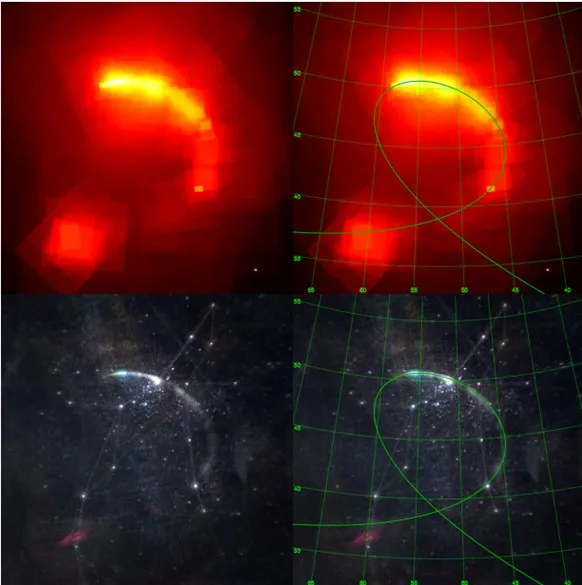
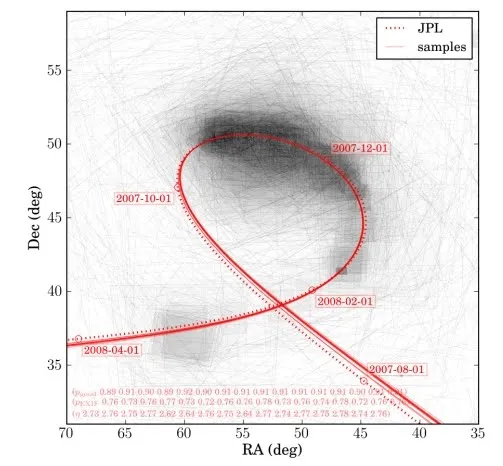
Image 1, the one that opens the post, allows you to see in dotted line the orbit according to JPL ephemerides and in solid line the orbit inferred by the work using web images.
The model used by the researchers has its defects, as they themselves point out. The most obvious of all is that many of the images are the same image. Someone takes a photo, puts it on the web and another person takes that image and uses it on their own blog or site. For the search engine, they are different images, but in reality they are not.
Conclusions
The work allows for some interesting conclusions. On the one hand, the result is consistent with the real orbit of the object, so, the astrophotographs, it could be said, were not poorly done.
On the other hand, the researchers found that they were using images that were not theirs to publish a work that necessarily must be well credited. Contacting 2241 people and getting their response would be quite difficult. That is why the paper only contains a few of the images used, but in those cases they did contact their authors, who had no problem sharing their photos and were enthusiastic.
The other lesson is that the amount of data from one image may be small, but the union of many images can produce something different. The researchers then performed a similar process with comet C/1996 B2 (Hyakutake) with a similar result.
Having Astrometry on one hand and a flood of unidentified astronomical images on the other makes one think about the combined use of the tools at our disposal today. One way to relate both things has been, as noted, Flickr.
But, is it possible to make a true and valuable sky survey only with images from the web whose origin is unknown? The authors believe so.
Tagging astrophotographs on Flickr
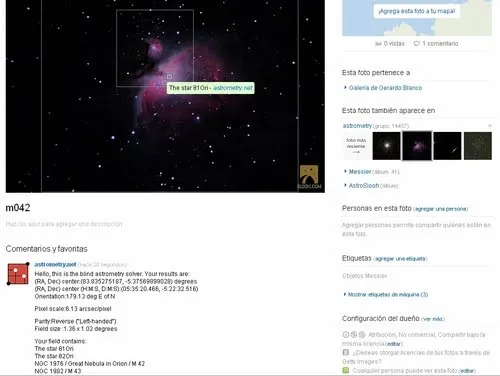
Although it was explained in Tagging the cosmos at the time, currently it is as simple as joining the Astrometry group on Flickr after which we can add images to the group. When doing so, automatically, once an hour, the image is "solved" adding a comment with the object's data to it. It must be an object of the cosmos, of course.
It is also possible to download the Astrometry source code.
Sources and related links
- Searching for comets on the World Wide Web
- Astronomers Calculate Comet's Orbit Using Amateur Images From The Web
- Searching for comets on the World Wide Web: The orbit of 17P/Holmes from the behavior of photographers
Dustin Lang (Princeton), David W. Hogg (NYU)
arXiv:1103.6038v1 [astro-ph.IM] - Found in space
About the images
- Image 1: the trails of the images with the JPL ephemeris (dotted line) and the comet's orbit inferred from the web image samples (solid line).
- Image 2: Top left shows the total pixel density of the images used. The heaviest point is covered by 493 images with a density of 4 million pixels per square degree. On the right, the same image is shown but with the coordinate grid and the JPL trajectory of comet 17P/Holmes.
Below, the images used, with coordinates and JPL ephemeris.