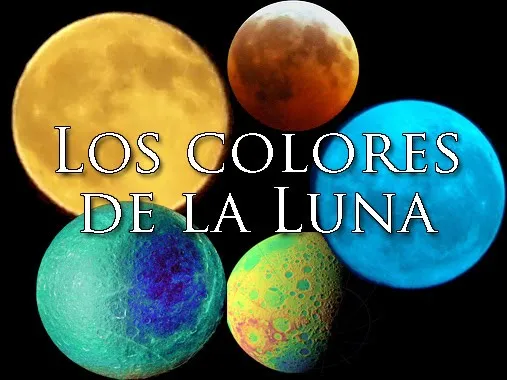
Does the Moon sometimes appear in different colors? What is a blue moon? Does the black moon exist?
We recently witnessed a lunar eclipse and were able to see the phenomenon of the Red Moon. Let's see examples at:
Image by Francis Anderson on Flickr
And we can see more:
http://spaceweather.com/eclipses/gallery_21dec10.htm
Why does the Moon look red during these eclipses? It is the glow of Earth's sunset and sunrise. Both, because in some places the day ends and in others the night ends.
If we were to leave Earth's surface in a spacecraft while a lunar eclipse is happening, and halfway we stop and turn around to see our planet, we would see the atmosphere glowing with a reddish color. That is what we see in Earth's projected shadow on the Moon.
The color tones can vary. For example, if a volcano erupted. On some occasions, volcanic ash in the atmosphere can cause a slightly bluish tone when viewing the moon.
And the blue moon?
Ah, I already answered that. But no. Although what was said before seems true and we can find literature on the subject (Krakatoa 1883), the expression "blue moon" is a phrase with its own history.
Some suppose it comes from the English phrase "Once in a blue moon", whose meaning is related to something that happens very rarely.
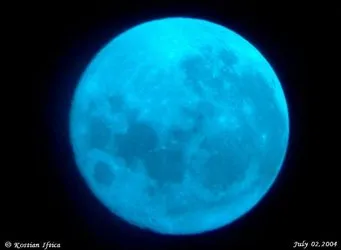
Currently, a Blue Moon is called the second full moon that occurs in the same month. This nickname has been traced back to an article in Sky & Telescope from March 1946 by James Hugh Pruett, an amateur astronomer.
Pruett misinterpreted data from the 1937 almanac of "Maine Farmers' Almanac" and, from there, the popularity of the term won out over its true origin.
The Origin of the Blue Moon
In S&T they have traced more than 40 editions of that almanac from 1819 to 1962 which refer to more than a dozen blue moons, none of which is the second full moon of a month.
There seems to be a connection between Blue Moons and the seasons of the year.
Instead of using the calendar that goes from 1/1 to 12/31, the almanac uses the tropical year, defined as the span from one winter solstice to the next (Yule)
Most tropical years have 12 full moons, three each in winter, spring, summer, and autumn, and each is named for an activity appropriate to the time of year. For example, the harvest moon is the one that occurs after the autumnal equinox.
But occasionally, a tropical year has 13 full moons, so one season has four, instead of three.
Currently we mark the beginning of the seasons when the Sun's celestial longitude passes through 0º, 90º, 180º and 270º. The Sun appears to move along the ecliptic at a variable rate because Earth's orbit is not perfectly circular. But it is possible to use another criterion, like that of the mean dynamical Sun or fictitious Sun: imaginary bodies that move along the ecliptic and the celestial equator respectively at a constant rate and produce seasons of equal length in time. The Maine Farmers' Almanac used that alternative method.
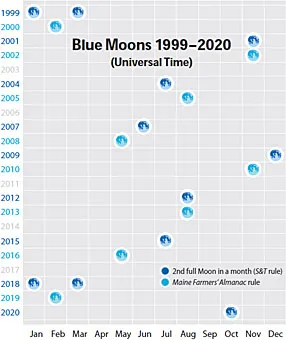
As can be seen, there will not be a second full moon in a month during 2011, but there will be one in August 2012. Credit: Sky&Telescope.
The almanac also followed other rules as part of the 1582 reform of the Gregorian calendar, related to Easter and Lent.
Thus, the names of the full moons in this almanac were set according to these rules: the seasonal moons had names assigned according to ecclesiastical rules for determining Easter and Lent. The beginnings of the seasons were determined by the mean dynamical Sun. When a season contained four full moons, the third was called a Blue Moon.
Why is this third full moon identified as the extra full moon of a season that has four? Because the other full moons had names related to the solstices and equinoxes: The moon before Yule, the moon after Yule.
Then, in a 1943 Sky & Telescope column, this topic was discussed in a column by Laurence J. Lafleur and it was noted that occasionally there are thirteen full moons in a year, without clarifying whether it referred to a tropical year or a calendar year.
Then, that aforementioned 1946 article ended up confusing everything. It's true it was easy to confuse because the Maine Farmers' Almanac was complex.
In summary: nowadays, a Blue Moon is popularly called the second full moon within the same month. However, we already know that the origin of the term was not that, but rather the popular definition we use today is due to a series of confusions.
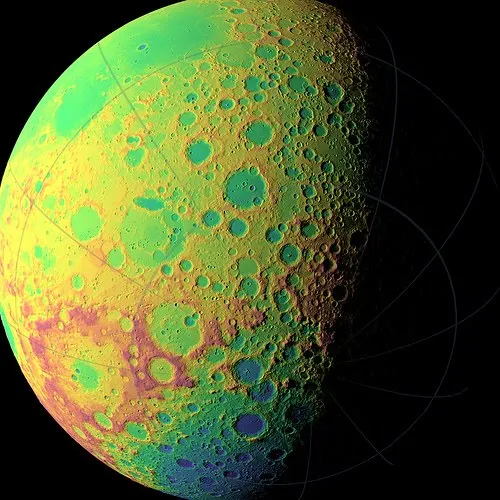
And the black moon?
This term also has several meanings. On one hand, it is possible to find that it is called that for the New Moon phase, that is, when the face of the Moon visible from our planet ceases to be so as it is not illuminated by the Sun.
However, the term Black Moon is not really a synonym, but rather alludes to the period when the Moon is very close to the Sun (apparently, in the sky). To such an extent that it cannot be seen from here.
The use of the term is also found in reference to a second new moon in the same month, analogous to the Blue Moon.
Another use is related to the absence of a new moon in a month (normally in February, because it has fewer days than the rest of the months, is when this can happen most. Therefore, if it occurs, in January and March of the same year there will be two new moons). See lunar phases for February 2014 southern hemisphere.
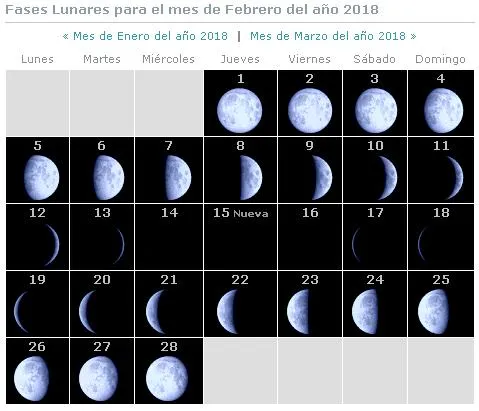
This is also called, in another sense, the absence of a full moon in a month. Again in February and with two full moons in January and March. (See 2018. Also look at January and March)
Yellow moon, orange moon
I have also been able to see yellow/orange full moons, when the Moon rises on the horizon shortly after the Sun has set.
This phenomenon is similar to why the sky is blue during the day and turns orange at sunset. It is an optical phenomenon produced by the interaction of the sun's rays with particles in Earth's atmosphere.
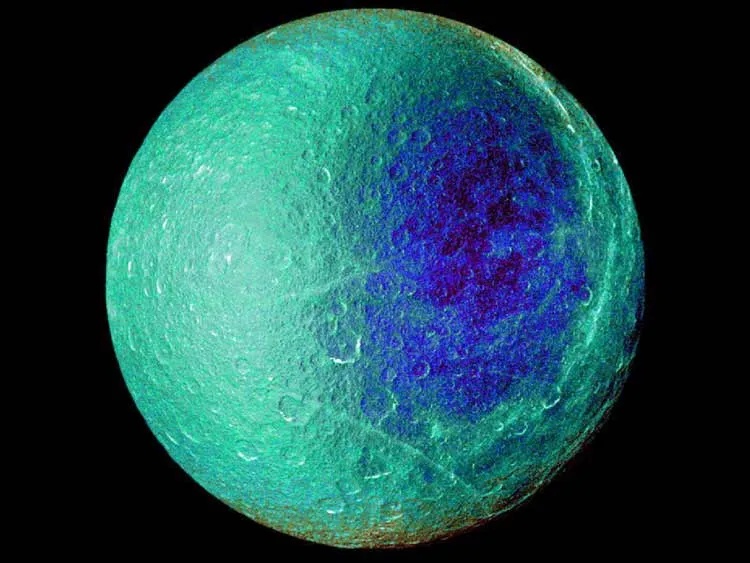
Moons of other colors
Perhaps we have exhausted the possible colors of our moon, but surely not those of the natural satellites of other planets.
The Moon these days
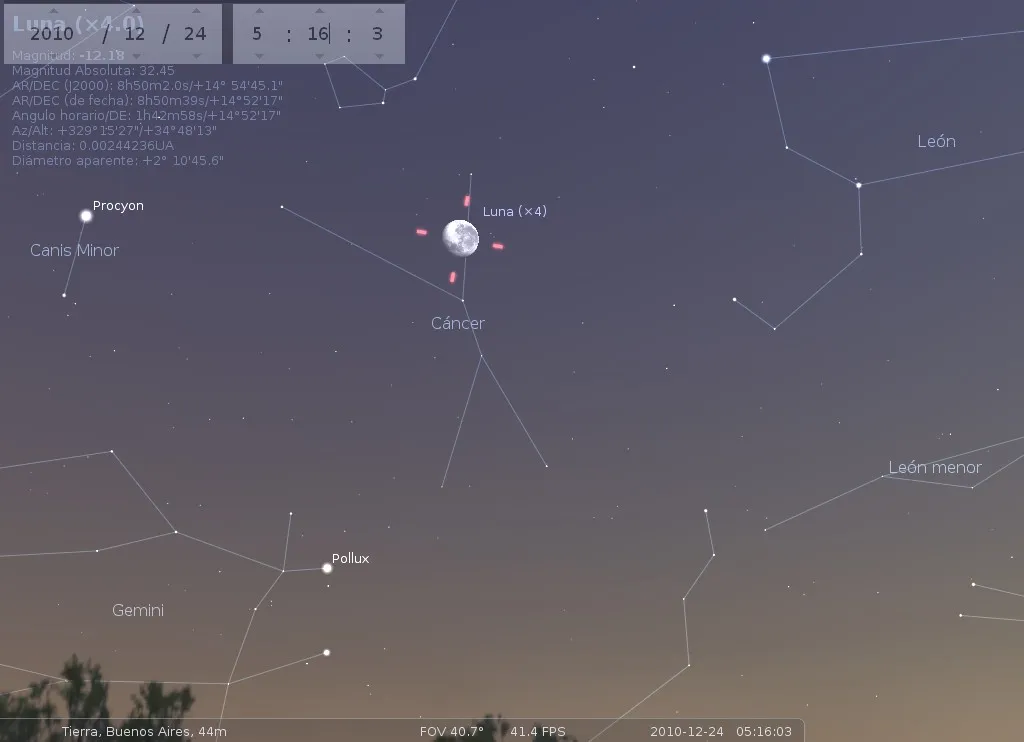
We have a Full Moon these days. On 12/25 the natural satellite will be at Perigee, on 1/4 it will be in solar conjunction and we will have a new moon. (For that date Uranus and Jupiter will be very close, closer than they already are.)
Sources and related links
- The October Lunar Eclipse
- A "Blue Moon" on New Year's Eve
- Farmers Almanac
- What's a Blue Moon?
- Once In A Blue Moon
About the images
- Blue Moon by Kostian Iftica at Science@NASA
- Yellow moon by Jo Naylor
- Moon image with NASA's LRO