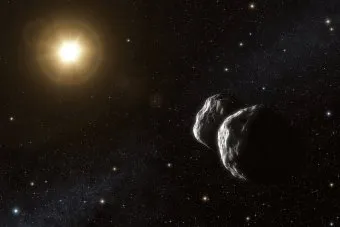
Asteroid 2002 VE68 orbits the Sun in the same time as Venus. But is it an asteroid or are there two? The history of astronomy has another story to tell about it.
Which planets in the Solar System have no natural satellites? Mercury and Venus, we answer with absolute confidence.
But the evening star has a particular companion. 2002 VE68 is an asteroid classified as potentially hazardous by the Minor Planet Center.
It is thought to have arrived at the place it currently occupies, 7,000 years ago, after a close encounter with our world. Currently it orbits the Sun in such a way that when it is closest to the star it lies within Mercury's orbit, and when it is farthest it reaches Earth's.
Its "kinship" with Venus is the result of having a 1:1 orbital resonance with that planet. An orbital resonance is when two orbiting objects exert a regular, periodic gravitational influence on each other, due to orbital periods related by the ratio of two numbers. For example, Pluto and Neptune have a 2:3 resonance, meaning that for every two times Pluto orbits the Sun, Neptune makes three trips.
In the case of VE68 and Venus, they take the same time to go around the Sun, which is why their resonance is one to one. That is why the asteroid is considered a "quasi-satellite" of Venus. Let's keep in mind that, in reality, a satellite orbits a planet, while VE68 orbits the Sun.
We can see the dance of these two objects around the Sun with the JPL applet:
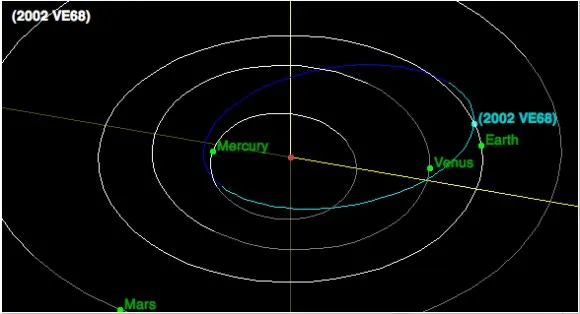
Sometimes these resonances result in an unstable interaction in which the bodies exchange momentum and the orbits vary until the resonance ceases to exist. VE68, according to the astronomers' calculations, will cease to be a "quasi-satellite" in about 500 years.
But this has been known since 2002 (hence the asteroid's name). What's new?
A few days ago, three astronomers led by M. Hicks of JPL/Caltech published measurements of the asteroid also known as MPEC 2002-V52.
The recent close approach of the object to our world allowed photometry of the aforementioned to be made between the nights of November 10 and 13 from the 0.6-meter JPL Table Mountain telescope.
What they found was:
From the color data, they determined that VE68 is an X-type asteroid. This is a group of asteroids with a very similar spectrum that could potentially have a variety of compositions.
The classification would allow it to be subclassified as type M, E, or P.
It had already been considered an NEA (Near-Earth Asteroid) of the Aten or Atón category after its prototype (2062) Aten. Asteroids whose orbit has a semi-major axis smaller than Earth's (1 AU) are classified this way. VE68 has a semi-major axis of 0.723 AU.
They were also able to determine its approximate size, at 200 meters in diameter, based on its absolute magnitude, and determined that it rotates every 13.5 hours. The amplitude of the light curve fluctuation could imply that it is actually a contact binary object, that is, two pieces of material orbiting a center of mass while in contact with each other.
The other moon of Venus: Neith
The title of this post is plural, but so far we have talked about one object (actually perhaps two, joined). The other relevant story goes back several centuries.
There were not a few who between the 17th and 19th centuries believed they had found a satellite of Venus.
Giovanni Cassini in 1672 and then in 1686. James Short in 1740, Joseph Lagrange in 1761.
In 1777 Johann Heinrich Lambert published his calculations of the supposed satellite of Venus.
Lambert proposed that the satellite be called Alembert after Jean le Rond D'Alembert, but the latter declined the offer because he was unable to calculate the orbit and therefore assumed the object was not real.
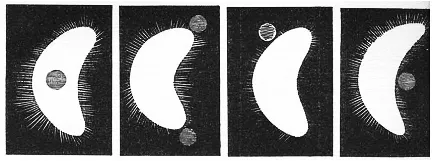
It was named Neith in the 19th century following the suggestion of M. Hozeau, former director of the Royal Observatory of Brussels. The name comes from an Egyptian goddess, Neit, Athena to the Greeks.
In 1887 the Belgian Academy of Sciences refutes the existence of such an object by pointing out that the records are of stars close (optically) to the planet in question.
In both cases we are seeing the scientific method in action. Its conclusions are not absolute because humans make mistakes, because we use induction to reason, and because the causal relationships believed to be found in Nature are often apparent.
Although sometimes it falls into a certain rigidity, science is not dogmatic. If it were, it would not change to adapt its conclusions to observed reality.
That Venus has no natural satellites (until the 17th century), that it does have one (17th-19th centuries), that it does not have one (19th-20th centuries), but hey, that it does have a "quasi-satellite" (21st century).
Statements that would seem contradictory, if it weren't for the fact that there is a story (or two) to tell. Narratives of trial and error, of the games of appearance and reality, thanks to which our understanding of the cosmos grows every day.
Sources and related links
- Asteroid 2002 VE68, a quasi-satellite of Venus
Mikkola, S.; Brasser, R.; Wiegert, P.; Innanen, K.
2004MNRAS.351L..63M - Broadband photometry of 2002 VE68, a quasi-moon of Venus
- Venus Has a Moon?
- D'Alembert
- Hypothetical Planets
- Neith: Wikipedia
About the images
- Illustration by F. Fontana: Wikipedia.
- Image of Venus: JPL