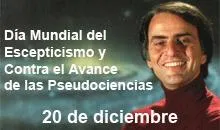
Just as we did last year, at the initiative of Proyecto Sandía, we celebrate skepticism day on the anniversary of the death of astronomer Carl Sagan.
We have spoken here on previous occasions about the logic of skepticism and the value of it.
We pointed out there that often being skeptical implies being considered a "spoilsport". Perhaps we are a bit, but that is not the goal. At least not as a "quest to be unhappy or pessimistic". Skeptics try, like everyone, to be happy.
But it turns out there are several paths. Among them, the possibility of "believing" something nice, blinding oneself to analyzing, listening to other ideas, in short, thinking whether that something is true, whether it is possibly true, or whether it is false.
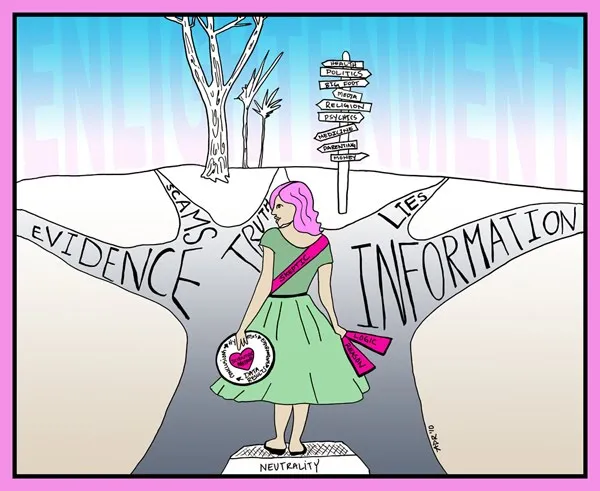
For me, personally, what bothers me the most is the inappropriate use of arguments. There are those who hold beliefs different from mine. That in itself is not bad at all. We all have different ideas. The problem is how we uphold them.
It is perfectly possible, from my point of view, to say for example "I believe it is possible that God exists. I cannot prove that He exists, but I believe it is a possibility and I would like to think that is the case".
Thinking this way does not imply, then, "knowing" that God exists. If we do not know whether something is true or false, because we do not have the means to do so, we will say "I don't know". Immediately afterwards, however, we can do something more. A statement can be either true or false. There, based on very subjective clues, experiences and personal values, we may tend to think that one of those two options is more possible.
Someone says: "I washed the car". I don't know if it's true or a lie. I could check, of course, but in the meantime, I can tell myself: this guy lies a lot. It's possible he is lying to me now.
Of course, that possibility will be true or not. For me, up to this point there is no problem, but it arises when what we believe we uphold with fallacious arguments.
Let me tell a particular case:
A while ago, an aunt sends me an attachment by email, with the title The Beauty of Numbers. The PPT presentation begins by pointing out symmetrical beauty with several examples, among them:
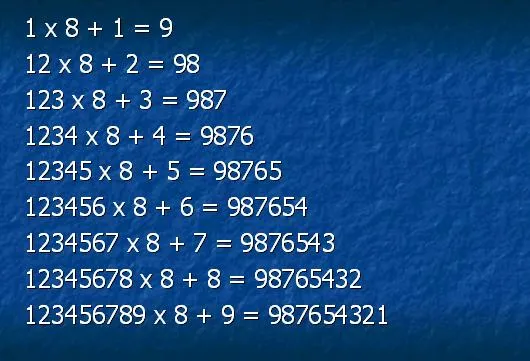
Then it asks things like:
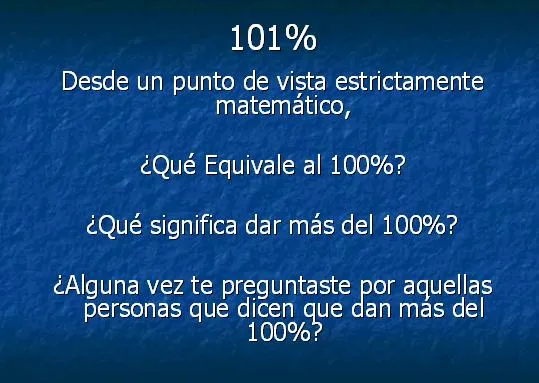
Immediately afterwards it indicates that if each letter corresponds to a number (numerology), then:
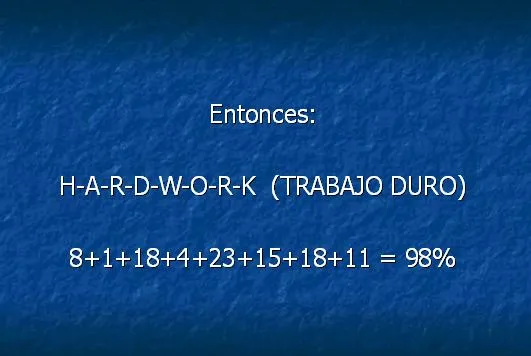
and:
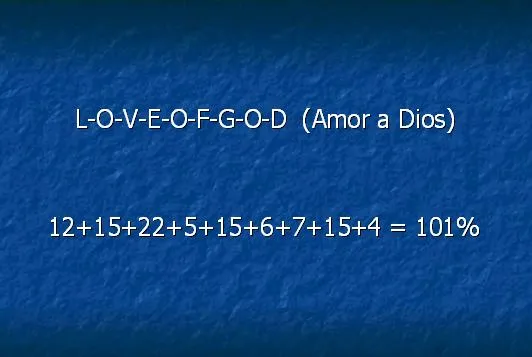
Conclusion!:
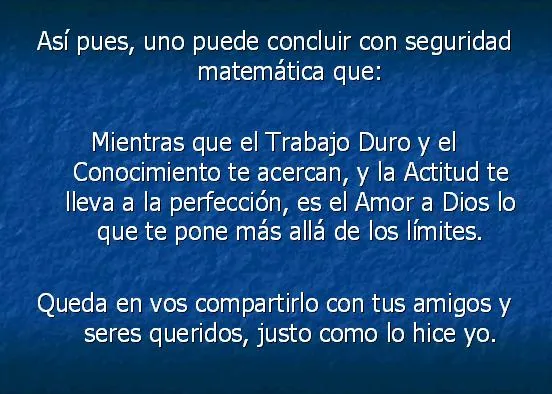
As you will see, you don't need to know much math to realize it's nonsense. Such a percentage of what?
On the other hand, if I followed the same reasoning:
K-N-O-W-L-E-D-G-E-S (Knowledge)
11+14+15+23+12+5+4+7+5+19 = 115!!
When I received that email I couldn't help but explain to her that it was nonsense, that it made no sense, that she was using math badly to try to prove something she believed in, when it wasn't necessary.
In any case, even if I don't share her ideas, it is completely tolerable and respectable for a person to say: "I want to believe in such a thing because it makes me happy and I want to share it with you".
I could say a few things about that. Not necessarily what does good, is good, as I unfortunately heard said on a television program this weekend. More unfortunate because it was a science program!
But if someone wants to think and express themselves that way, go ahead. I will not agree and that's it.
But between that and using an argument to try to prove something with a lie there is a distance.
Using critical thinking implies analyzing reality, weighing clues, using our logic. It does not mean we must all think the same. Being skeptical, today more than ever, implies being tolerant.
Phil Plait, the famous astronomer-blogger, in a conference a little while ago, emphasized this because the form makes the content. If we are intolerant in our message to others, our ideas will never get through.
On the other hand, a person using fallacious arguments does not necessarily mean they are wrong.
Skeptics know that the senses deceive us and we are cautious, we try to separate the apparent from the real. But we are also human beings. We also fall in love and become disillusioned, love our pets, our family, have children, celebrate birthdays. We have desires and even intuitions.
On this Skepticism Day 2010, I would like to remember Sagan as one of those who (along with Asimov and some professors I have had) "unchained" me, as in the allegory of the cave.
And leave these two messages: Let's correct the errors in others' arguments to separate the real from the apparent, yes, but with great care in the forms, with the utmost respect and without discrediting all others' ideas.
If someone says that the cube root of 27 is 3 because 3+3+3=27, it implies the result is correct, but the reasoning is not. Let us know how to distinguish between the two things.
I don't know, aunt, if God exists or not. I think probably not, but it's debatable, of course. That said, the 101% thing is nonsense.
Sources and related links
About the images
- Initial image from: Skepchick.org