An autocatalytic chemical reaction could replicate the physics of Type IA supernova events, according to an experiment and a simulation.
A supernova is an event that occurs in some stars at the end of their lives. Some of these events occur in white dwarfs.
A team of physicists mimicked this type of supernova explosion in miniature.
"We have created a smaller version of this process by triggering a special chemical reaction in a closed container that generates similar plumes and vortex rings," said Stephen Morris, a physics professor at the University of Toronto.
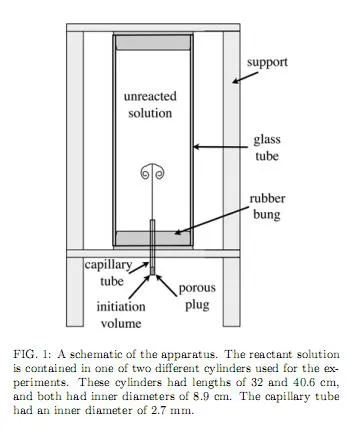
Autocatalytic chemical reactions release heat and change the composition of the solution, which can create buoyancy forces that stir the liquid, leading to further reaction. "A supernova is a dramatic example of this type of self-sustaining explosion where gravity and buoyancy are important effects. We wanted to see what the liquid motion would look like in such a reaction," commented Michael Rogers, the experiment's leader.
"It is extremely difficult to observe the inside of a real exploding star light-years away, so this experiment is an important window into the complex fluid motions that accompany those events," explained Morris.
In their recent publication, the researchers begin by talking about plumes.
The term plume is used to describe the presence of a distinct, localized mass within a fluid (gas or liquid), of lower density than its surroundings. Therefore, a plume tends to rise.
These plumes can be stable or not and often form vortex rings that at some point can detach (Pinch-off).
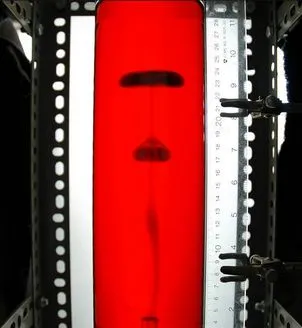
These vortex rings can be created by the separation of the "head" of plumes in an autocatalytic chemical reaction. In a container, such a reaction creates a kind of reactive plume that can be interpreted as the "bubbles" generated by Type IA supernovae, with the difference that they can be studied in the laboratory.
The work describes both an experimental and a numerical investigation of the behavior of these autocatalytic plumes produced by a propagating front of an iodate-arsenous acid (IAA) reaction.
It involves injecting an amount of acid into glycerol to trigger a self-sustaining reaction.
Unlike smoke rings produced by a cigarette, which slow down as they rise and mix with cold air, IAA rings become faster and harder to study. Therefore, viscosity was increased by adding an agent, glycerol, to slow down the process enough.
The vortex ring took between 4 and 10 minutes to form and rise 40 centimeters. This could be similar to the vortices formed in a white dwarf as it begins to explode, growing larger and more powerful over time.
But it's not the same. "First and foremost, there is nothing 'nuclear' about our reaction," noted Morris. However, the phenomenon can be considered analogous.
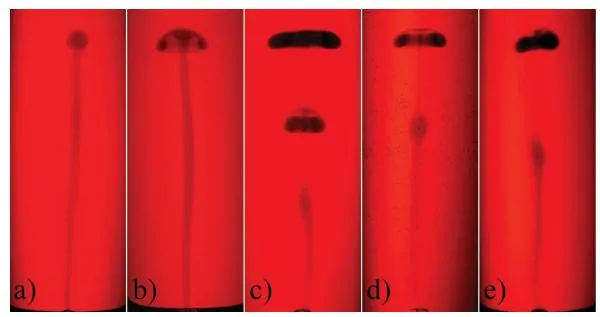
Among the conclusions the researchers draw from both the experiment and the numerical simulation performed on the subject, they note that in the more viscous solutions, plume separation (pinch-off) was rarely observed, while in the less viscous solutions it was not observed. But in the mid-range concentrations, that pinch-off occurred multiple times from a single initial event.
The morphology of the plume heads was quantified in terms of their radius of curvature and their diameter/height ratio. They find that this ratio evolved over time very differently from non-reactive plumes.
Video: Chemical reaction driven plume: a "supernova" in a jar
http://www.youtube.com/watch?v=fLOChJdAteA
Note written for the XIV Carnival of Physics, in this edition hosted by Las historias Eulerianas. To join and read the entries, there is a social network on Ning.
Sources and related links
- Physicists Create A Supernova In A Jar
- "Supernova in a Jar" Offers Peek Inside Star Death
- Autocatalytic plume pinch-off
Michael C. Rogers, Abdel Zebib, Stephen W. Morris
arXiv:1010.0283v2 [physics.flu-dyn]
Phys. Rev. E 82, 066307 (2010) [9 pages]
DOI:10.1103/PhysRevE.82.066307
http://www.physics.utoronto.ca/nonlinear/abstracts/RM10abstract.html - Physics - Fluid Statics
About the images
- The images belong to Michael Rogers et al.