The year 2011 was proclaimed the International Year of Chemistry by the United Nations. What is the "periodic table of astronomy" like?
Thanks to the work of Fred Hoyle, Hans Bethe, and others, we know how the production of elements occurred in what is known as nucleosynthesis.
Primordial nucleosynthesis, during the first minutes after the Big Bang, produced the basic elements: hydrogen nuclei (75%) and helium nuclei (25%) and free electrons that would combine into atoms only hundreds of thousands of years later.
It is these lighter elements that formed the primordial stars a little over 13,000 million years ago.
Heavier elements were forged by stars of successive generations through nuclear fusion. These heavier elements (carbon, neon, oxygen, silicon) are distributed in the universe by planetary nebulae and the solar wind.
Even heavier elements are forged in supernova events (argon, calcium, nickel, iron).
Enriched gas can be stripped from a galaxy if it falls into a cluster. The pressure of the hot gas that bathes a galaxy cluster causes the gas from the infalling galaxy to enrich the interstellar medium, as is the case with ESO 137-001.
Oxygen was detected in intergalactic filaments millions of light-years long. It was surely produced more than ten thousand million years ago, in some of the first supernovae. An example is H 2356-309, a vast reservoir of gas in a wall-shaped galaxy structure 400 million light-years from Earth called the Sculptor Wall.
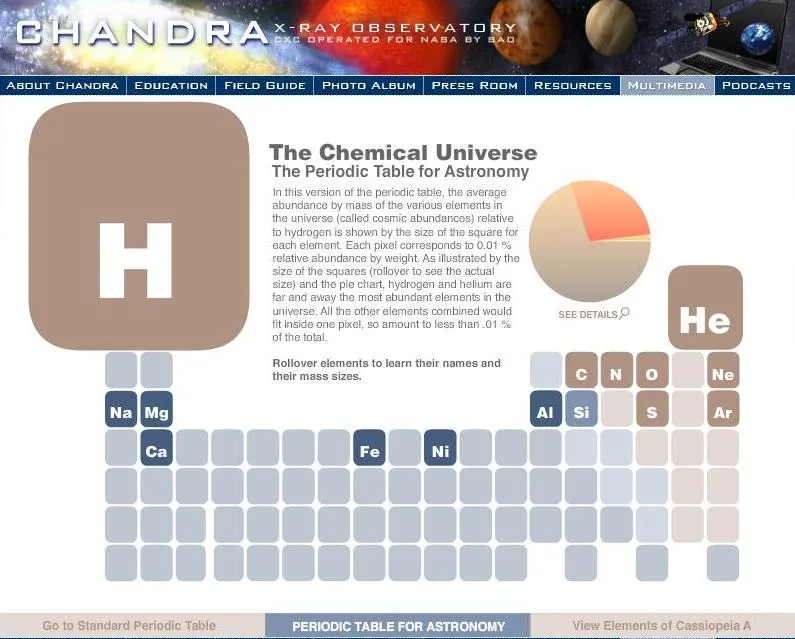
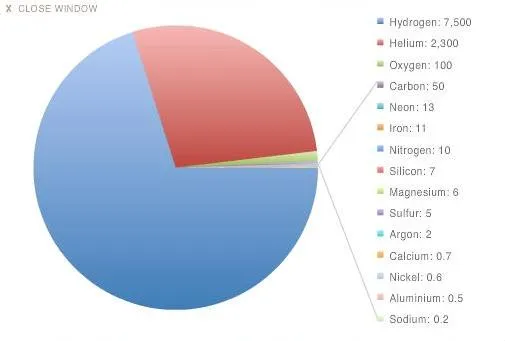
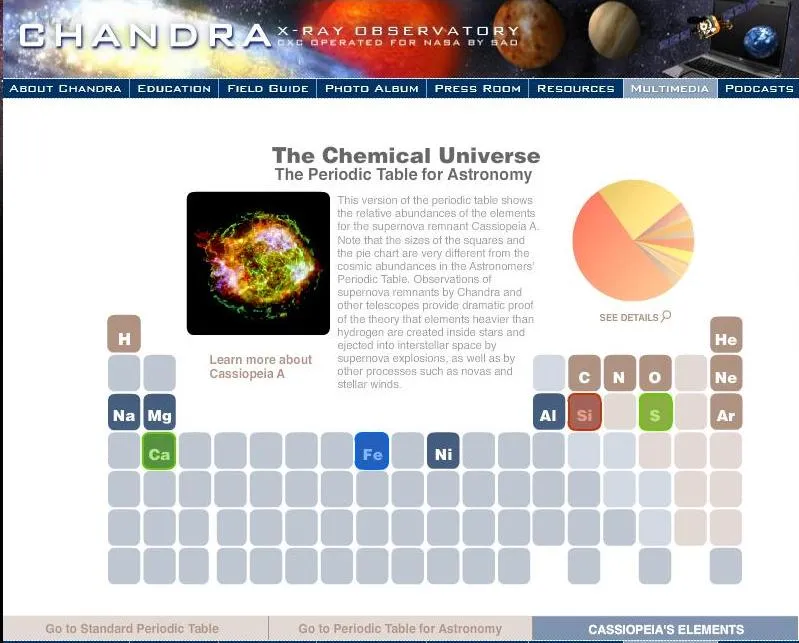
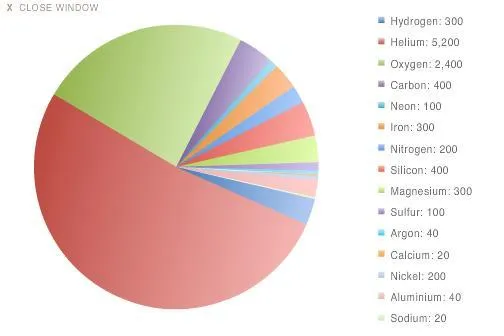
The Chandra X-ray Observatory has an interactive flash that shows the complete periodic table, the "astronomical" periodic table, and the elements in the Cassiopeia A supernova remnant.
The second table is a version with the relative abundance by mass of the various elements in the universe.
A new periodic table
A few weeks ago, a possible change to ten elements of the periodic table became known. "For more than a century and a half, many of us learned to use the standard atomic weights—a single value—found in chemistry textbooks and on the periodic table of the elements. As technology improved, we discovered that the numbers on those charts were not as static as we had believed," said Dr. Michael Wieser of the University of Calgary.
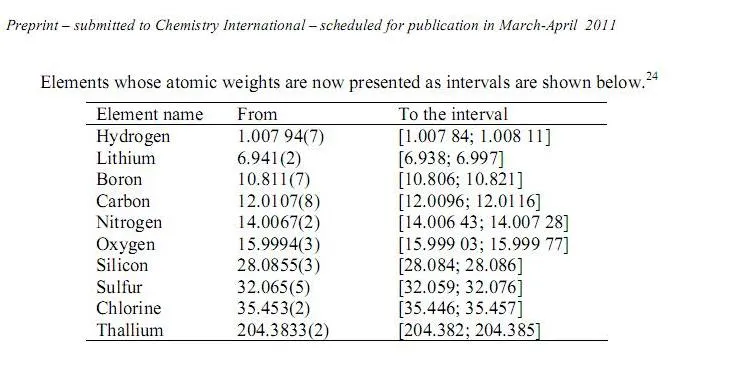
Modern techniques can measure atomic weight in many precise ways, and small variations in atomic weight are important in research and industry. That is why the atomic weight of ten elements will now be expressed as intervals, according to what was published in Pure and Applied Chemistry and in Chemistry International.
In the article Atomic Weights—No Longer Constants of Nature, by Tyler B. Coplen and Norman E. Holden, in CI, it is noted that the variation in the atomic weights of these ten elements will be an interval [a;b], where a and b are the lower and upper limits, respectively. The atomic weight should not be expressed as the average of both values. The difference (b-a) is the range.
Playing at nucleogenesis
Nucleogenesis!, by Judith Herzfeld, is a game with natural rules designed to familiarize students with nuclear reactions and the general "geography" of the table of nuclear isotopes.
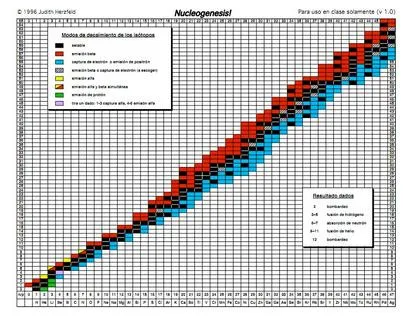
Nucleogenesis! gives students extensive practice in manipulating nuclear reactions because the game's mechanics require players to repeatedly calculate the outcome of nuclear reactions, such as alpha and beta decays, and fusions of nuclei with protons, neutrons, or alpha particles. The board itself consists of a truncated table of nuclear isotopes. During the game, students will become familiar with the location of the "valley of stability" and the characteristic decay modes on either side of it. A more complete discussion of this game is found in the Journal of Chemical Education 76, 349-352 (1999) DOI: 10.1021/ed076p349.
Note written for the XV Carnival of Physics, in this edition hosted by Curiosidades de la Microbiología. To join and read the entries, there is a social network on Ning.
Sources and related links
- Chandra, Cosmos and Chemistry, by Wallace Tucker
- Changes to the Periodic table
- Compilation of Minimum and Maximum Isotope Ratios of Selected Elements in Naturally Occurring Terrestrial Materials and Reagents
- Atomic Weights—No Longer Constants of Nature
Tyler B. Coplen and Norman E. Holden
Vol. 32 No. 2, March-April 2011, Chemistry International
About the images
- Images from the Chandra Observatory.
- Image, for illustrative purposes only, of Nucleogenesis, by Judith Herzfeld.