CANFAR is a project whose goal is to create a network platform to support astronomical research, using the best of Grid infrastructure and the cloud.
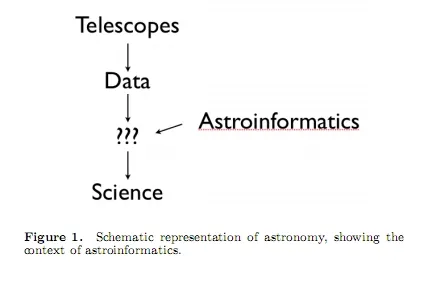
Nicholas Ball and David Schade (from the Herzberg Institute of Astrophysics, Victoria, BC) wrote a white paper on "Astroinformatics in Canada" in which they define astroinformatics as an emerging field due to the flood of data from new instruments. Astroinformatics includes data organization, classification, data mining, visualization and statistics.
The quantity and complexity of data being obtained in astronomy is becoming intractable without a significant component of automation. For this, powerful algorithms are required, many of which already exist in data mining, statistics and computational astronomy, but we are going ever further in the automation of analysis processes and the discovery of knowledge in databases, that is, data mining, neural networks, decision trees, etc.
I don't think I exaggerate in saying that any astronomer/astrophysicist of the future (of the present, I would say already) will necessarily need to have specialized knowledge in these techniques. Astrophysicists currently have programming knowledge (IDL and other languages), but it gives the feeling that the exploration of non-trivial data through global databases will be an increasingly common task every day, especially in those countries that do not have large instruments. However, infrastructure is also needed for this.
One of the examples given in the paper about existing applications that use astroinformatics methods is the reprocessing of MACHOs, an acronym for Massive Astrophysical Compact Halo Object. Data from these objects are being reprocessed in CANFAR to provide a significant improvement in photometry. This will allow the comparison of light curves for long-period variables with radiative transfer models to improve the constraints on models describing stellar atmospheres. This involves the ingestion of 7.6 terabytes of data, processing and production of catalogs. The total processing time is estimated at 13,444 days (36.8 years). It would be impossible on traditional computers, but with hundreds of them at the University of Victoria, the task can be completed in a few days.
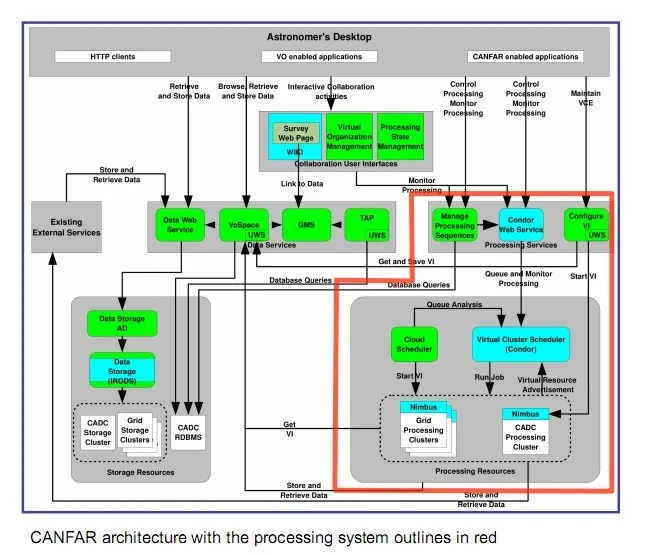
CANFAR is the Canadian Advanced Network for Astronomical Research which, together with CANARIE (a national research network of that country) have the project of creating a cloud-based platform to support astronomy. The effort is led by the University of Victoria in British Columbia together with the Canadian Astronomy Data Centre (CADC) and the participation of 11 other universities in that country.
The CANFAR team says that a schematic view of contemporary astronomical research shows that the system is a global network of infrastructure, with scientists and telescopes as I/O (input and output) devices.
A poster describes the project as "an operational system for the delivery, processing, storage, analysis and distribution of large astronomical datasets" that includes several Canadian organizations to create a "unified data storage and processing system".
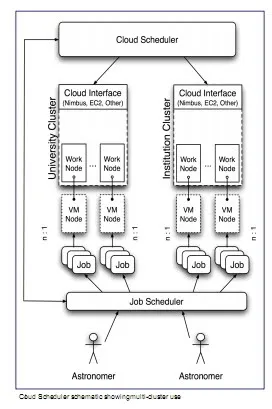
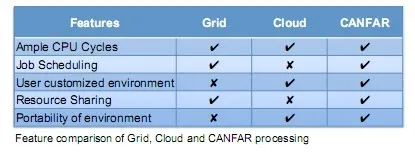
It is also noted that it has "the best combined features of the grid and cloud models by providing self-configuring clusters deployed across multiple cloud clusters.
The poster points out limitations in the services of grid and cloud infrastructures and to account for that CANFAR is a hybrid system that makes use of job scheduling while abstracting grid processing resources as a cloud.
Sources and related links
- Astroinformatics in Canada
Nicholas M. Ball, David Schade
LRP 2010 White Paper
from LRP 2010 white papers (Nick Ball, Astroinformatics) - HPC in the cloud: Canada Explores New Frontiers in Astroinformatics, by Nicole Hemsoth.
- Virtualisation and Grid Utilisation within the CANFAR Project
Gaudet, Séverin, in ADASS 2010 Presentations (Poster 077)
About the images
- "Astroinformatics" diagram. Credit: Nicholas Ball and David Schade.
- CANFAR Architecture, Comparison and Scheduler Diagram from Presentation by Séverin Gaudet