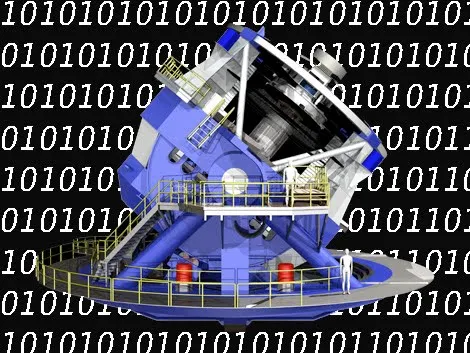
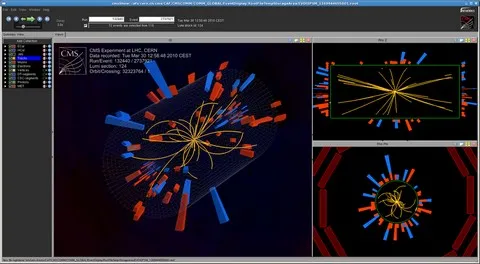
Not only does the expansion of the universe seem to be accelerating. In the last four centuries, discoveries in astronomy also seem to be increasingly rapid. Will findings continue to be produced at an increasing rate? Is there a limit to the progress of astronomy?
At the XXVII General Assembly of the IAU (the International Astronomical Union) held last year in Rio (August 3-14, 2009) there was a special session (11th to 14th) on the topic of the "Acceleration of the rate of astronomical discovery".
From the Special Session 5 website it is possible to access the Proceedings of the meeting. In those documents, hosted on Proceedings of Science, Ray Norris (an astronomer from CSIRO, Australia) we can learn the opinion of some experts on current and future astronomy.
It is not about making predictions, but about evaluating the present (in relation to the past) and perhaps projecting the future.
Ray P. Norris (astronomer at CSIRO, Australia) reviews the presentations in an introductory document with the same name as the session. He notes there that the meeting was born from a conference in Lithuania between him and Clive Ruggles, from which the topic emerged. In what was the International Year of Astronomy 2009, it seemed a good occasion to rethink the rate of astronomical discoveries that seems to have accelerated in the last four centuries. Are there limits to progress? What lessons should we learn from the past?
Here I will summarize the views of some of the presenters.
Innovation and team
In the first session, "Back to the Future," science historian David DeVorkin introduced a historical perspective by examining what worked and what didn't and how knowledge about some topics in astronomy "evolved."
His view is that a robust science must employ proven technologies for routine work, but innovation is also needed and that means taking risks.
And he emphasizes multi-disciplinary enterprise, fundamentally with physics.
Data and archives (the legacy)
Elizabeth Griffin, from the Herzberg Institute of Astrophysics, raises a very interesting topic. As is known, there is a gender issue in astronomy as in other disciplines. In this science, that led in the past to women being assigned "minor tasks," such as classifying and archiving the photographic plates obtained from telescopes.
And she says that this stigma, basically about women, passed on to the archives. Archives are a "minor thing," to the point that she recounts that a researcher was talking about a new instrument and she asked if there was adequate data support. To which the researcher responded, as a reflex, that if he had to choose between a new instrument and a data archive, of course he had to choose the first."
Today the data obtained from telescopes is digital and its handling is much better regarded. However, she brings up the topic of the legacy of photographic observations. According to her, there are about 3 million plates archived around the world that are slowly being digitized.
We talked about that a while ago: Searching in the archives of the universe
The flood of data
Other presentations go in the direction of the new paradigm of modern astronomy. Vast amounts of data and metadata stored in huge databases and Virtual Observatory tools allow cross-referencing data to obtain information that may ultimately be a discovery or, at least, be used as a working hypothesis.
Software, metadata: standards are sought
Three scientists from the Harvard-Smithsonian Center for Astrophysics talk about the ADS system (Astrophysics Data System) from NASA as an example of what should continue to happen. The system allows searching for data and metadata, for example it is possible to search for papers on X-ray emission in Abell clusters and filter according to some criterion, for example, papers that have links to data. But the researchers believe this integration lacks semantic and contextual information.
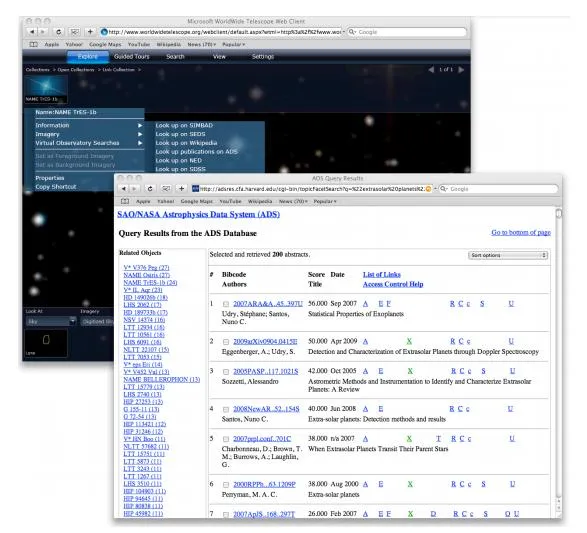
Ultimately they say that in the intense era of scientific data it is increasingly important for researchers to be able to move easily between scientific results, the data used to publish them, and the processes used to generate them.
Some ideas on this have already been expressed, in various ways, which we commented on here in due time:
Scientific articles 2.0
Science 2.0
Access
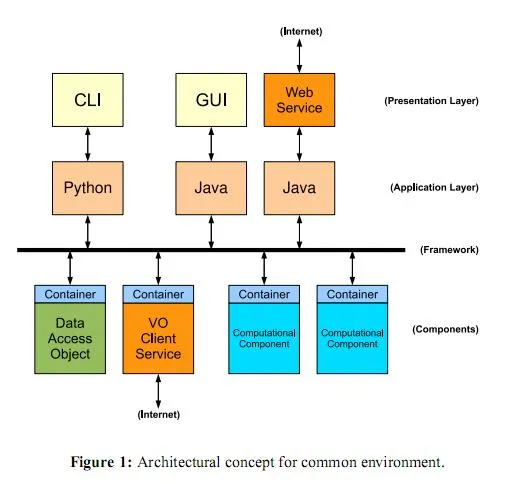
Other researchers point out the need for data to be more quickly and efficiently handled for access and sharing. How to efficiently convert "raw" data into relevant astronomical information. They propose a conceptual architecture for a future software environment in astronomy.
Preben Grosbøl (ESO) and Douglas Tody (NRAO) point out the concepts about an architecture for an environment arising from the OPTICON network (Optical Infrared Coordination Network for Astronomy) which includes a working group on Future Astronomical Software Environments (FASE). (1)
Technological limits
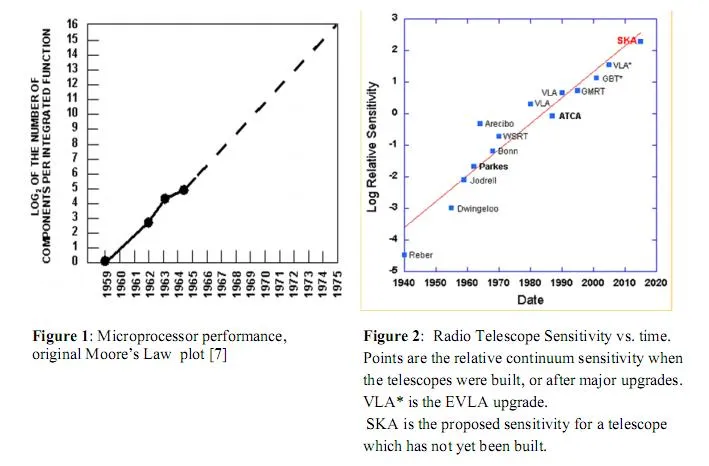
R. D. Ekers (from CSIRO) talks about exponential growth in science. It seems well established that scientific advances follow a technical innovation in other areas. Exponential growth is seen in particle accelerators or the famous Moore's Law for transistors, but also for telescopes and radio telescopes.
Can exponential growth be maintained?
Here the researcher makes a distinction between "Small science" and "Big science" in the terms of D. J. de Solla Price (2): from institutional science, to national organizations, to international ones.
He tries to demonstrate the importance of "Big Science" with this graph (among other arguments):
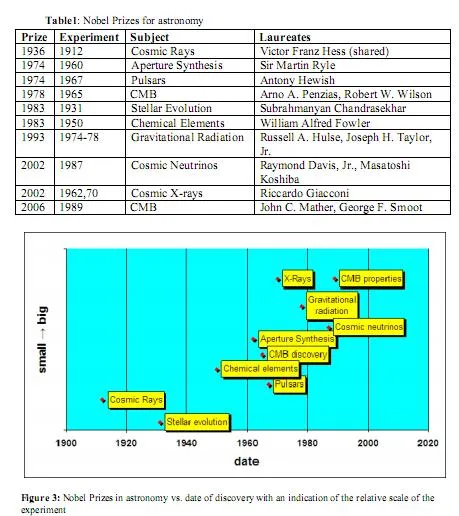
This shows that, as time passes, there is a growth in instruments, although "small science" should not be discarded at all. On the other hand, many discoveries occur by "Serendipity".
The following figure shows key discoveries in radio astronomy from 1930 to 1990 against time, comparing discoveries made with special-purpose instruments against those made with more general-purpose facilities. It seems that the number of discoveries made with special-purpose instruments has declined over time.
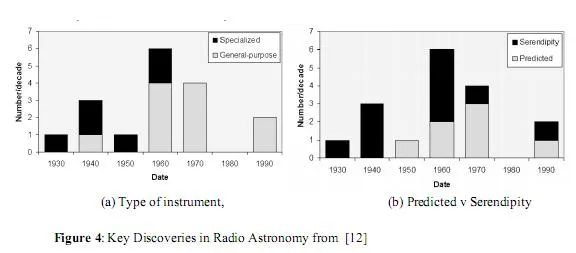
A graph is also shown with "serendipitous" discoveries that seem to prevail over predicted ones. (3)
Another example of "serendipity" is given by Jocely Bell Burnell in her "Reflections on the discovery of pulsars."
Astronomy and society
Discoveries are not made with telescopes and facilities alone. Human capital is indispensable. But does the professional career of a modern astronomer encourage exploration, innovation, teamwork?
George Miley (from Leiden University) talks about society's influence on astronomical discoveries and asks the above.
The professional career
He does so in reference to the researchers' need to publish or perish, but goes further. He says that many great scientific advances were made by "nonconformists."
If earlier we spoke of innovation and risk-taking as characteristics that could encourage the generation of research and findings, the current quantitative view of scientific work may be creating less risky, more conformist professionals.
It seems that for a researcher who, for example, is not satisfied with the current view of cosmology, or wants to investigate any other topic on which there is a "consensus view" from a different perspective, it may be difficult to obtain encouragement (academic, institutional, economic). Their prestige, which currently seems based on the quantity of papers, could crumble, not only for investigating "weird" topics, but because perhaps they cannot produce articles as frequently as another colleague.
Another aspect related to society and the professional astronomical community is obtaining funds, for which researchers have to convince political authorities that their work is valuable. This, at the same time, reaches the rest of society, because in many cases, that money comes from the public treasury, to which we all contribute.
For "small" things, in relation to economic cost, this may not be an issue. But if the astronomical community of a country thinks that to progress in its area it is necessary to build a large telescope, a large amount of money will start to be discussed.
Political authorities and ordinary citizens then ask:
Why is it necessary to do research in astronomy?
The question can have many nested sub-questions: Why not use those funds for "useful things"? Why not try to solve "real" problems of society?
It is not an unimportant question and its answer may require deeper reflection than I can give in these lines.
What "use" does art have? Does anyone care if Mozart's music does not "solve a real problem"?
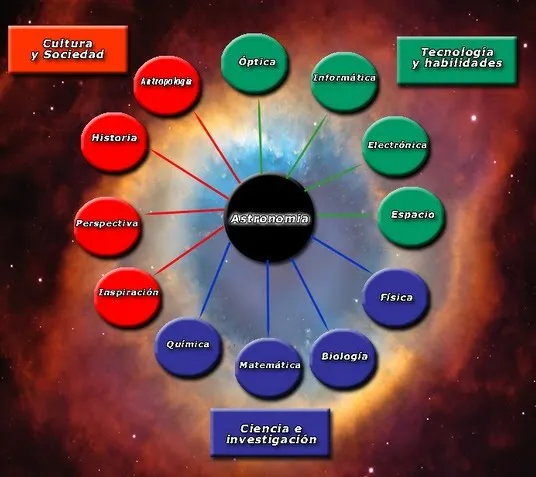
Astronomy is useful, it has been a driving science for technological advances. It is history and heritage. It is an excellent tool for encouraging science learning and a way to foster critical thinking.
Conclusion
Why do discoveries occur? There are many ideas and no definitive answer. Technological possibilities, teamwork, financial support are certainly variables to consider. However, creativity, daring are not budgetable.
Education and, to some extent, scientific outreach, also have their weight in the training of human resources and in public opinion.
Nowadays, not only because it can be useful, but because there are means available, a more efficient use of data in astronomy is considered, in the manipulation of data obtained by instruments to obtain valuable information quickly. Standards seem insufficient, although developments related to virtual observatories already give an indication.
And the data must come from instruments that are more sensitive, larger every day, and made in collaboration with other countries and the contribution of other disciplines.
Analysis also requires grouped and interdisciplinary work and the use of technological resources such as computational simulations on large clusters. And the publication of research claims its place in the use of new media.
If all these factors (and surely others not mentioned here) are taken into account, within a historical, local and global context, astronomy will be able to continue advancing rapidly. But, even if one tries to create a "perfect recipe" with these ingredients, the seasoning of creativity and serendipity is indecipherable.
Nature will never cease to surprise us. I am one of those who think the universe is an infinite set of Russian nesting dolls, that it will always have something more to amaze us. We know a tenth of one percent of nothing.
However, there will be nothing new under the Sun, if there is no spirit to go out and probe the unknown, to lift stones to see what's underneath, or to look up to see what's out there.
The new astronomy in Argentina
In our country there are some initiatives related to adapting data and its manipulation to new technologies. From large projects like the National Virtual Observatory to web applications for outreach (which I will talk about soon). There are also projects for installing instruments with other countries and the country has had an international collaboration in the Gemini project for years. And the Pierre Auger Cosmic Ray Observatory, in the province of Mendoza, is one of the most important experiments in these latitudes for the world.
In this context, the Cristina cluster should also be mentioned.
Sources and related links
- Accelerating the Rate of Astronomical Discovery
- (1)Requirements for a Future Astronomical Data Analysis Environment
Astronomical Data Analysis Software and Systems XIV (ADASS)
ASP Conference Series, Vol. XXX, 2005 - (2) D. J. de Solla Price, Little science, big science, Columbia University Press 1963.
- (3):Source of the graph data:
The exploration of the unknown
P.N Wilkinson, K.I. Kellermann, R.D. Ekers, J.M. Cordes, T. Joseph W. Lazio;
New Astronomy Reviews, Vol. 48, Issue 11-12, p. 1551-1563, 2004. ) - What will the astronomy of the next decade be like
- The future of astronomy, beyond 2009
About the images
- Image 1: Moore's Law/Radio telescopes; Image 4: Nobel Prizes and 5: key discoveries. Credit: R.D.Ekers, Big and Small, in Accelerating the Rate of Astronomical Discovery - sps5
- Image 2: ADS/WWT. Credit: A. Accomazzi, S.S Murray and M.J. Kurtz, Towards a Resource-Centric Data Network for Astronomy, ibidem.
- Image 3: Architecture. Credit: P. Grosbol and D. Tody, Making access to astronomical software more efficient, ibidem.
- Image 6: Astronomy Central: based on the illustration from the IAU Strategic Plan 2010-2010.