The natural "fires" of the cosmos are far more marvelous than the man-made booms and colored lights.
Etymologically, "pyrotechnics" has its roots in the Greek words "piros," fire, and "techne," art or technique, the "art of fire."
If its use is both military and civil, it is clear that its handling can be dangerous.
Gunpowder is the key element: through the pressure generated on gas trapped inside a capsule, it explodes. This explosion involves many ingredients of all kinds.
Common black powder usually contains 75% potassium nitrate, 15% charcoal, and 10% sulfur.
The interior of fireworks contains chemical compounds placed precisely to generate the explosions and the boom, and with tubes, spheres, and paper barriers distributed to compartmentalize the explosions. The capsules are divided by section to control that the secondary explosions occur with a delay.
The sounds and colors are produced by a combination of metals and oxides. For example, while copper produces blue flames, lithium salts produce red color, aluminum and titanium white, barium generates green, calcium generates orange color, and sodium produces yellowish hues.
Precautions
Exposure to pyrotechnics and fireworks can be harmful to health. What to do about this? Well, on one hand, "ecological" fireworks are being developed. On the other, there are some safety measures to consider such as: buying legal products (in the case of Argentina authorized by RENAR), not touching them if they don't explode and throwing water on them, that they be handled by an adult following the instructions on the box/wrapper. More recommendations to avoid accidents can be seen at RENAR.
Civil use, uncivilized?
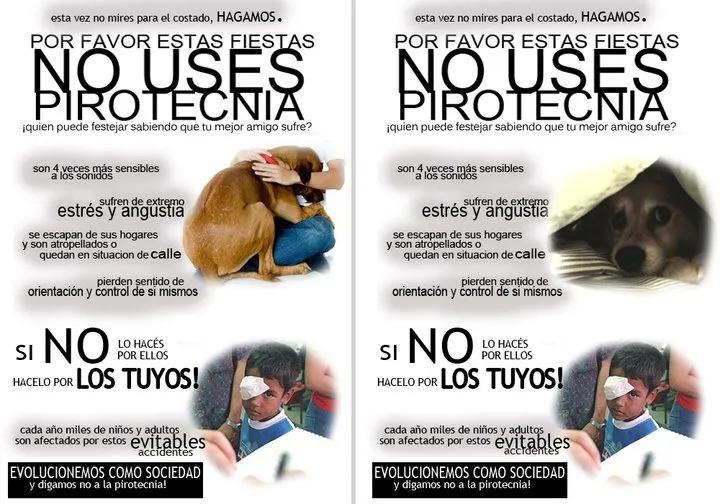
The boom generated by the use of pyrotechnics is dreadful, unbearable for the human beings who generate them and much more intolerable for our pets. Furthermore, as I mentioned before, it is potentially dangerous for ourselves, especially children.
Although the custom has spread, it would be good to reconsider the use of firecrackers and bottle rockets. What sense can there be in generating a boom in itself? Well, sometimes, kids find it funny to make a firecracker explode near another person or generate a deafening noise by placing it in front of a metal door (of some neighbor they don't like because they don't return the ball).
Parents can set limits for their children, even when they, capriciously, ask to use firecrackers because they see others using them and the sonic scandal catches their attention. But I know it's difficult. My nephews are un-stoppable and my sister and her husband have to deal with them every day!!
But I think it is possible to explain to them how dangerous it is, the damage caused to animals, and show them that they wouldn't like the same done to them.
I am not religious, but many of the people who celebrate "Christmas" do so with a feeling of peace and reconciliation. Well, it would be time to put it into practice.
Cosmic pyrotechnics: non-artificial fires
GK Per
When we put certain chemical compounds in a tube to create fireworks, we are undoubtedly talking about an artificial creation, although its components are part of Nature. But there is nothing, nor anyone, manipulating the stars to create these light shows, so they are natural fires of light and color that we can capture thanks to large telescopes.
Analogies are a way to establish relationships between different objects or situations. The universe offers us a varied range of lights of light and color. There is no gunpowder in the stars, but sometimes they "explode" as novae or supernovae.
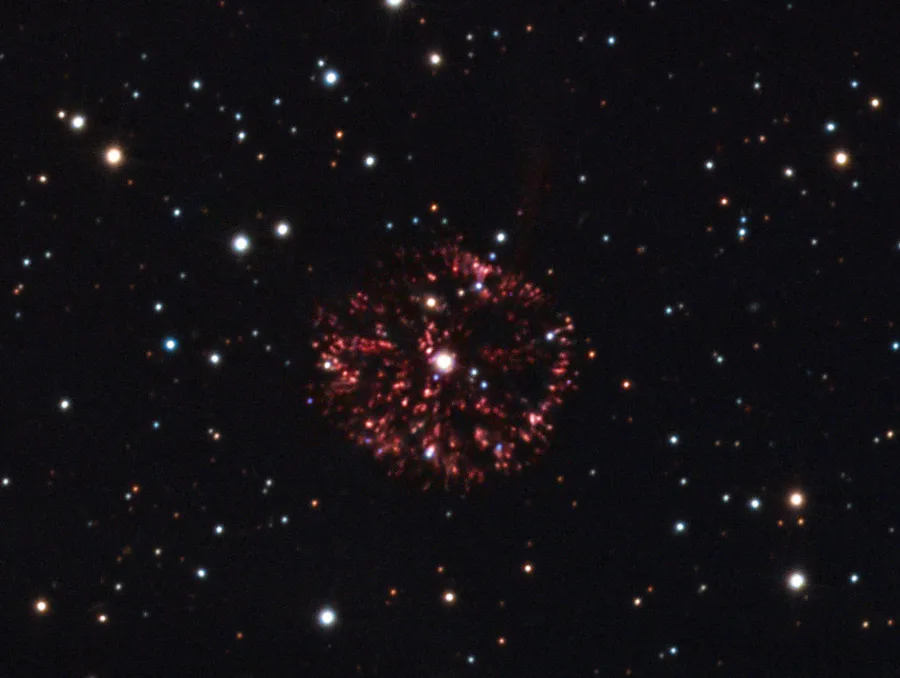
On February 21, 1901, the Scottish clergyman -and amateur astronomer- Thomas David Anderson was walking home in Edinburgh when he casually observed a bright third-magnitude star in Perseus. The next day he reported it to the Greenwich Observatory and realized he had discovered Nova Persei 1901, the first new star of the 20th century.
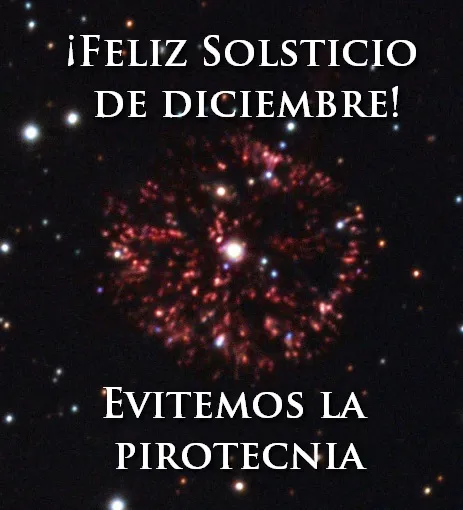
The nova remnant GK Per looks like a fireworks show in the sky. Its origin, however, is not gunpowder but rather these classical novae originate from cataclysmic variables: a red giant transferring part of its matter to a white dwarf, in a deadly dance. There are four classes of classical novae: fast, slow, very slow, and recurrent.
There are also magnetic and non-magnetic ones.
This image composition allows us to visualize the analogy with fireworks. GK Per lies about 1500 light-years away.
And more non-artificial fires in the cosmos
Another example is that of the Helix Nebula, as we see below:
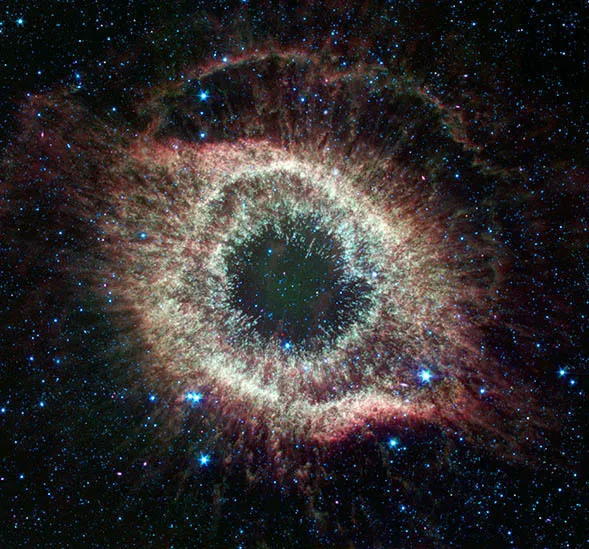
This image was taken for the fourth anniversary of Spitzer's launch.
Cataloged as NGC 7293 and also known as the Eye of God or Cat's Eye Nebula (perhaps if a supreme being existed it would be a cat?) it is located 680 light-years from Earth. It is a planetary nebula created by a star similar to our Sun at the end of its life.
Galactic fires
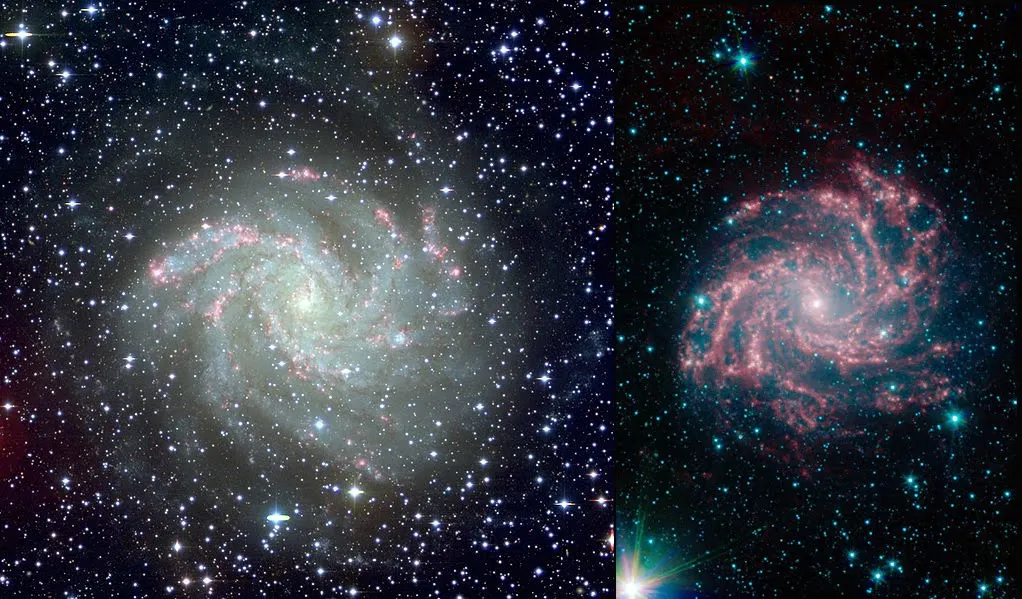
Another case of similarity of astronomical objects with fireworks is that of NGC 6946, a spiral galaxy about 10 million light-years away between Cepheus and Cygnus. About eight supernovae have been detected there, which is why it is also known as the Fireworks Galaxy. However, the origin of its special colorfulness is different: star formation.
What do we celebrate?
Those who are not Catholic or those of us who were as kids and no longer are, still usually gather with family for this time of year. Others, on the other hand, do not modify their habits and continue with their lives as if nothing. Is there something to celebrate? Every day is a good reason to do so, although the end of the year is a time to take stock and is a good excuse for a social gathering.
So while the Sun seems to enter Sagittarius (and not Capricorn) and the Earth, seen from the star, seems to enter Gemini (near M35) I raise a glass from here and wish you all a Happy Solstice!
Note written for the XXV Carnival of Physics, in this edition hosted by Cuentos Cuánticos. To join and read the entries there is a social network on Ning.
Sources and related links
- AAVSO: GK Persei
- El sofista: GK Per, the nova of 1901
- Spitzer Celebrates Fourth Anniversary with Celestial Fireworks
- Spitzer: The Fireworks Galaxy (NGC 6946)
- The Strange Ingredients in Fireworks
- Todopetardos: Black Powder
- Webquest: The Physics and Chemistry of Fireworks
About the Images
- GK Per: Nova of 1901: Adam Block, Mt. Lemmon SkyCenter, University of Arizona. APOD.
- NGC 6946:Spitzer. NGC 7293: Spitzer and Las Palmas/Kitt Peak (Wikipedia)