Both professionals and amateur astronomers have studied the skies for centuries, but their respective roles have changed considerably.
According to Johan H. Knapen, from the IAC, while in the 19th century the interests of professionals and amateurs began to overlap, in the 20th century they became differentiated. One of the main reasons is the use of large, expensive and exclusive telescopes, beyond the reach of amateurs.
At the beginning of the 21st century, technological progress allows amateurs to access advanced telescopes, cameras and computers at a reasonable cost.
According to Knapen, there are some areas in which amateurs can collaborate (and indeed do so) with professional advancement in astronomy:
Ultra-deep exposures
In an era in which professional astronomers continue to produce spectacular deep-sky images, it may seem surprising that amateurs can contribute. However, this is due to the combination of two factors: the brightness level achieved in an image does not depend so much on the aperture of a telescope, and often professionals cannot spend an entire night or more to obtain an image. When amateurs do precisely this, the result can be extraordinary.
An example of this collaboration between Professionals and Amateurs (sometimes shortened as ProAm collaborations) are amateur astrophotographer R. Jay Gabany and astrophysicist David Martínez-Delgado. They use the robotic and private Blackbird Observatory with a 20-inch telescope to take images of nearby galaxies, reaching levels greater than those of SDSS. This is achieved thanks to the combination of a large field of view (a small telescope with a large CCD), long exposures (5-20 hours) and the use of filters to maximize the amount of light that passes to the camera.
As an example, their image of NGC 5907 is reproduced.
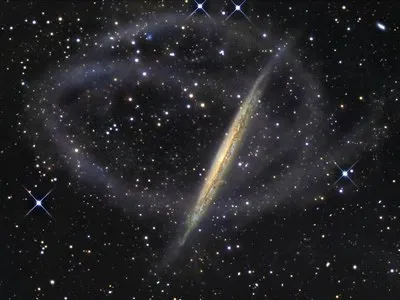
The stellar streams of NGC 5907
Huge tidal streams of stars appear to be what surrounds the galaxy NGC 5907.
See APOD 19-06-2008 and in Spanish at Observatorio.info
Credits & Copyright: R Jay Gabany(Blackbird Observatory) - collaboration;D.Martínez-Delgado(IAC,MPIA), J.Peñarrubia(U.Victoria)I. Trujillo (IAC)S.Majewski (U.Virginia), M.Pohlen (Cardiff)
As Gabany recounts on his site (www.cosmotography.com), his interest in astronomy was born as a child and was fueled by Carl Sagan's Cosmos series. Years later, he regained his taste for astronomy through the spectacular images of Robert Gendler.
When Martínez Delgado found those photos on the web, he realized that his theoretical models agreed with those images that had not been obtained with professional telescopes. There, one of the greatest ProAm collaborations was born.
Meteors and meteorites
Meteors are easily observed from the ground and, if it is a sufficiently large piece, it can reach the surface and be called a meteorite from then on. They are interesting because they can shed light on the physical and chemical conditions beyond the solar system.
It is true that some amateurs, instead of pursuing a scientific purpose, try to seize meteorites for subsequent commercialization, but these are exceptions (as there are also among professionals).
Asteroids
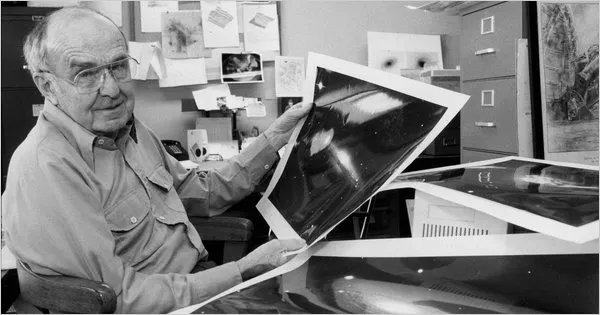
Although asteroids are small, they occasionally occult a star. Knowing the positions of bright stars and asteroids with considerable precision, occultations can be predicted. The observer will see the star's brightness decrease for a certain duration of time. If a large number of observers collaborate by observing the same event and share their data, it is possible to create maps of the asteroid.
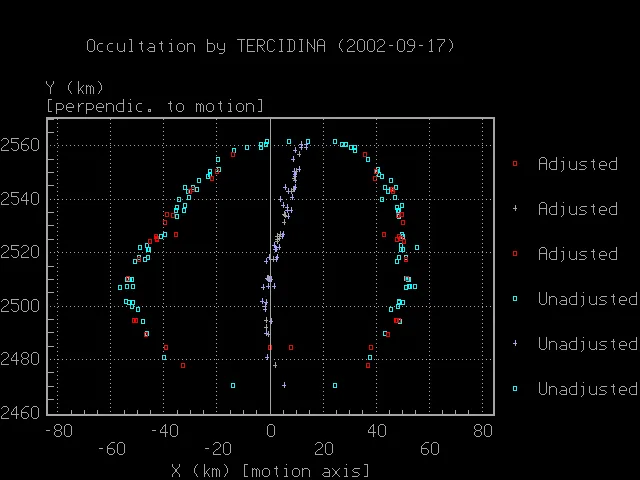
Credit: J. Lecacheux.
The Convento Group
Knapen's article is part of the proceedings of the Workshop "Interacting Stellar Winds" that took place between May 29 and June 2, 2010 at the Convento da Arrabida, Portugal.
There they presented the work carried out by a ProAm collaboration to study a pair of stars, WR 140, a WR+O binary with a very eccentric orbit and a period of approximately 8 years. The observation of its passage through periastron in visible wavelength is used for measurements at other wavelengths to understand the interaction of both components and the geometry and physics of the system. For this (and other objectives) a group of professional and amateur astronomers managed to get a proposal for 116 nights on the Mons de Teide telescope approved, supported by the IAC.
A direct consequence of the meeting was the establishment of a new ProAm group, the Convento Group.
Comets and supernovae
Before 1996, about a dozen comets were discovered per year, of which between 1 and 6 were found by amateurs. Currently, the figure reaches 200 per year, but amateurs contribute 1%. The increase occurred due to new forms of observation, such as the SOHO satellite.
Something similar happens with supernovae. The most immediate example is the recent discovery of a supernova by a 10-year-old girl.
Citizen science and distributed computing
For some years now, citizens can participate massively in projects like GalaxyZoo, now turned into a true ZooUniverse.
Furthermore, distributed computational systems allow the use of computer processors (all the time or when not in use) to be used in a variety of research projects. SETI@home and other BOINC projects are clear examples of which we have spoken here on several occasions.
Variables
Knapen mentions the study of variables, of course, but here I would like to pause.
The contribution of amateurs in the study of variable stars is fascinating. Nowadays it is possible to participate from Citizen Sky, but this is not something new. The American Association of Variable Star Observers (AAVSO) has existed for a century, a centennial that will be completed at the end of this year. Although the exact date of its founding is debated, there is an agreement that it would be October 10, 1911. However, the 100 years of AAVSO's life will be celebrated throughout 2011.

Surely throughout the year I will continue commenting on this. It is worth noting that to be a member of AAVSO you do not need to have deep knowledge or have a telescope. Being a member of AAVSO provides some benefits (use of AAVSOnet, bulletins and newsletter, credentials), but more importantly, you will be collaborating with one of the great astronomy organizations in the world.
No telescope or CCD is needed (though if we have them we can contribute with observations, of course) because it is possible to use robotic observations and analyze them, or create software (usually free and open source), in addition to learning.
I cannot fail to mention Jaime Rubén Garcia (Instituto Copérnico), President of AAVSO, nor the recent incorporation into AAVSO of another Argentine, Sebastián Otero who collaborates in VSX since the beginning of the year, as he himself reported in Espacio profundo.
In Praise of Amateurs
Doctors, lawyers, engineers and businesspeople. In short, people spend every day on the street, in the office or inside a supermarket. What could they have in common with each other? Well, some yearn to be astronomers and follow their dream with amateur zeal.
Amateurs are volunteers. They decide how their time is spent and chart a path guided by their fascinations. Usually, they follow their dreams without formal training or expectation of compensation. If interest is suddenly lost, they go on their way, and are replaced by another person full of energy and new perspectives. The self-selection of amateurs ensures their participation.
In contrast, despite your devotion to the place where you work, it is very likely that you face a task that has to be done at the request of an employer or by market forces, beyond your control. At that moment, polished professional skills can become hampered by a lack of authentic interest. Amateurs, on the other hand, are not subject to assignments. They preselect their projects and attack them with force.
This is a critical difference between professionals and amateurs; the latter may not be polished, but they are driven by an intensity that cannot be faked.
Thus, the next time you hear this or that about an amateur, look beyond appearances. Although the world depends on conscripts, it also needs recruits.
At Cosmotography, NGC 4258 (M106)
Sources and related links
- Scientific collaborations in astronomy between amateurs and professionals
Johan H. Knapen
arXiv:1101.0684v1 [astro-ph.IM]
Published in the proceedings of "Stellar winds in interaction". - The great role of amateur astronomers and astrophotographers in modern Astronomy and Astrophysics
- Science for Citizens
- iSGTW: Opinion - Scientists, meet the citizens
- Citizen Sky
- Sidewalk Astronomers
- Astronomers Without Borders
About the images
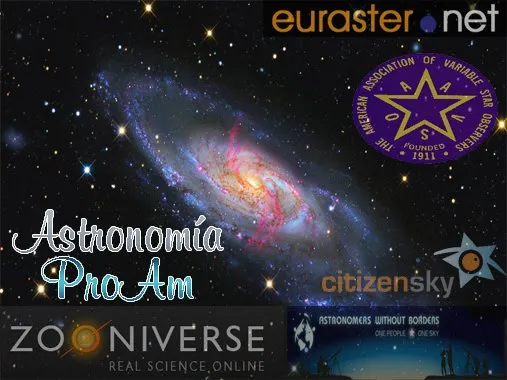
- The initial image is a combination of the logos of AstronomersWithoutBorders, CitizenSky, AAVSO, Zoouniverse, Euraster and NGC 4258 (M106) from Cosmotography.