Although what we perceive in the Southern Hemisphere is somewhat different from what is observed in the Northern Hemisphere, the solstice of December 21 affects all human beings.
Many times we establish differences among ourselves. In other cases, on the contrary, we believe we find similarities. The ability we have to find things that are the same and things that are different characterizes us as a species. Sometimes we use it to determine geographical, political, and, unfortunately, also xenophobic borders.
In other cases we use that ability to do something rarely found in animals: we create symbols that unite us despite not knowing each other. A flag, for example. Imagine a person with the flag of (Spain, Uruguay, Colombia, etc.). Upon meeting another person who has the same flag, they are immediately bound by a bond of empathy, despite not knowing that person.
In this sense I now say "Solstice" or I say "December 21".
It's true that for many it doesn't mean anything special, but perhaps for you, as for me, it has a particular significance. In some way, despite distances, languages and other differences, among those of us who understand what is happening, there is an empathy.
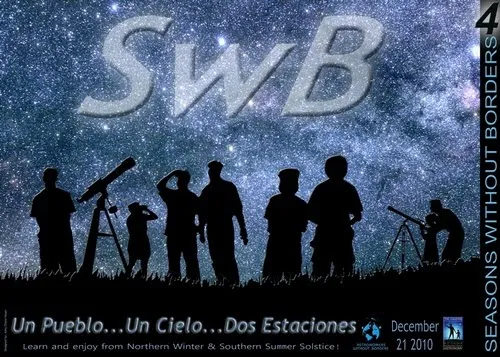
That is why this solstice is an event we can celebrate all over the world, as Astronomers Without Borders proposes.
What will happen this 12/21 is that the Sun will reach its maximum declination of 23.5 degrees.
Ancient astronomers thought that the stars and planets had their own "spheres". The fixed stars were then attached to a crystalline sphere.
Although today we know that is not the case, it is useful to use this concept to establish coordinates that allow us to guide ourselves. That is how the celestial sphere is used.
That abstract sphere surrounding the Earth generates an apparent view of the movement of the stars. It seems that the stars rise from East to West, that the Sun revolves around the Earth. It's the other way around, but it's useful, as long as we know this.
On that sphere, the plane of the Equator is projected onto the Celestial Equator.
Likewise, the path that the Sun apparently follows in the sky is also a plane called the Ecliptic.
When the Sun is located at the points where both planes meet, we are at an equinox.
On the other hand, when the Sun moves away on the Ecliptic from the plane of the Celestial Equator and reaches its greatest distance, we are at a Solstice.
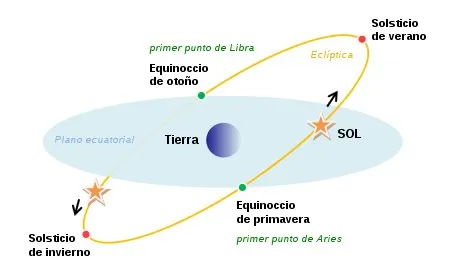
If this is a fact that all the inhabitants of the world can understand, that in itself is a reason to celebrate without borders.
But there is more, and I specifically wanted to talk about this.
We often say that Earth's orbit is elliptical, that it has the shape of an ellipse, that it is not a perfect circle. It's true, even though its eccentricity is small and it is practically a circle.
By saying it is an ellipse with the Sun at one of the foci, we illustrate it like this:
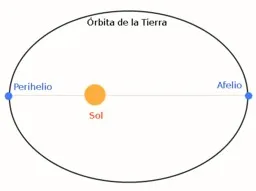
The problem with this graph is that for self-taught individuals, that shape of Earth's orbit would be the origin of the seasons. Sometimes Earth is closer to the Sun, sometimes farther away. However, although it is true that our world is closer (perihelion) or farther (aphelion), that practically does not affect the climate.
The cause of the seasons is the tilt of Earth's axis with respect to the perpendicular of the Ecliptic. It is an angle of 23.5º.
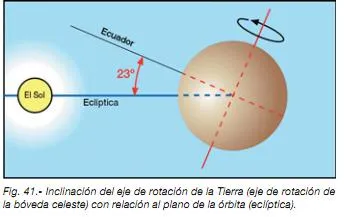
Let's make it more graphic:
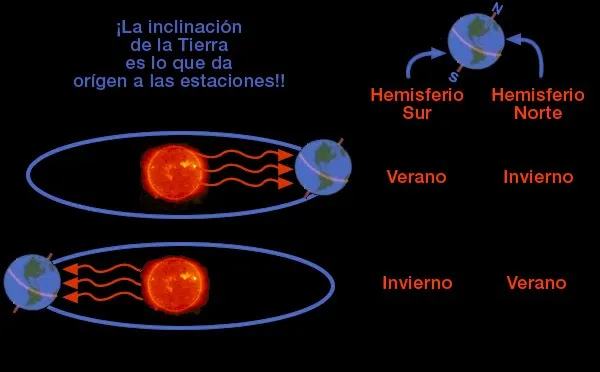
What happens is that the Sun during the solstices and for a few months is high on the horizon, in the case of the Southern Hemisphere. Its rays reach the Earth's surface perpendicularly.
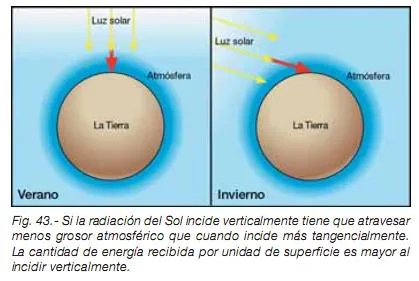
Let's do the following experiment (it can be mental):
Take a flashlight and a piece of paper. Orient the flashlight perpendicularly over the sheet. We will see that the flashlight's light rays concentrate on a point. Something different happens when we tilt the flashlight: the rays, instead of concentrating, disperse.
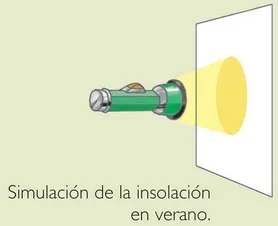
Well, this will happen this December 21 at 23:38 UTC. But before...
An eclipsing solstice
As if this were not enough, this solstice will be accompanied by a total lunar eclipse, as we reported in The Coming Eclipses.
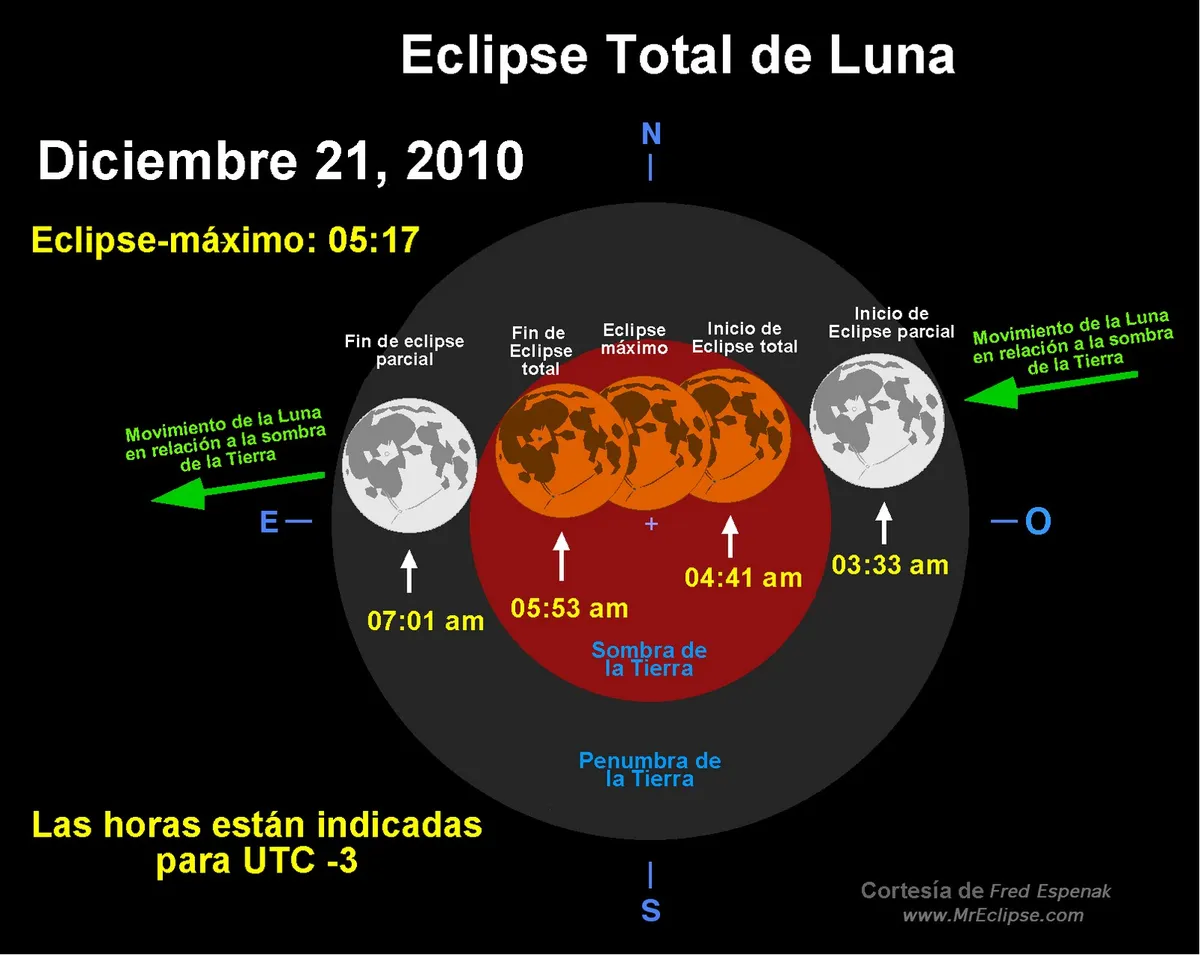
Note: The image above was created by Fred Espenak and edited so that the texts are in Spanish and the times are in UTC-3.
For those who wish, it is possible to download a psd file with all editable texts, as well as a jpg without time specification, which can be edited to indicate the times in any time zone.
Sources and related links
- Mr Eclipse
- Astronomers Without Borders
About the images
- Image Seasons and Perihelion-Aphelion, from Wikipedia.
- Fig. 41 and 43 from www.astrosabadell.org
- Image: Seasons-Tilt from Windows UCAR
- Flashlight image from Kalipedia.
- Logo and poster from Astronomers Without Borders