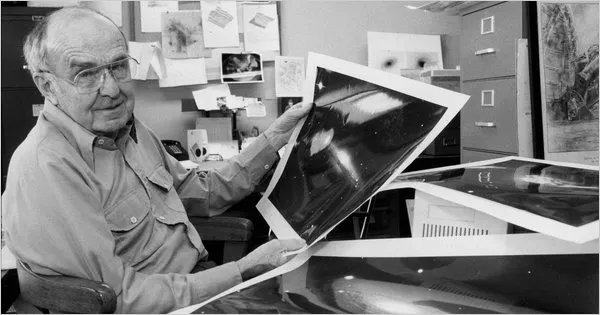
American astronomer Allan Sandage passed away on November 13 at the age of 84. He was an assistant and continuator of Edwin Hubble's work.
The news really hit me. I had established a certain bond, let's call it sentimentaloid, with Sandage, because of a wonderful book: Lonely Hearts of the Cosmos. That work was written by NYTimes journalist Dennis Overbye. In the same newspaper he reported yesterday that, according to the announcement by the Carnegie Observatories, the cause of death was pancreatic cancer.
"For more than six decades, Dr. Sandage was like one of those giant galaxies that sit at the center of a cluster, dominating the cosmic weather," Overbye noted.
In 1949 Sandage was a young Caltech student when he became Edwin Hubble's observational assistant, the Mount Wilson astronomer who "discovered" the expansion of the universe.
Hubble had planned an observing campaign with the new telescope on Mount Palomar, but in 1953 he was struck by a heart attack. The newly minted PhD Sandage, at 27, inherited the work of finding out what the fate of the universe would be: infinite expansion or contraction?
Sandage seemed to have a strong character, was impulsive and passionate. But even after retiring from the public sphere, from the Carnegie Observatories, he kept working. In June he published his last paper on variables.
Wendy Freedman, director of Carnegie with whom he rivaled, referred to Sandage as the last giant of 20th-century observational cosmology.
Allan Rex Sandage, who was born in Iowa on June 18, 1926, is often pointed to as the one who set the course or established the direction of observational cosmology. The great task of the 20th century seemed to be the one that could decide between two models that emerged after 1929: the steady state or the Big Bang. In 1961 Sandage published a paper in The Astrophysical Journal showing that the task could be done with the 200-inch (5-meter) telescope. He described cosmology as the search for two numbers: the expansion rate (known as the Hubble Constant) and the deceleration parameter.
Meanwhile, he investigated the birth of galaxies. By analyzing the motions of old stars in the Milky Way, he showed in 1962 that our galaxy was born from the collapse of primordial gas probably 10 billion years ago.
In 1959 he married an astronomer, Mary Connelly, who survives him along with their two sons David and John.
In 1956 he suggested that the Hubble constant would be 75 km/s/Mpc (Hubble had said 530!), but by 1975 the value had dropped to 50, corresponding to a universe 20 billion years old.
This estimate brought him and his collaborator G. A. Tammann a lot of headaches. In 2001 a team using the Hubble telescope reported a value of 72 km/s/Mpc. But Sandage was stubborn in maintaining that the value was lower.
To get an idea of who Sandage was, let's say he published more than 500 scientific papers (530 according to ADS) throughout his career, that he published the Hubble Atlas of Galaxies in 1961 and that he did it before the digital era.
An astronomer of the old school
Much of his observational work was done before the advent of digital detectors and comfortable observing rooms surrounded by consoles.
A while ago, an Argentine TV director (Ricardo Benítez) made a documentary about Las Campanas. On YouTube we can see a trailer for The Silence of Las Campanas, which shows the facilities of that modern Carnegie observatory, installed in Chile. By the way, it would be good if they repeated that documentary sometime.
But Sandage did not enjoy those technological privileges, although he did have an instrument that was among the best in the world at the time. He had to work crouched in the "cage" of the telescope's prime focus, suspended over the beast.
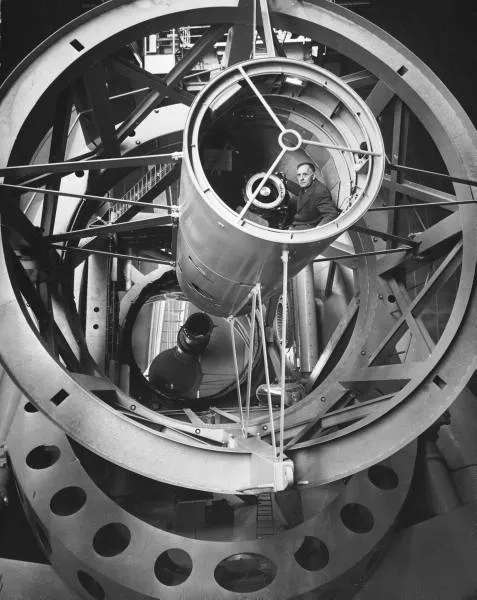
It is not my intention here to overestimate his capabilities or his skill as an astronomer. I am not unaware of his errors, his tantrums, but he did mark an era, he was an icon of an astronomy that is no more. The new astronomy, very digitalized, computational, is increasingly precise, more monstrous, perhaps less romantic. Although that "spirit" remains in amateur observers and in those who studied and were raised in other times and who still have much to teach.
Sandage was not a better astronomer than others. I do not praise him here because I believe Americans are superior or that the past was better.
But he was a representative of a tradition, much more homemade, less precise, more manual. A lone astronomer as we can hardly imagine today.
In the book The Day we found the Universe, Elaine Bartusiak accounts for great contributions by Vesto Slipher, Henrietta Leavitt and Georges Lemaître, as if to demystify Hubble as the "discoverer" of the expansion, something about which, moreover, he was not entirely sure. But she also describes Hubble's work (1):
Observing with the 100-inch [telescope] was a choreographed dance in the monumental dome, 100 feet high and almost as much in diameter. Sometimes Hubble could just lean back in a curved wooden chair, his favorite, and serenely smoke his pipe in the dark, while taking a photograph. But other times he was located high up on a platform that could be adjusted to any height via rails on each side of the dome. With the telescope's motor on adjusting the telescope as the night sky moved slowly overhead, he and his assistant made sure the advance was in sync with the Earth's rotation..."This was the best of the observational astronomy experience," noted the Mount Wilson astronomer, Allan Sandage, "a dark and quiet dome, a monstrous telescope moving slowly, and the mastery of the dangerous platform, all with the interest of collecting data on a problem of transcendental significance".
And then, the plates. No, there was no CCD. You had to develop large plates and make comparisons by eye, mounting plates on top of each other. What professionals today can do with software and mathematical calculations to remove the similarities between exposures and keep the differences, that, did not exist.
No, my sadness is not because an American astronomer died. The "character" from a wonderful book that made me feel the need to start telling what Argentine astronomers research, where they do it, how, has left.
Toward the end of the aforementioned book, Overbye recounts an occasion celebrating what would have been E. Hubble's 97th birthday, in 1986, after the Challenger explosion. Sandage spoke.
And Overbye says about it:
"He was there to remind us all of something that could easily be forgotten in the tempestuous march of technical data: astronomers do make progress. The stars are impossibly old, but they are not eternal. There are impossible distances, but not infinite distances. [...] Great science, like great art, returns to the obvious. [...] Stars are born and die. Galaxies are born and die. Atoms are born and die. Particles are born and die.[...]
If Sandage was wrong in cynically belittling superstring theorists, he was certainly right when he said that the main lesson of cosmology was the presence of a mystery at the heart of existence, a mystery that ultimately should be savored more than solved. That was the task of cosmology, like the mythology of the ancients: to bear witness".
And Sandage bore it. A page of the history of astronomy has turned.
Sources and related links
- Allan Sandage, Astronomer, Dies at 84; Charted Cosmos’s Age and Expansion
- The Loneliness Of the Long-Distance Cosmologist, by Richard Panek (07/25/1999)
- S&T: Tribute to a Pioneering Cosmologist
- Palomar: Allan Sandage, 1926 - 2010
- The Passing of Allan Sandage
- A Solitary Astronomer No Longer, by PAUL GILSTER
- (1): The quote is from Centauri Dreams.
About the images
- Image of Allan Sandage by Bart Bartholomew from NYT.
- Image of E. Hubble at the Hale telescope. Credit: Mount Palomar.