The New Journal of Physics announced that the abstracts or summaries of scientific articles published in that journal will contain integrated videos.
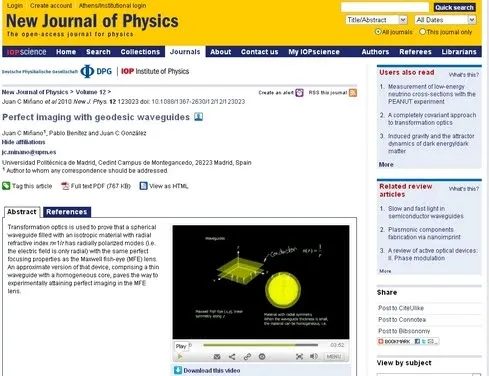
The New Journal of Physics (NJP) announced on February 4 the launch of video abstracts as one of the new integrated contents that give all authors the opportunity to go beyond the limitations of the written article, by personally presenting the importance of their work to the journal's global audience. The first examples of the new videos supplied by the authors are available at http://www.njp.org/videoabstracts, as reported by IOP Latin America.
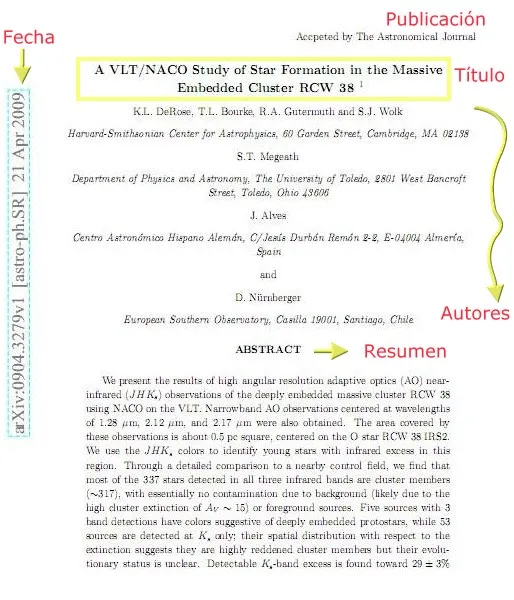
Scientific articles, called papers in English, are documents that include the authors' names, the institution they belong to, a summary or abstract of their research, keywords and then the text itself, normally with an introduction, analysis, conclusion and references.
"We hope that the possibility of putting faces to names, and visualizing some of the research in action, will give a human touch and help the scientific community to grow further," said Neil Wilson from the University of Warwick, UK, whose work on the structure of graphene can be seen at http://iopscience.iop.org/1367-2630/12/12/125010/.
Launched in 1998, NJP is an open access journal co-owned by the Institute of Physics and the Deutsche Physikalische Gesellschaft and published by IOP Publishing. The introduction of this new video service reflects the journal's founding objectives to take advantage of the opportunities offered by the online medium to make physics research as accessible and available as possible worldwide.
The video abstracts in NJP are permanently free to view, in accordance with the journal's open access publishing model, and include a sharing functionality through social media channels to maximize community engagement, interaction and visibility.
Among the available video-abstracts we find:
Perfect imaging with geodesic waveguides by Juan Miñano, Pablo Benítez and Juan C. González, from the Universidad Politécnica de Madrid.
Juan C Miñano et al 2010 New J. Phys. 12 123023 DOI: 10.1088/1367-2630/12/12/123023
Another example is:
Spacetime could be simultaneously continuous and discrete, in the same way that information can be by Achim Kempf, University of Waterloo, Canada.
Achim Kempf 2010 New J. Phys. 12 115001 DOI: 10.1088/1367-2630/12/11/115001
In this work Kempf points out that spacetime could be simultaneously continuous and discrete.
This paper is part of:
Focus on Classical and Quantum Analogues for Gravitational Phenomena and Related Effects.
As we see in these two examples there are several possibilities for using video-abstracts. In one case authors may refrain from appearing on camera -which requires a particular handling of communication-, but use the video as a way to visualize a multimedia presentation, something scientists are accustomed to. In the first example, the Spanish authors preferred to use a presentation, while in the Canadian example the author is seen on screen.
Another possibility is to add a transcript of the video, since this video-abstract is not necessarily a copy of the abstract or summary that appears in the paper, and pronunciation and audio quality could hinder the understanding of what is being said.
Thus, in the second case, we can have access to the transcript of the text.
I think it could be a facilitating tool to publicize complex theoretical works in a simpler way, for example.
It occurs to me that video-abstracts should have differential content relative to the published work, which allows for facilitating communication for the interested general public, which includes students, teachers and journalists.
Sources and related links
- Physics Gets Personal
- Scientific articles 2.0
- Scientific articles in a humorous key
About the images
- Screenshot of the New Journal of Physics site.