What is better for exterminating cockroaches: insecticide or a flip-flop? How does a piece of toast spread with jam fall if it is tied to a cat's back? If triple-decker sandwiches have three slices of bread, shouldn't single ones be called double? In the book "Demoliendo Papers" a group of students and scientists demonstrate the most outlandish hypotheses while complying with the fundamental precepts of scientific publications.
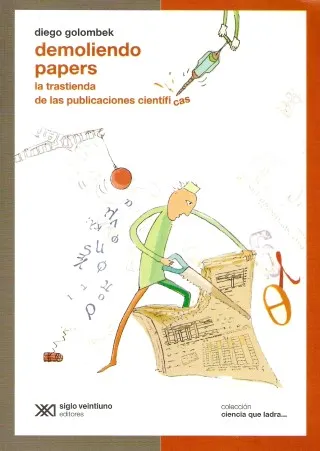
The book by Diego Golombek proposes to learn a little more about what a paper is, this hermetic form of communicating science that researchers have and which also serves as a means to measure their output.
Golombek holds a Ph.D. in biology (UBA), is a researcher for CONICET and a full professor at the Universidad Nacional de Quilmes (UNQ), where he directs the chronobiology laboratory.
The book consists of only two parts: a prologue by sociologist Pablo Kreimer (UNQ, CONICET, FLACSO) that introduces us to the world of scientific articles. He tells us about a seminar on scientific journals that he attended and where he presented his thesis: papers can be many things, but they are, above all, rhetorical instruments, discursive pieces intended to persuade. And he added, as he recounts, that "papers are not science, and even less so, THE TRUTH, but rather they are exercises that scientists practice to convince others of how important the things they do are."
Does it sound impertinent to talk about papers like that? Does he really believe it or are they statements that only seek "impact"? If the reader wonders this, there will be agreement with what Kreimer says a Catalan biochemist asked him. Kreimer's idea is not to destroy the meaning or importance of scientific articles, but to ask ourselves what they are, why they are written, what consequences they have, in short, to dissect a text that often seems "sacred."
Certainly while reading the prologue I had the same feeling as the audience at that seminar. But I quickly realized that it is not "attacking" but "questioning" and there I felt much more comfortable.
Kreimer then explores the most common answers to the reasons why scientists publish papers, which point to two dimensions of modern science: the social and cognitive aspects.
It is clear that one publishes to make a work known to other members of the scientific community, primarily, and to the general public. Due to the language used in scientific articles, not just anyone will be able to understand them completely. Many scientific publications emphasize this point, with the idea that the text can be "as comprehensive as possible." Up to a certain point, of course. Mathematical language is usually present, as it is an indispensable tool used by the different scientific disciplines.
But scientific articles also fulfill a cognitive role, science generates knowledge. On this point Kreimer points out some aspects of the so-called "scientific method": observe, measure, model...
Then the sociologist indicates that, even if we accepted that articles represent science, they ARE NOT science. Papers hide more than they show, especially failure is hidden: not all the detailed experiences of how the research was developed are recounted. Nor is the "tacit knowledge" pointed out, non-codifiable aspects such as the experimenter's skill, etc.
Another idea of Kreimer's is that the publication of an article attempts to move from a weak argument to a stronger one. The science that is done is that which has not yet been accepted as such, in which there are doubts, aspects not well measured, etc. And that cannot be done as we would in a casual chat. One appeals to graphs, statistics in graphs and tables, and a number of elements that try to strengthen the argument. Kreimer cites Bruno Latour regarding "strategies to convince," when it is pointed out that such and such a thing has already been demonstrated by So-and-so. So-and-so being, perhaps, a Nobel Prize winner.
I repeat, the idea of Golombek, who directs this collection called "Ciencia que ladra," and that of Kreimer, is not to discredit the importance of papers, but to better understand their role. And the purpose of the prologue is to become aware that, beyond the intention of meticulously recounting an experiment and its conclusions, there are other aspects in articles. They are a discursive element in which one tries to convince through a series of resources.
The truth is that publishing a paper can be a real headache and is an entire activity in itself. Researchers must make their objective clear and why that intention is valid, that is, demonstrate that studying or analyzing such and such a thing is important for such and such a reason. They must also detail the means they used: how such a thing was observed, in what context and circumstances, what was intended to be observed and what was observed. After stating the different data obtained and their method of obtaining, they must interpret them, think of a model in which that data fits with reality and with previously established experiments and laws. Indicate the references and conclusions and add images, graphs and other resources that favor the understanding of the topic.
The Sokal affair
Towards the end of the prologue, Kreimer reminds us of the case of the American physicist Alan Sokal, who decided to do what the sociologist calls a "joke-trap-experiment." Sokal sent to a cultural studies journal (Social Text) an article called "Transgressing the Boundaries: Toward a Transformative Hermeneutics of Quantum Gravity." What a title, right?
With a hermetic language that appeals to vague notions of quantum gravity, Sokal writes a lot and says nothing. But in another journal (Lingua Franca), the US researcher revealed that the previous article was a parody.
And this adds an element to the context of scientific publication: writing in a difficult manner does not imply that one is telling the truth. Appealing to established names does not mean they endorse our arguments. Fallacies that we may believe to be truths only because we are unfamiliar with the specific language of each discipline.
But it also points out that, as Kreimer says, laboratories have become paper factories, where the latter is not at the end of the research path, but is ahead. Hey, we must gain prestige, we have few publications, let's write some paper!
Does this really happen? It does, yes, which is why the public, and especially the press, must be vigilant that the research they disseminate is truly new and not a rehash of previous work that adds or subtracts nothing.
The outlandish articles
In the same spirit as Sokal's "hoax experiment," Demoliendo papers offers a series of pseudo-scientific articles on the most incredible topics, from the "Valid criterion for the classification of crustless sandwiches" to the "New protein would be responsible for mate-induced sleepiness syndrome."
Clearly some of these "articles" are written for a River Plate audience, all too accustomed to eating crustless sandwiches and drinking mate, but others are truly universal: "The physical principles that determine the cat's landing on its feet prevail over Murphy's Law that determines the toast falling with the jam side down."
The articles were written by real researchers from the Universidad Nacional de Quilmes, who demonstrate they know how to construct a paper and have an excellent sense of humor.
Dissection of a paper
The various "joke" papers published in the book are structured as follows:
Title, Authors (Institutions they represent); Abstract; Introduction; Materials and methods; Results; Discussion; References.
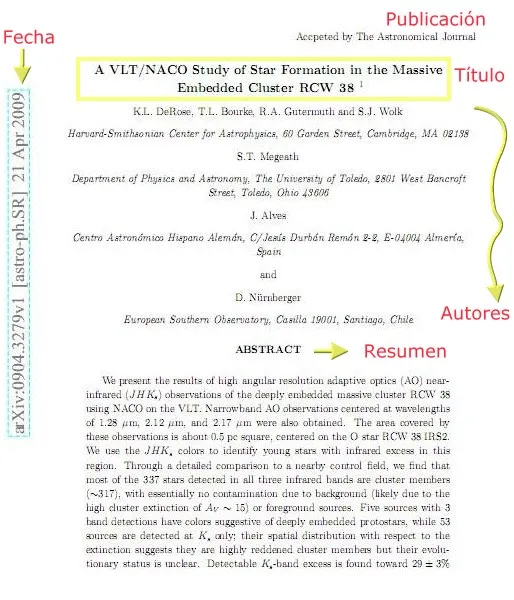
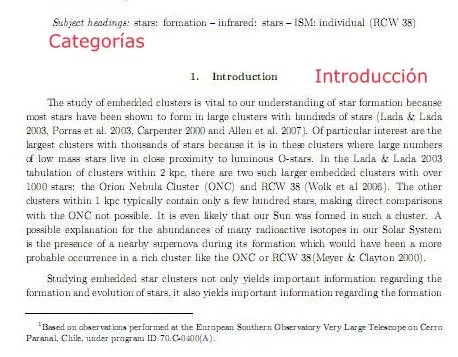
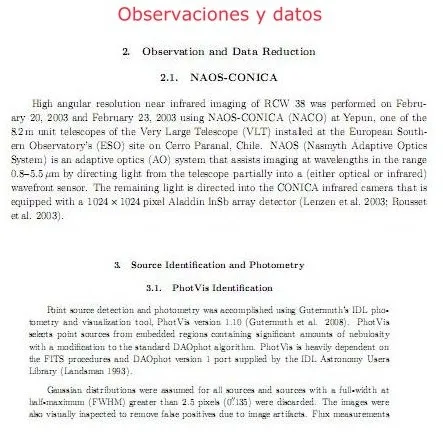
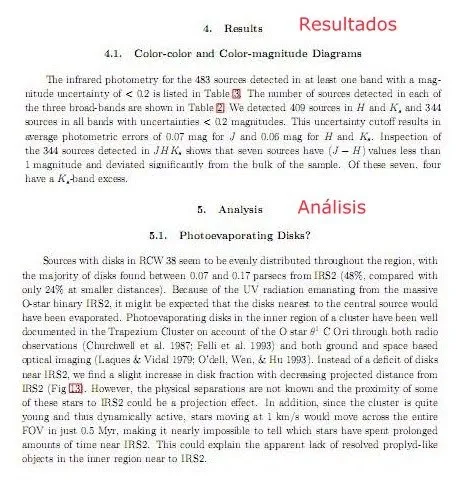
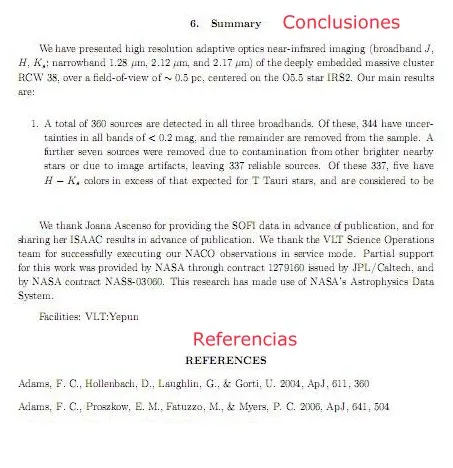
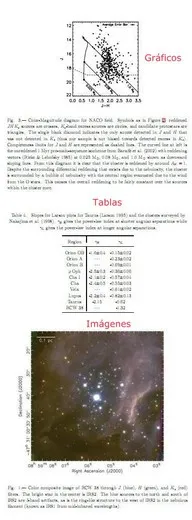
In a "real" paper these are not the only possible sections. It will depend on the topic and discipline. For those who have no idea what papers are like, we provide here a "dissection" of one, indicating its parts. It is just one example of many possible ones; however, the format, general structure, and even the language are part of a fairly standardized style. Even articles produced by Spanish-speaking researchers will be written in English when submitted to international publications.
We take as an example the paper "A VLT/NACO Study of Star Formation in the Massive Embedded Cluster RCW 38," by K.L. DeRose et al, published in The Astronomical Journal, April 21, 2009, arXiv:0904.3279v1.
We published a note about this scientific article in the post titled:
"A look at the infernal cradles of suns and planets".
More at:
How to write a scientific article
The scientific article of the future
The preparation of a scientific article
Definition of the scientific article
Why do all papers look alike?
Scientific articles are usually written in plain text files but processed with LaTeX, a text processing system. It is not the same as a rich text processor that we mortals are more accustomed to, like Word, Write, or others. It is a very complete system that processes documents written in some editor. There are editors specifically designed for use with LaTeX that facilitate access to the various functions. The basic idea is to write using certain codes, something like "writing in html." The system has different "templates" to facilitate writing all kinds of documents, from the simplest to the most complex, using columns, indexes, footnotes, etc. The concept is based on separating the text (content) from the format and the result is usually a pdf or postscript file.
There are several derivations of the system (originally TEX), of which MikTex is one of the most popular.
What the book lacks
Asking a book for what it did not aim for is like waiting for the bus on a street where it doesn't run. The work does not propose, in its 152 pages, to investigate all issues related to scientific articles. Therefore, many aspects remain untreated in this work, although there is varied bibliography on the subject. But I particularly think it would have been appropriate to investigate a bit about measuring scientific production and peer review.
There are other works that delve into the world of publications by referee or arbitrator. It is a system by which researchers send their articles to journals that have the content evaluated by "experts" in the field. These referees evaluate different criteria, in particular whether similar unreferenced research already exists or if the discursive style is appropriate. Some voices have been questioning whether this system is correct, particularly in cases where the number of arbitrators is minimal and the evaluation is delayed, among other aspects.
Similarly, the publication of papers and the citations made of them by other authors are often measures of a researcher's output. And there are different criteria for making these measurements, as well as the impact factor of specialized journals.
There are also editorial issues, for example the retention policy of publications that can only be accessed by subscription or payment, versus the idea of open access articles available to all of society.
Publish or perish
It represents so much for the scientist that a phrase was coined that sums it all up. "Publish or perish," which means "Publish or perish" and is cited in the book's prologue. A researcher who does not publish, does not produce, their work has no impact among their colleagues, does not receive grants or subsidies..."perishes." This pressure can unfortunately lead to the publication of fraudulent research.
Book data
Demoliendo Papers
Compiled by Diego Golombek
Prologue by Pablo Kreimer
152 pp. | 19 x 13, 5
ISBN 978-987-1220-08-3 July 2005
1st ed. 4th reprint. Buenos Aires, 2009
Siglo Veintiuno editores
Colección Ciencia que ladra
Table of Contents
On the birth, development, and demolition of papers
PABLO KREIMER
The physical principles that determine the cat's landing on its feet prevail over Murphy's Law that determines the toast falling with the jam side down
JOEL PÉREZ PERRI
Valid criterion for the classification of crustless sandwiches
NICOLÁS PALOPOLI
Pill hormone as a regulator of pre-ingestion reactions of Hostile Reaction Syndrome
Cat Pillphobia
PAULA BELUARDI
Humorin: addiction on buses
GEORGINA COLO
The out-odor pheromone and the expression of the mearumfueradutarrum protein are necessary for the loss of directional control of urine output
LUCIANA FUENTES AND NATALIA MARTINEZ
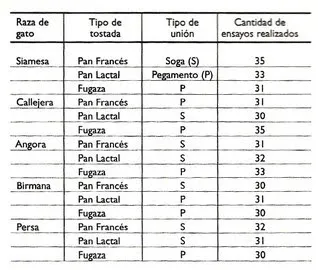
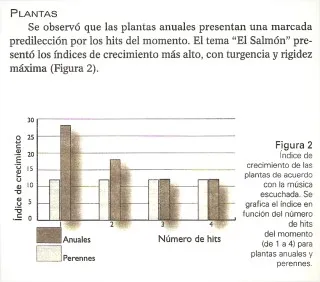
The musical tastes of plants affect their normal development
VIRGINIA GONZÁLEZ AND DOLORES VALDEMOROS
A new protein would be responsible for mate-induced sleepiness syndrome
AXEL HOLLMAN
Inzombiavirus and other herbs: the never-before-told story about zombification
MELINA LAGUIA BECHER
Comparative study of biomass yield variations in S. cerevisiae and E. coli with different types of nutrients and under different mood conditions
MATIAS NÓBILE
DNA self-replicates, thank God
PABLO PELLEGRINI
New treatments to reduce cellular stress
NATALIA PERIOLO
Effectiveness of the flip-flop or aerosol insecticide in killing cockroaches
SANTIAGO PLANO
Suicidal tendencies in snails warn of psychiatric pathologies in man
MAXIMILIANO PORTAL
Early detection of Homo sapiens sapiens bolsum syndrome
MARTA CANDELARIA ROGERT AND MARTIN FABANI
The desperate attempt of Culex pipiens to keep us awake
ROSANA ROTA
Analysis of the divinity of the button
LUCIA SPERONI
Sources and related links
- What is scientific production?
JUAN CARLOS ARGÜELLES - EmuleNews:The art of "sneaking" a "junk" article into an international "prestige" journal
- EmuleNews: Publish or perish, research once and publish twice in the same journal and issue
- Perfil.com:How high-impact "scientific" studies are put together
About the images
- Cover of Demoliendo papers. Credit: Siglo XXI
- Images from the paper "A VLT/NACO Study of Star Formation..." cropped and with red annotations to indicate the parts.
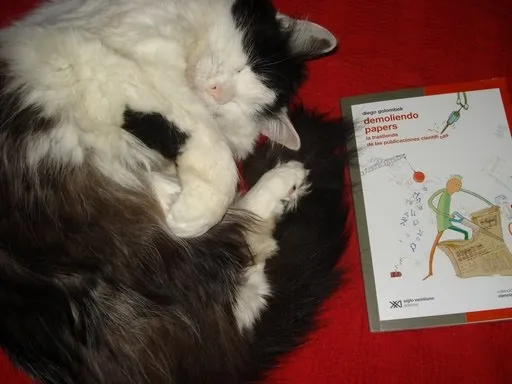
- Image of Marget, the skeptical cat, and the book Demoliendo papers. (The cat gave it four paws (out of five possible)