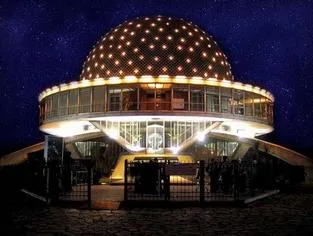
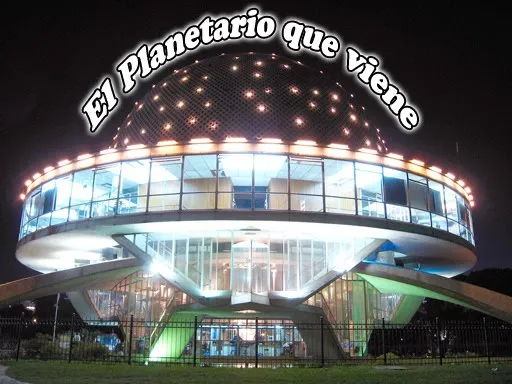
I interviewed the Director of the iconic building in the City of Buenos Aires to find out what works are being carried out and what the Planetarium to come will be like.
Lucía Sendón de Valery has been working at the Planetarium for over 30 years. The Geography graduate and disciple of Antonio Cornejo -who held the position of director from the building's inauguration in December 1966 for three decades- received me in her office, one hour before the Sun transited the local Meridian, at noon in Buenos Aires.
-Good morning.
-Good morning.
-I wanted to ask you about the works being carried out at the Planetarium. There was a brief summer break, then activities resumed, they were resumed, but not completely. The showroom is still closed. What works are being carried out and until when are they expected to continue?
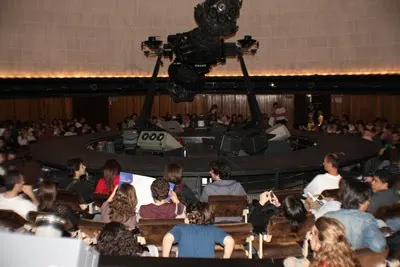
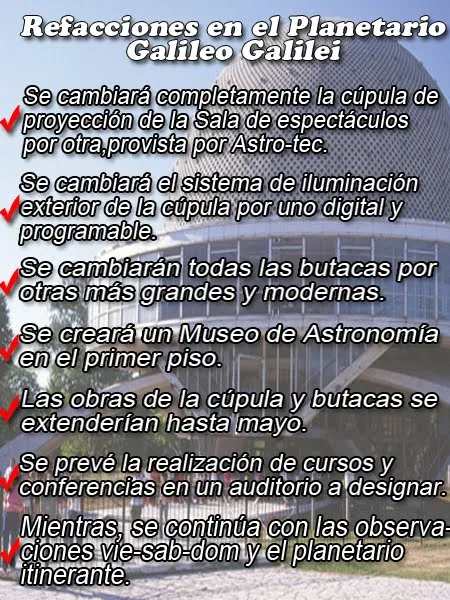
-Actually we are at a breaking point, let's say, at the Planetarium, since we are doing renovations like never before, all at once. We began a break at the beginning of the year, as we always do. The equipment needs annual maintenance, it gets a lot of use and we usually close from December 15 to January 15. This year we extended the closure of the Planetarium, inside the building, since the projection dome of the showroom is being completely replaced.
-Completely replacing what does that mean?
-Completely
-The inside part.
-The inside part is getting a completely new dome. The dome was very deteriorated. This building will soon be...
-44 years old.
-44 years old, so it has been running at full capacity all these 44 years of life. Behind it has a fiberglass wool where a lot of dust accumulates and since the plates of the inner dome are perforated aluminum, that dust is constantly passing through and deteriorates, visibly, let's say, and that harms the projection. So the entire inner dome, which is aluminum plates, is being replaced. Plates, also of aluminum, but of a different shape, but exactly the same size, will be installed, meaning the original structure of the building is not modified in any way. The seats will also be changed. This is the first stage of a modernization process.
-All the seats?
- All the seats. The seats have already completed their cycle.
-They are like those in old movie theaters.
-Exactly, they have completed their cycle. They are the original ones, we have been reupholstering them, but there comes a point where they are no longer usable. This is specifically...
-How many seats does the room have?
-Originally it had 360 seats.
-A good number.
-A console was added, over ten years ago, that reduced it to 340. And lately, as the room was in such bad condition, we really didn't reach 300 seats, because many were broken. Also we have a stage.
-In the middle.
-In the middle, which is for the play The Little Prince, which we have been performing in recent years, so the capacity was reduced, but we assume that, although the new seats are larger, because they are a bit larger, they will take up more space and we assume the room's capacity will be reduced. Because seats of the same size are difficult to find now. Now they all come like those in movie theaters.
-Will there be 250 left?
-Yes, I hope more. I hope it's 280.
-And besides the seats and the dome, which is not little, but is there anything else being done?
-Well, the project is also technological modernization. The incorporation of digital projectors and also, in the long term, the replacement of the Zeiss Planetarium with a more modern model.
-Meanwhile, will some renovations be made to the current instrument? Because those of us who come to the planetarium know that some LED doesn't light up correctly or on one side a little wrong, the brightest star in the sky is not... They are small things, the instrument can be used completely well anyway, you can see the sky well, but they are things one would hope to achieve at some point.
-Yes, exactly, we are on that. Anyway, the projection quality of this device is hardly comparable with others. I was at an international planetarium meeting last year and I have seen newer projectors, I have seen digital projectors and, really, the Buenos Aires planetarium, except for the technology, which is analog, not digital, visually, the lenses of this projector are incomparable. At this time there are no projectors that have this lens quality like the Zeiss planetarium has[1]. But it is true what you say regarding that, lately, there were stars that had less brightness, that some were out of place. We have replaced the lamps because the original planetarium lamps are no longer manufactured. We got Osram to adapt some special lamps for us, which are 1000W lamps, not common to find and they have the same power and the quality of the sky has improved a lot. We started using that in the last period of last year. When the planetarium reopens you will notice the difference.
-And when will that happen?
-I don't know exactly.
-Approximately.
-Approximately, we estimate at the end of April, beginning of May.
-Until then there will be no shows in the showroom.
-No
-And the courses that are usually given, which also take place in the same room?
-That's the issue. We are looking for alternative places to hold the courses. The planetarium courses are particular because they have all the tools of the projection room. That is, we use the sky, the projectors, so they are really special courses. So we will limit ourselves to projecting a powerpoint in a place, so as not to lose the courses until then, and we are looking for a place that is not too far away so that people who usually come to the planetarium don't find too much difference. So we are looking for an auditorium within the City Government to continue the courses outside the Planetarium, because here inside, until May, there will be no courses.
-At least until May.
-At least. And I hope it really is May. Works sometimes get complicated. You know when they start, but not when they end.
-The idea of the traveling Planetarium is very interesting. What is mobilized, who goes and how is the project currently?
-Well, today it is one of the two activities we are carrying out while the Planetarium is closed. We have the observations outside, on Fridays, Saturdays and Sundays, and the other activity is the traveling Planetarium. The traveling Planetarium emerged during my management to go so that they come. That is, it does not intend to replace the function of the Planetarium. It is a project that aims to motivate students, children, teenagers. We go to homes, schools, hospitals, different centers that call us and, in reality, it is an audiovisual projection and it is a workshop. We bring microscopes, we bring telescopes, screens with projection. The person who does it is a specialized teacher, the one who gives the talk, so they have good handling of the students, of the children. So we go to the schools and a whole projection is done with a game, with a back and forth and after that different types of workshops are done. The children handle, they take elements to handle. It is a trigger for the children to feel interested in coming to the Planetarium. That is, it is not an activity that replaces the function of the Planetarium nor does it intend to be a mobile planetarium, with a dome with a planetarium, it is not that, it is not the objective. The objective is a motivator that goes to the school and is giving excellent results.
-It is an educational project in astronomy, but not of sky motion projection. And today can schools in principle request that?
-Schools or schools, homes, institutions, clubs...
-From the City of Buenos Aires...
-No, from the City and Greater Buenos Aires. Actually it is a project that we are doing. The person who goes, goes with their own car. It is still complicated. Now it seems we got sponsorship from Citroën that will lend us the vehicles for the days we are going to use the traveling planetarium.
-Does one person go?
-No, it's a team. Three or four people go. A technician goes, because sound, lighting, a whole large apparatus we bring has to be provided. If we get a vehicle we could go further. For now we are moving in Greater Buenos Aires and the City.
-What other activities are planned for the city's residents during 2011?
-The conferences that we also give are very well received by the public because the fact that a scientist, a researcher specialized in a topic comes and is accessible to the public, especially people who like astronomy, who know astronomy, is something that is not so easy to have. Scientists are very generous and are very willing to come here to the Planetarium and we do cycles every year. Now, with the Planetarium closed it gets complicated and the idea is, in the same auditorium where we give the courses, to also bring conferences. We are waiting to see if this only lasts until April and if the modernization of the equipment continues that will lead to it being closed longer. That is, for now, the only thing that is going to be changed is this, but there is the second stage of the project, which is the issue of the projectors and if that happens it will be closed longer. So we have to think that, practically everything we do, will be outside the planetarium. That is the issue of this year, which is an atypical year. A year that I am happy that this is being done because it will produce a great change in the Planetarium.
In addition to the modernization, I wanted to tell you that we are also making a change in the external lighting of the building, which we are going to inaugurate now on March 11. This is also a very large work because it is very expensive, all computerized.
-We are talking about the lighting of the dome, the outside part.
-And of the building too, of the legs, all the external lighting of the building. It is a lighting with LEDs, different from what we had until now, that can vary... For a special moment we can do something with colors, in short, so we are also with a lot of expectation in that regard.
-That is used in other parts of the world, especially the great capitals, although it makes a little noise for me, allow me to be honest, because it is supposed that those of us who like astronomy fight for there to be darkness in the sky. And at the same time, perhaps, these events that are nice to see, the truth is that one enjoys them, not to be a hypocrite, but at the same time they pollute. And we are in a place where observations are also made. It is supposed that the two things will not happen at the same time...
-That is the idea. Since it can be changed and can be programmed the idea is that it has a lighting... We have the hope -we are still waiting, we don't know the programming very well- and what we want to project are constellation figures, everything that has to do with the sky, not that it be a Christmas tree, we wouldn't like that. In short, we are going to give it our touch, astronomical, to the dome, and on some special occasion, yes a special lighting that makes it seem like the Planetarium were a spaceship.
-It has the shape of a "flying saucer".
-And on the ring lights have been placed, with movement, and that gives the sensation that the Planetarium is moving. But we will only use it for certain occasions.
But it is true what you say regarding pollution. We are also jealous of that topic because we have the observation activity and now we have the opportunity to manage it and when there is activity with telescopes or we do live descriptions of the sky, as part of the activity, we turn off the lights so there is darkness.
-We can conclude that this year there will be a little less Planetarium, but at the same time with the concrete hope that there will be much more Planetarium.
-Exactly. We believe this is a stage that must be gone through. We thought it was going to be last year, but it was done this year and we assume this will be an important change for the building. At the same time, we are remodeling the first floor where 'Experiencia Universo' used to operate. We have removed it, because it was something very limiting for public traffic. We are working on a very important project to create an astronomy museum. We have been working on that since last year. It is very expensive...
-With display cases or something like that?
-We want to do something surprising, very technological, so an architect and an engineer who is a specialist in science museums are working on it and we have the advice of IAFE [2] regarding how to handle some content. And we need external help, we are looking for help, through patronage, because this is something very expensive. The City Government is putting a lot of money into the hall here right now, but for the museum we are looking for...
-Sponsorship or patronage?
-It is a public institution, so everything is regulated, if it were a private institution it would be simpler, so we are doing everything according to regulations, we are seeing through the Patronage Law [3] if we can get companies to collaborate with this project which is very expensive. We won't have it finished in a year, perhaps a first stage. But we will do exhibitions and we already have contacts with the embassies of Germany and France who will bring us exhibitions from these countries that are interesting.
-Thank you very much, Licenciada.
-No, on the contrary, my pleasure.
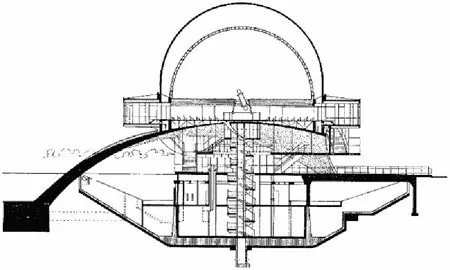
The building has two basements. One descends from the entrance hall via a helical staircase.
Notes from the interview
The company from which the dome materials were purchased is Astro-tec, apparently one of the best in dome supplies. According to comments by Licenciada Sendón de Valery, the company Carl Zeiss was consulted (since the Planetarium instrument is from that firm) and agreed that the supply should be from that company. Furthermore, according to the licenciada's comments, during her visit to Alexandria for an international planetarium congress (IPS 2010) she corroborated that it is one of the most valued companies in the field.
(I add that another prestigious company regarding domes is Spitz.) The hiring of this company would not have been done from the direction of the Planetario, although with its consultation, but directly from the Chief of Government of the City, under Horacio Rodríguez Larreta. Apparently there was no price competition or bidding.
My ideas
Licenciada Sendón de Valery seemed to me an upright, prepared, honest woman. I am giving a subjective opinion, clearly, of what I perceived. Appearances can be deceiving, as we know, but my dialogue with the licenciada extended beyond the interview transcribed above. That is why my feeling is that she is an intelligent and honest woman, but I also believe that the big decisions, at least those related to important hiring for the works being carried out, go elsewhere. And that the licenciada takes advantage, without asking too many questions, because she wants the best for the Planetario.
What worries me is the interference of private companies in the public sector. At least it worries me that projects end up being directed due to sponsorship. The company Scania sponsored the last soccer tournament, without that influencing the fundamental decisions of that sport in our country. That is to say, sponsorship does not necessarily imply negative interference. Seeking through the mentioned Patronage Law is not bad, since it is a concrete regime through which companies cannot do just anything. But we will have to be attentive. I prefer to pay for being distrustful than for being naive, it's a personal defect.
On the other hand, something must be added to the other side of the scale. Those materials for the construction of the dome are being supervised by UTN, since a technological endorsement for that project was sought. I myself, before the licenciada mentioned it to me, was able to see the large boxes inside the building with the inscriptions Astro-Tec and UTN.
Notes, Sources and related links
- [1]: The Planetarium instrument.
- [2]:IAFE - Instituto de Astronomía y Física del Espacio
- [3]: Patronage page of GCBA.
- Planetario Galileo Galilei
About the images
- Partial image of the Hall and Graphic of the structure. Credit: Planetario Galileo Galilei.
- The initial image includes a photograph by Sebastián-Darío on Flickr