Interview with Professor Pablo González, about what it's like to teach astronomy, computer science, physics, and mathematics. Also, we talk about the 2nd Young Astronomers Meeting.
A month ago I held a contest here. Among the winners, who were chosen randomly through Sortea2.com, was Pablo González. When I contacted him to give him the binoculars, he told me he was a teacher, that he was just starting his vacation and that, if possible, instead of mailing them to him, I should keep them until his return and he would come pick them up wherever I indicated. I replied that it was no problem and that was that. Three weeks later, upon his return, he contacted me by email to arrange the handover. That's when I realized I had already exchanged an email with him before. It's because I had been told earlier that he was organizing the Second Young Astronomers Meeting that I wrote about here.
When searching the web, I realized that although he was an engineer, he taught astronomy, physics, computer science, and mathematics. And then I thought not only about giving him the binoculars, but also about being able to talk with him and publish the interview.
He gladly agreed and we met at a café to talk about education.
-Who is Pablo González? You're a mechanical engineer.
-That's right. Almost completely converted to teaching because although I worked all my life in engineering, the foundational work, my first job and my current job is teaching.
-Your first job was as a teacher?
-Yes, it's something I discovered because I thought I would dedicate myself to science or technology and while studying engineering I was a lab assistant at Colegio Don Bosco, in Ramos Mejía. And from there, I discovered the teaching vocation. I believe the vocation isn't born, but is part of a discovery.
-But doesn't a person who wants to be a teacher have to have something?
-Yes, yes, absolutely. Every year I set out for it to be a personal year, of training, of growth, and I always end up doing some educational project, so that utopia I had of slowing down the work pace a bit, at least in the extracurricular part or the part related to astronomy, I could never fulfill. But I don't regret it because that is my happiness. The fact of being able to transmit what one knows, the little that one knows, and the much that one gains. Because when I started I thought it was a very demanding and very thankless job.
-It's not like that?
-It's still demanding, but I believe it's very rewarding.
-The gratification has nothing to do with the salary.
-Not at all. A teacher, to give you an idea, today accumulates salary for two reasons: seniority and accumulation of hours. Which in both senses is a perverse system. Why? Because although there is no career plan for the teacher, a teacher today doesn't start as a teacher and can end up as a principal, the jump is teacher-principal, there are no intermediate stages, where one could also categorize the salary, so from a logical point of view the issue of seniority is raised.
-Well, there's the issue of points, right?
-But it helps you to win competitions or win hours.
-Not to earn more.
-No, not at all. The score in teaching gives you the opportunity to get more work. And although the law states that one can have a maximum number of hours, by changing jurisdictions it's possible to dodge that, so the way to earn a decent salary is to accumulate hours. And that's a tragedy. Because a teacher who has 60, 70 hours is a teacher who is absent a lot, who doesn't teach well, no matter how much the guy knows and already has the topic he has to teach very well-oiled. I'm at my limit, about forty hours.
-To which you have to add the time for grading and preparing classes.
-Exactly. With that, my entire workday is already covered. Fundamentally, if I have to describe myself, I would say that Pablo González is a guy who is one of the few fortunate ones who enjoys his work.
-When one studies, one tends to think that some or much of what is taught is useless, that it doesn't serve a purpose. What is the point, in this context, of teaching astronomy? What is the point of learning astronomy? Do your students ask themselves that question?
-Well, I also teach mathematics. Precisely, they bring up all that abstraction of mathematics to me, not to mention the famous phrase 'What are logarithms for?', they ask me. And I used to think about it myself and tried to find the instrumental part, the application of mathematics in life, the practicality. But we must start from two things: first, that we have to abstract ourselves. Mathematics needs a certain degree of abstraction to be understood. That's where the kids question it. Because adding to know how to shop and not get cheated with the change, the kid will understand that, but if I ask him to solve a logarithm, no. So the justification comes from this side, and answering the astronomy question: it's a matter that goes beyond the immediate utility it might have. It's a matter of mental openness, of elevating the spirit and using the brain, of formation, of growing as a person. All this in an absolutely materialized, consumerist, directed, closed society, like the current one, anywhere in the world, sounds too naive, innocent. However, let's think that everything built through effort generates growth and mental openness. That's one side. The other is that of the teacher who focuses on memorizing concepts, names, and that is indeed unproductive. I don't need to know the names, dates, but the causes and consequences, why it was discovered, for example, that we are 150 million kilometers from the Sun, what were man's needs to observe the sky. Astronomy was the most useful science until clocks were invented. Until the clock, there was no science more useful than astronomy. Not only for measuring time, but for navigation, seasons, etc. But for me the greatest justification is from the point of view of personal growth. Later, when the kid knows a lot of things, he realizes where he can use them. But if he doesn't know them, he will find himself in a practical situation without the tools to solve it. And I'm no longer talking about astronomy, but about any science.
-Is it possible then to say that more than teaching astronomy, mathematics, physics or computing, you are trying to teach how to think?
-You said it: trying. Because I have many limitations as a teacher. My training is scientific-technical. I have a natural part, but I am not pedagogically trained. That deficiency makes me focus more on some methodology that I received as a student and that seemed good to me for the kids. Not only is education absolutely dynamic, but it is also boxed in. In what sense? I believe everyone would like to be a teacher if the kids behaved well, if the building conditions were ideal, if the means to teach were total, if the time to prepare the class and evaluate were necessary, if one had an assistant, if the kids didn't have to wear uniforms, didn't have to keep schedules, the bell didn't ring, there was no need to give grades... Faced with all those situations I believe many people would be teachers and with absolute happiness.
-How does one deal with that?
-Precisely, one deals with it.
-With the kids' behavior?
-Well, that is something I knew how to handle. I can say that is one of my qualities. A friend has a keychain that says "To educate is to love." And I believe that is fundamentally it. Of course one has to know. If I have respect for the kid, they automatically respect you. In my twenty years of teaching I learned that you stand in front of the class and the kid at that moment takes an X-ray of you and it is practically infallible.

-And what do the students look at?
-How you stand in front of the class. They don't even look at your clothes... I usually wear a jacket and tie because later I go to the university, but the day I don't wear a jacket and tie I am the same teacher. The kid detects what respect you have for him. They don't even look so much at whether a person knows or not. But at whether you respect them, if you are going to run them over, if you have some problem, if you are looking at the clock to leave, if you want to "get by" with the class, if you prepared the class.
-Sometimes the student can confuse between the "buddy" teacher and the "demanding" one and only when it's over does he realize that the latter is the one who perhaps left him something.
-That's right. The one who is remembered is the one who left something. And if he didn't leave me knowledge of his subject, at least he left me a lesson. Sometimes it's not about teaching content. When I started, I killed myself to finish the syllabus, for the tests to be perfect, I was very strict in that sense. Now I pay less attention to that and more to what one transmits. And when one becomes aware of to what extent one can modify a life by being a teacher, it should give one chills, shouldn't it?
-Any example?
-A computer student. When I started the astronomy workshop, he was in first year, and he came to show me something. And I told him: "Yes, yes, we'll look at it later." Although I didn't treat him badly, at that moment I ignored him, perhaps without realizing it. Despite that, he stayed in the astronomy workshop. When he graduated and we continued being friends, he told me that and I realized that a gesture, a word, an attitude that one doesn't measure, can do a lot of harm. The same, the other way around. If one puts a look, at the precise moment, one changes the kid 180 degrees. Having the power of change, not of decision, of change, over human lives in that so sensitive stage of growth scares me. That is where one has to have lead boots. One cannot exceed with language, with attitudes. One cannot shout, get angry. It all sounds very nice. But you have to be 40 hours teaching with all the limitations I mentioned and with kids who hormonally change too much from one year to the next, from one month to the next. And also, let's add, a social problem that is not that it didn't exist in my time, but that was contained on the other side.
-Are we talking about drugs?
-No, not only. Today the social perimeter and the family context are different. Before the family was the nucleus and cases where they were poorly constituted were exceptional. Now, teaching takes a back seat, you have to contain the kid affectively, emotionally, in some cases economically with some scholarship. And then there is the issue of drugs. But you have to avoid stigmatization: of thinking that "you because you are a drug addict, dark-skinned or immigrant you won't get anywhere." You have to be very careful with that thinking that because you got this far you can't go on. The kid feels that and it's a setback.
-Have you had pregnant students or boys who are going to be fathers?
-Yes, quite a few. I have a girl now who has been a mother for two years, and she is brilliant. There comes the issue of stigmatization. One thinks that because she became a mother and theoretically "made a mistake," which maybe it isn't, but that socially she is condemned as such, from there to think that she won't be able to because she has to breastfeed, take care of the kid. No. This girl demonstrated the complete opposite. It's true she has a good family structure that supports her, but apart from that she showed that she is much more diligent than many of her classmates.
I have been mainly in private schools, but also in public ones and in fact today I work in a state institution, at the UTN. One can talk about economic differences, uniforms, family structure, but the kid is the same everywhere. What changes is the context.
-There is an idea with that, linked to the average student. It is logical to think that if they previously studied the same contents, they will know the same, that the social context can be similar. But, ultimately, we are all different. Some with greater or lesser difficulties to learn, for example. How is that handled? Is it ignored and you move on or is it possible to stop more personally?
-One of the limitations, besides the fact that education is corseted in schedules, plans, years, cycles, a structure difficult to break and which, on the other hand, you need some framework as a reference, besides all that there is the limitation of the number of students. Theorists talk about...five, six. I would be happy teaching twenty. Then I could do personalized education. With forty it's impossible. Even so, with time, with tutoring, but also with other resources like dividing the class by levels, there are possibilities, but in the current context there are two options: we move forward or we level down. I try every year to give the screw another quarter turn, to demand a little more. I still find a very good response from the kids. One of the fundamental issues is motivation. You can motivate from within the class or outside the class. The second is much easier, because the kid isn't rigid. That's where the popularizers are, those who run workshops, those who come from outside. There everything is great. But when you have the forty kids sitting down, trying to get them to be quiet and for everyone to understand at least one concept, that's when it becomes difficult for you. One of the things I learned is to cut back on content. Encyclopedic education did not yield the expected result. It improved the general culture of society, but the harmful effects of that education are being seen.
-You teach astronomy. In two schools. In the morning and in the afternoon. How can you teach astronomy without looking at the sky?
-It's as Konstantin Tsiolkovsky said: 'You have to foster imagination.' I can have resources: videos, models, looking at the Sun during the day. But I try to foster the act of imagining and doing what the Germans called 'thought experiments.' For example, the other day we considered that the classroom was our spaceship. What conditions should this environment meet to travel into space? I also use the multimedia part, but one has to go beyond resources. One should be able to teach physics with a string and a stone. I'm also using games, some inspired by NASA, like a Goose game or trivia. And some I came up with myself, like having a series of photographs and ordering them on a Cartesian axis based on size and distance.
In Book VII of The Republic, Plato brings us the juicy dialogue between Socrates and Glaucon on the importance of astronomy: it forces the soul to look upward. Not for the details. True teaching is not in staying with the beauty and order, but in glimpsing what lies beneath, in the speed and movements of the stars. For education, in astronomy and in the sciences in general, to be something more than a collection of data, to allow going beyond the mere utilitarianism or practicality of knowledge is, perhaps, a utopia. But as Tsiolkovsky seems to have said: 'Today's impossibilities will be possible tomorrow.'
Applause, medal and kiss
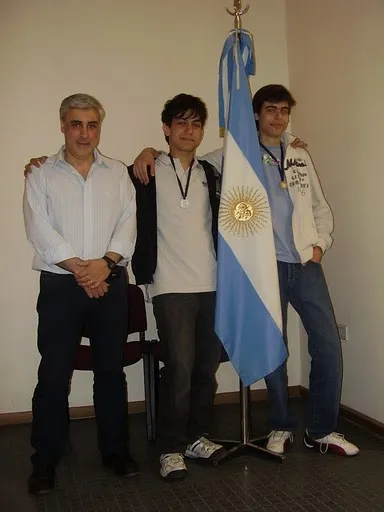
Pablo González was the tutor professor of Agustín Girola and Federico Duca who, from the ORT Technical School - Almagro Campus, obtained first and second place, respectively, in the 2010 Argentine Astronomy Olympiad at Level 1.
2ND MEETING OF YOUNG ASTRONOMERS
OCTOBER 28, 29 AND 30, 2011
Buenos Aires - ARGENTINA
Since I originally wrote here about this meeting until now, the program has expanded with a more than interesting offering. Talks and Workshops with the participation of prominent scientists in astronomy and astronautics. Launching rockets, observing the sky, didactics for teachers, learning about scientific news firsthand, are some of the attractions of this meeting.
It takes place over three days, with accommodation and meals included, at Casa San José, Route 2 Km. 42,800 - La Plata - Province of Buenos Aires.
Vacancies are limited and it is about to close. Participation has an economic cost, but it is possible, if necessary, to request some help/scholarship. I recommend visiting the site of the 2nd EJA and seeing the details there. In case of any doubt or requiring more information it is possible to consult Pablo.
Sources and related links
About the images
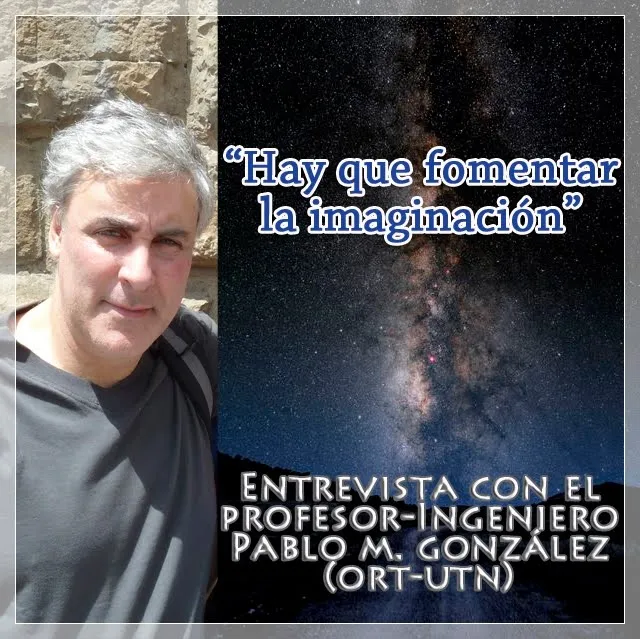
- Initial image: Combination of a photo of Pablo González (Credit: P. González) and the Milky Way (Credit: Larry Landolfi).