Interview with Dr. Alejandro Gangui, Argentine astrophysicist, on astronomy, education, and science communication. Second part.
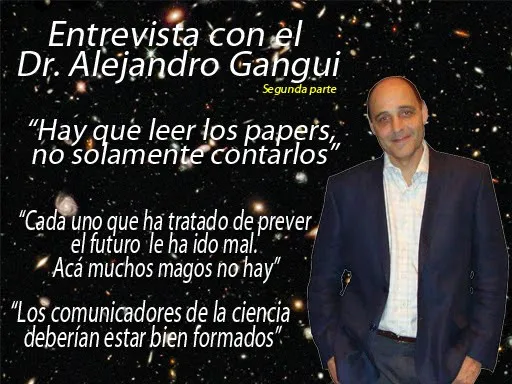
The following is the conclusion of an interview whose first part has already been published.
-In Argentina, a lot of research is done. There are many astronomy and astrophysics "papers". More than I would have suspected a few years ago, despite not having large instruments: Casleo, La Plata, Córdoba comparative instruments...
-...with people from abroad. But we should also consider the following: the number of publications should not be a parameter of how well the country is doing.
-And how do we estimate it?
-Well, you have to read the papers, not just count them.
-The quality.
-And yes, we are looking for the quality...
-But, nowadays, the h-index [3], the number of citations, the impact factor...
-That points a bit to how long the papers' memory is, let's say, what is the forgetting horizon of your paper. If the forgetting horizon is one year, it means that after a year...that's what Brandon Carter used to say, I remember. There are many horizons in cosmology: the cosmological horizon, the black hole horizon, and the papers' horizon...
-Still, within a decade you take an old paper and who knows what can happen. The binary system was thought of for one thing and then computing ended up developing.
-Clearly, the issue is having access to that. And, among all this sea of things, being able to find that paper you need. Production has multiplied so much that, it's what happens to one. You find twenty papers you should read, twenty papers you found cited and I manage to get five and read those five, which maybe are not the right five. And about the others I never find out because I can never get them, because I don't have the funds to do it, because I don't have anyone to look for them for me. With there being so much, it's hard to locate the ones that are really important. It's fine, it seems logical to me that everyone publishes and a lot is published, but it's true that it makes a lot of noise. There is a lot of noise and it's difficult for someone who is not extremely expert or well-informed, to find out...
-But then politicians are the ones who have to distribute the funds and somehow they have to decide where they will go and decide what science is doing well, doing poorly, where something needs to be improved. How do they do it?
-Well, they are scientific policies that can give advantages to your area or may not be so. Evidently if one considers that astronomy is not as essential as other sciences, for example long-standing diseases...
-That's why I asked before.
-No, clearly. The issue is that being satisfied with already having the computed tomography scanner and well that's not enough, it has a development and if it ends up in a new scanner or something that improves people's health, much better. Trying to cut from the research side and trying to steer the research so that everyone goes in the same direction, in general, has not worked. And in general it's dangerous because the freedom of creativity...
-It's important.
-You have scientists who want the freedom to study ridiculous things, like why does a banana peel slip?, although maybe there are things that seem more important, but then the banana issue ends up being more important because it leads to a new material, that is, it's very difficult to foresee what will happen and everyone who has tried to foresee the future has done poorly. There aren't many wizards here.
-But is there any way to know if astronomy/astrophysics in our country is doing well or poorly?
-Yes, there are indicators, the number of researchers, the issue of the papers, and that depends a lot on the money available in the institutions to allow researchers to collaborate with people from abroad. Because while it's true that here there is only El Leoncito and other places and the guys are observational...
-Or use Gemini. [4]
-Use Gemini remotely, the optical internet has to work well, it implies a series of things that don't depend only on you, it depends on an entire research infrastructure. That has to do with tradition, with the support that type of science has had in the country for a long time. In this era, a bit more reactivation is seen, that salaries are better, that money flows a bit better. But Argentina is cyclical. If the solar cycle is 11 years, maybe next year... (laughs)... but well that never becomes entirely clear to us. But for the moment people take advantage to do as much as they can with what they have at hand.
-Among other things, astronomers and astrophysicists have to build software to publish their data.
-Yes, clearly.
-And do they do it well or poorly? I say this because there are some recent works pointing out that astronomers, scientists in general, don't know how to make software.
-Well, they weren't prepared for that, right?
-And in Argentina, is there no specific training, is it only self-taught knowledge?
-Yes, they have computer science and programming courses in college, but in general when things have to be done well, either they are exceptional guys, or they are people who get into collaborative work. Computer specialists in collaboration with people who do astronomy. Also the observations. Not everyone goes to the telescope. On one hand, one would like to make the whole shoe. Sometimes one makes the eyelet, another the laces, another the leather. That depends on each person. I suppose people should, at least not be experts in, but try to be well informed about what their colleagues do. But that often doesn't happen. It all depends on each person's curiosity. As in all human activity, there's a bit of everything.
-What does it feel like, Alejandro, to be a cosmologist? From the outside one sees that they have to be people who know a great deal, about physics, mathematics, English, programming. And they ask important questions. From the outside they are, in a certain sense, admired. With some caution...
-It's like the one who works on black holes and it sounds good. But when you start studying black holes it's like the physics of any compact object, but black hole sounds much nicer. There's a bit of snobbery with all that. As also happens with biologists, those who do biology in the traditional way, maybe like the old naturalists or with a bit more current technology, but who say 'We are losing enrollment' because everyone wants to dedicate themselves to molecular biology.
-In astronomy, with data from Conicet, astronomers (not physicists) are very few. I think there are about 150 astronomers and 130 thousand doctors, in Argentina.
-The medical sciences have always been much more numerous...
-And social sciences much more...
-Yes, there are also many. But the type of work is very different. The astronomer needs facilities to work, while those in humanities often don't even need them.
-Just a library.
-Right, sometimes that's enough for them. Here we need a little more. You depend a lot on the computer and the computer system and consulting a lot of bibliography to know if what you are doing hasn't been done by someone before. Well, like every area it implies a series of infrastructure. And regarding cosmology itself, it sounds very pompous, but it's applying known physics to study the cosmos. In general it should be much simpler than other types of physics. We are not studying the molecules that make up a living being. We are talking about large concentrations of mass, but which are seen practically as little dots. In general cosmology is very simple. Now, it has many variants, many models of cosmology and implies advanced mathematics. But it's not as difficult as other areas that could get into aspects of how a living being organizes itself which can be much harder than trying to understand a cosmology paper. That is, this is mathematics, computer science and having ideas of what could be a good evolution, a good behavior, a good prior history that takes into account the universe you see, in the data one is gathering and trying to make that fit well with the theoretical part.
-Simulations are also done.
-Yes, regarding imagining how the universe was in the past, according to the number of points, of matter you put in the simulation, you can represent a piece of the universe large or small. Then you have a lot of range of evolution in your numerical code...
-And big computers. I think in Argentina, what Dr. Tissera [5] does is very important, but if one compares it with other simulations like Millennium and others, they are small.
-That's why people here collaborate with people from abroad. They are connected with people who have much larger computer systems. There are also people who go to CERN. Evidently an accelerator is difficult to build, so we prefer that they have it in Geneva, so that if something happens it's far away (joking), and here people travel.
-Speaking of the accelerator, in other countries there is a permanent custom of researchers telling the public what they do: press releases from universities or telescopes. Here what researchers do is little known. Occasionally something in some newspaper, in magazines like Ciencia Hoy, but what is disseminated is little.
-On the part of science communicators or on the part of researchers?
-I think on the part of researchers because communicators have to find out somehow what researchers do.
-Well, there are two things. First, science communicators should be well trained. A person who does science communication cannot communicate, with the same degree of relevance, things about astronomy with things about biology. It implies that the person is extremely gifted, extremely trained, or that things go over their head, that is, it requires specialization in the area the person wants to cover, otherwise one stays on the surface and sometimes messes up, makes mistakes and something said wrong by a communicator is a shame because they have a lot of access to people. So they should be very careful with the things they say. Therefore they must be trained, apart from their qualities as a communicator, which, evidently scientists in general do not have. On the side of scientists who set out to communicate, yes, there isn't much because traditionally it hasn't been a very valued thing. Nowadays, little by little it's being valued a bit more. It depends on what one does. One can write an entire book, it takes a whole year or two, and that isn't worth much, at least it wasn't worth much for Conicet or for the University. In general the researchers themselves are discouraged from doing that type of work. A work that can reach the general public implies that the work is not technical and is well written, so that the public is interested and can understand it. You don't show graphs that the public could never understand...
-Or equations. Stephen Hawking said they told him not to put equations in his book because it scared people away.
-Well, but it's true. Unless you have an equation and you treat it like a kind of painting and describe it as a painting. An art historian is capable of describing a painting; a physicist, a mathematician, if they put an equation, they have to be able to describe it in great detail and that takes up a lot of space. That's why it's discouraged by editors. Not only are equations scary or poorly placed. The same with graphs. Often you put a graph in a book or an article because it's really nice and you think your peers will say 'Ah, great, what a good level' because you put that graph, which is very hard to interpret. No one will understand it. What is useful are things that gradually lead the public to understand at least 30 or 40 percent of what you want to explain. Those books or articles are not for you to show everything you know, but for the reader to know a little more.
-For them to understand.
-And well, in general, scientists are not prepared for that. If on top of that you think that the institutions or those who evaluate us, they don't value that very much at all, the result is that no one is going to do it.
Sources and related links
Notes:
- [3]: I'm referring to the h-index.
- [4]: Gemini Argentina
- [5]: Dr. Patricia Tissera, Numerical Astrophysics Group, IAFE.
About the images
- Combination of: Photograph from the 2009 Science in Stories Contest. Credit: Viviana Bianchi; with background image of Hubble Ultra Deep Field Infrared. Credits: NASA, ESA, Z. Levay (STScI), G. Illingworth (UCO/Lick Observatory and the University of California, Santa Cruz), R. Bouwens (UCO/Lick Observatory and Leiden University) and the HUDF09 Team.