A video shows a map where events were geotagged according to Wikipedia.

Gareth Lloyd, a BBC software engineer, says that many articles on Wikipedia are tagged with geographic coordinates. Many have references to historical events. By crossing this data it is possible to have a dynamic visualization of the world's history, according to Wikipedia.
This is based on what Lloyd and Matt Patterson did for the History Hackday, an event to make historical documents accessible and understandable.
The best visualization was this duo's.
What they did was take the data from Wikipedia articles, in its English version. In total about 424 thousand articles and 35,000 references to events. They linked 14,238 events with places and then created a visualization of that data.
The tables with the data are available, in case anyone wants to look at them, as is the source code of their work.
The video lasts 1:42 and begins in the year 499 BC. The year passes quickly and can be seen in the lower right corner of the video. For the first few seconds the time value is covered by the Vimeo overlay.
A History of the World in 100 Seconds from Gareth Lloyd on Vimeo.
As expected, until the 15th Century there are almost no visualizable events in America. The European and Asian Old World lights up almost exclusively until 1200. And after 1400 the world explodes with lights, increasingly.
Beyond the bias that undoubtedly exists in the work, from a historical point of view by taking exclusively Wikipedia and in particular its English version, it is certainly an interesting concept.
You can get an idea of the static distribution of the coordinates in this Google Maps heat map:
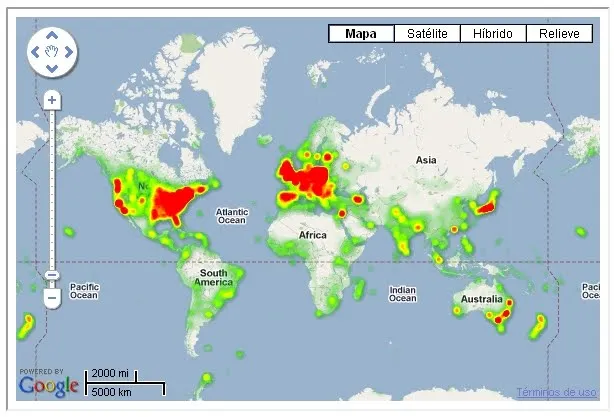
Where are the geographic coordinates in a Wikipedia article?
I searched for a random reference among the cited tables, I took an article that randomly was 107 The Bee, a radio station. I went to the article on Wikipedia and:

But we can find the same in other articles. For example, the city of Banfield on Wikipedia in English and also in Spanish.
To learn more, visit Lloyd's page where he explains how to process articles from Wikipedia.
Sources and related links
- A history of the world in 100 seconds
- Flowing Data: History of the world in 100 seconds, according to Wikipedia
About the images
- Images by Gareth Lloyd.