At the intersection of two imaginary circles lies a search for Nature's equilibrium.
Recently I was talking about the use of analogies, which can be fabulous in their proper context. I don't know if I'm forcing this comparison, but I find it attractive.
A few hours ago, the Sun reached an intersection between two apparent circles. The circle of the ecliptic and that of the celestial equator.
I don't think it's necessary to explain, because we already know. It's not the Sun that moves around the Earth, but the other way around, but from here it seems that the star moves across the sky. That path is called the Ecliptic. And twice a year, on that path, it intercepts the Celestial Equator, a projection of the Earth's Equator onto an imaginary sphere (the sphere of the sky or celestial sphere). Although both circles are imaginary, they are useful for determining positions.
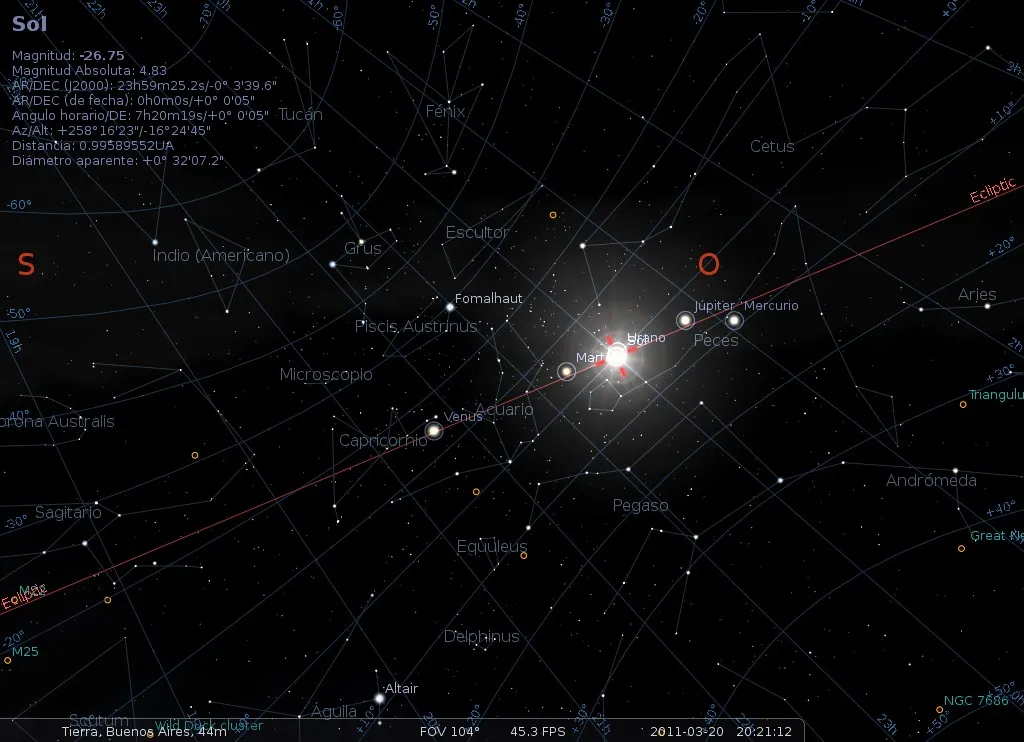
Geographically speaking, on those two occasions of the year, which are called Equinoxes, the Sun rises in the East. We are used to saying that it always happens that way, but in reality, except at those two moments, the Sun rises a little more to the North or to the South and not exactly in the East.
Do you want to check it? Today is your day. Wake up early (or go to bed late), so you can see the rise of our star. There will be the East. It is supposed that the opposite side is the West, but if you don't want to make a mistake, today itself determine where the Sun sets. You can make marks on your terrace or in the yard or take some element as a reference.
Repeat this same thing throughout the year (on the solstices would be ideal) and you will have made an empirical verification. If you have children, grandchildren, nephews, students, it can be a moment to share and educate.
So the Sun will be at the Aries Point (or rather Pisces Point) and will be 12 hours above the horizon and another 12 hours below. It is this symmetry that triggers my analogy with the search for balance, although it would be reinforced in six months with the Sun at the Libra Point (although it wouldn't be that, but rather Virgo Point, right?).
The water problem
And if we talk about balances, since tomorrow the 22nd is World Water Day, it would be good for us to think about this objective so precious in theory and so difficult to achieve.
On the special site created by the United Nations for this celebration we are told:
The objective of World Water Day 2011 (WWD 2011) is to focus international attention on the impact of rapid urban population growth, industrialization and the uncertainty caused by climate change, conflicts and natural disasters on urban water supply systems.
This year's theme, Water for cities: responding to the urban challenge, aims to highlight and encourage governments, organizations, communities and individuals to actively participate in responding to the challenge of urban water management.
Let's do the math: About 7 billion people live in the world. 3,300 million of whom live in cities. Roughly speaking, half. One in two people lives in a city. The urban population is increasing faster than the capacity of its infrastructure to adapt.
The scenario is worse if projections are made, since it is estimated that in 20 years it will already be 60% of the population living in urban areas.
The relationship between water and cities is crucial. Cities require an enormous supply of fresh water and, in turn, have a great impact on that resource.
While you and I have drinking water at very low cost, there are 828 million people living in poor neighborhoods or settlements who do not have that possibility. The alternatives are: drink non-potable water or buy water, which costs them much more than it costs us. Those who have less, pay more.
Add to that pollution, the amount of waste that is disposed of through watercourses. Among other things, this pollution promotes cholera, diarrhea and malaria outbreaks.
Wait, there's more. As if that weren't enough, we waste, through leaks and inefficient systems. If less were wasted, millions of people who do not have access to drinking water could have it.
The imbalance
How is this state of affairs possible? On this issue, as in others, it is possible to have different perspectives, which are often presented as antagonistic, unbalanced.
Physics stipulates that one only builds in imbalance (e.g., thermal imbalance). And dialectics also proposes a kind of antagonism that can be productive. Agreements and disagreements are often as provisional as the passing of the seasons or the liquid state of water.
Recently I read on Francis's blog an interesting entry that says that sometimes environmental entities are "eco-intransigent," exaggerated in making their demands and that their claims are not scientific, but are presented as indisputable.
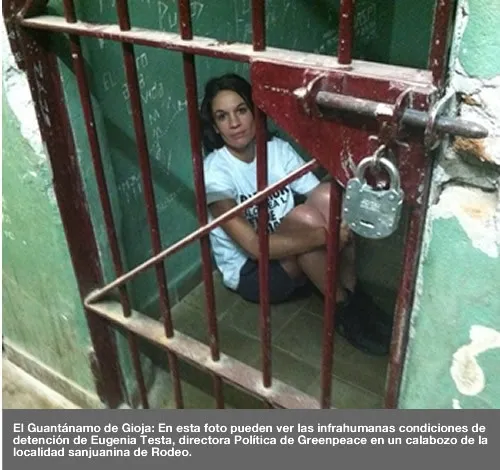
The issue of nuclear energy these days has awakened a certain exaggerated mood. Greenpeace just launched an anti-nuclear campaign, for example.
As I pointed out in a comment on that note by Francis, I believe it is possible and necessary to seek a balance. While it is true that claims must be scientifically contrasted, it is no less true that if it were up to the industries, almost nothing would change, because providing environmental security implies a cost. Green organizations, even with exaggerated demands, propose a change, an improvement. And, in fact, most of their demands, when achieved, are at a lower level than requested. But I prefer to demand a change than to stay with the status quo.
There is the issue of water. Mining companies, paper mills, etc., all have their arguments, all present environmental impact studies, none pollute. If we stick with that, we are surely going down the wrong path. And, it must be said now: the decisions are ultimately a matter of political will. It is not the scientists' responsibility to make these decisions. So when evaluating between progress and risk, we must listen to both sides. With verifiable data, without bias, and with the human concerns of the case.
Let's look at the sky this noon. There is a balance there that we must also seek here. In one hemisphere it will be sowing time, while in the other it will be harvest time. In one part of the world it will rain and somewhere else clouds will form.
May this boreal spring and austral autumn, we try to seek that balance between the possible and the impossible.
And may those clouds not cloud our reason.
Sources and related links
- Planetarium: Equinox
- United Nations: World Water Day
About the images
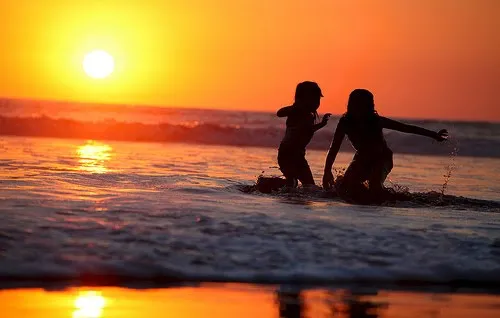
- The first image is a beautiful photograph from Cycle for Water, a Flickr group for WDD 2011.
- World Water Day logo, United Nations.
- Screenshot from Stellarium.