Astronomers have used powerful telescopes sensitive to X-rays and infrared radiation to find evidence of a substantial population of massive stars that emit X-rays.
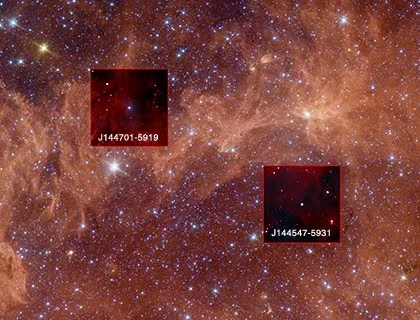
The image shows infrared data from Spitzer near the plane of the Milky Way. Both insets contain an artificially darkened view of the data to highlight a bright X-ray source in blue, detected at the center of each inset with Chandra.
Analyzing the data at different wavelengths revealed that these bright sources are very massive stars. Two other massive stars have been found near the plane of the Milky Way using similar methods. Deep observations made with XMM-Newton also provided valuable information on these two objects. These four stars (named AX J163252-4746, AX J184738-0156, AX J144701-5919 and AX J144547-5931) are at least 25 times more massive than our Sun and lie between 7,500 and 18,000 light-years from Earth. Due to their enormous mass, these stars will live briefly, only a few million years, and will end their lives in supernova events.
Why do these stars shine so brightly in X-rays?
Some massive stars have winds that expel material from their surface at millions of kilometers per hour. If this fast-moving material collides with the winds of a companion star, it slows down so rapidly that it acts as if it had collided with a wall the size of the Solar System. The resulting shock waves from the collision generate temperatures of up to 100 million degrees and produce copious amounts of X-rays.
The Chandra observations follow a previous survey of the Milky Way's plane called the ASCA survey. That survey detected about 160 X-ray sources, but only a third could be definitively identified, due to ASCA's limited spatial resolution. But the Chandra X-ray Observatory can add the necessary precision. Many other unidentified Galactic X-ray sources still remain, so the population of massive stars remains to be discovered in future observations.
Video: Images of J144547-5931 and J144701-5919
http://www.youtube.com/watch?v=VkeTFkXjjV8
Sources and related links
- Identification of a Population of X-ray Emitting Massive Stars in the Galactic Plane
Gemma Anderson et al.
ApJ 727 105 DOI: 10.1088/0004-637X/727/2/105
arXiv:1011.3295v1 [astro-ph.HE] - J144547-5931 and J144701-5919: Hunting for the Milky Way's Heaviest Stars
About the images
- Images of the stars detected by Chandra and Spitzer: J144547-5931 is in the constellation Centaurus and J144701-5919 in the constellation Circinus, the compass, visible in the Southern Hemisphere.
Credit; X-ray: NASA/U. of Sydney/G.Anderson et al; IR: NASA/JPL-Caltech