A collection of links to music, images and videos relating art and science. Today: Images: The loop, the swan, the broom and the witch, Caught red-handed, The cosmic Green Lantern ring; Sound: Jay Baker and a Circle of space and time to listen to; and TED Talk: J. Drori: What we think we know.

Images of the decade
NGC 3132
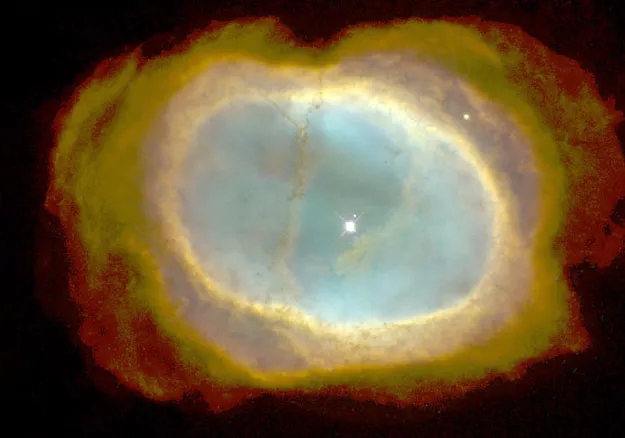
It is the fainter star, not the brighter one near the center of NGC 3132, that created this strange but beautiful planetary nebula. Commonly called the Eight-Burst Nebula or the Southern Ring Nebula, it is located in the constellation Vela about 2,000 light-years away.
Credit: Hubble Heritage Team (AURA/STScI /NASA)
It was NASA's Astronomy Picture of the Day (APOD) for June 24, 2001. Also in Observatorio.
The loop, the swan, the broom and the witch
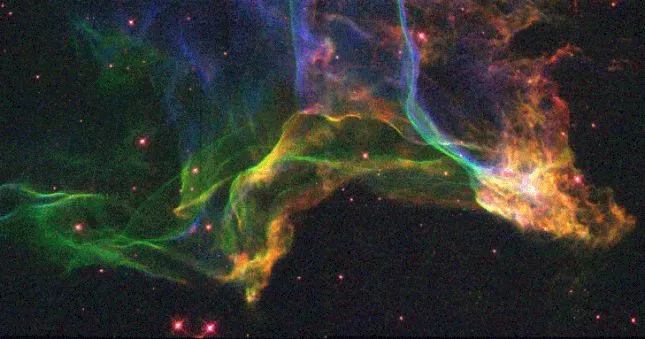
The shock wave from a 20,000-year-old supernova in the constellation Cygnus is still expanding into interstellar space. It is located 1,400 light-years away and its catalog number is NGC 6960/6995, although it is also called the Witch's Broom Nebula.
Credit: J. Hester (ASU), NASA
It was NASA's Image of the Day for June 23, 2001. And in Observatorio.
Images of the week
IRAS 22036 5306
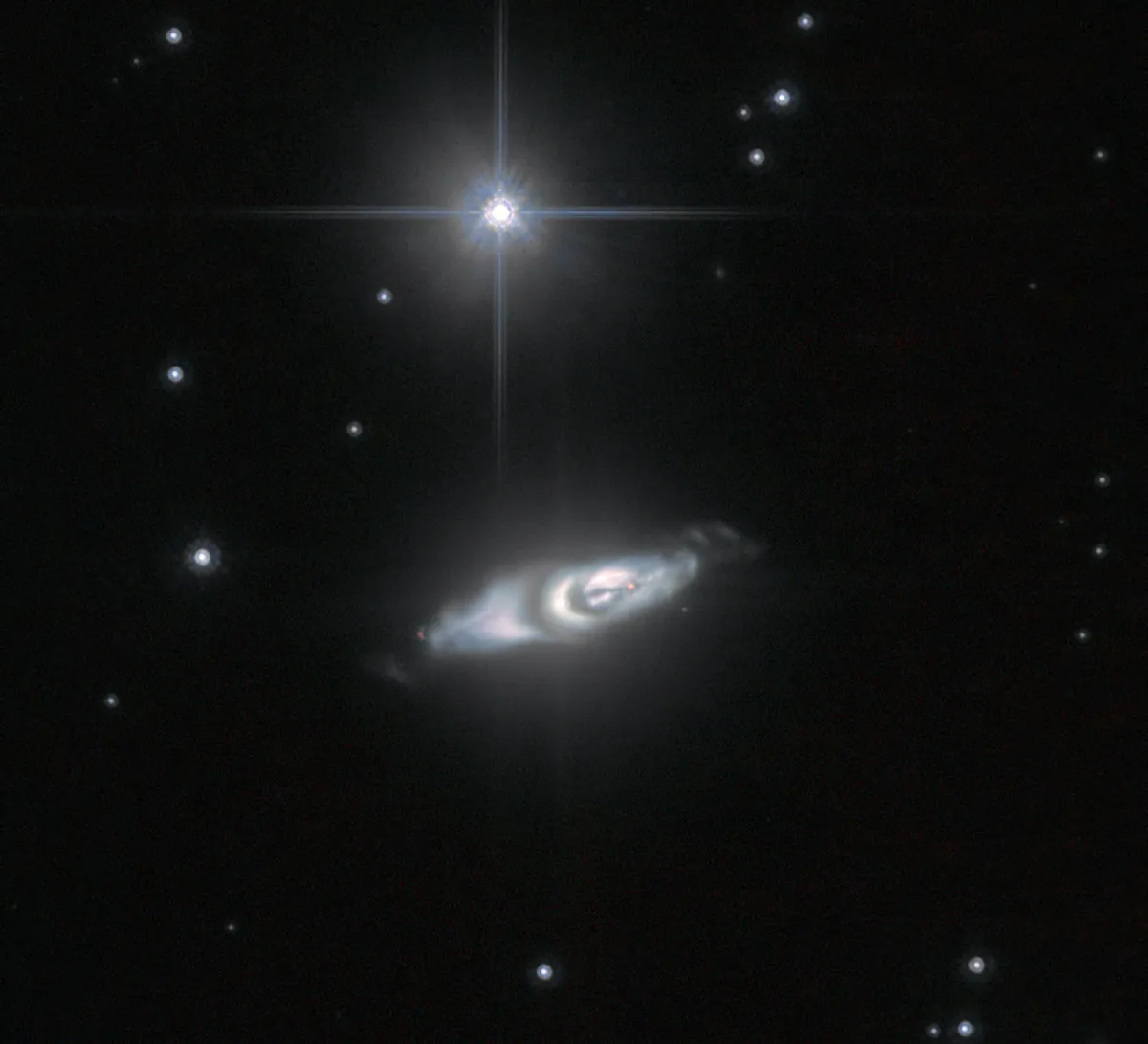
A rare Hubble capture: near a nearby bright star in this image, the strange spiral object known as IRAS 22036+5306 was captured during a brief and tumultuous period in the late life of a star.
Inside the object lies an ancient star that expelled nearly all of its outermost material forming a cloud. Within that veil, the dense exposed core of the star shines hotly.
It is the short transition of a protoplanetary nebula. Soon, the central star will be a white dwarf whose intense ultraviolet radiation will ionize the surrounding gas, making it glow colorfully. This rare object is located 6,500 light-years away, in Cepheus.
It was the Hubble Space Telescope image of the week.
Credit: NASA/ESA
Caught red-handed
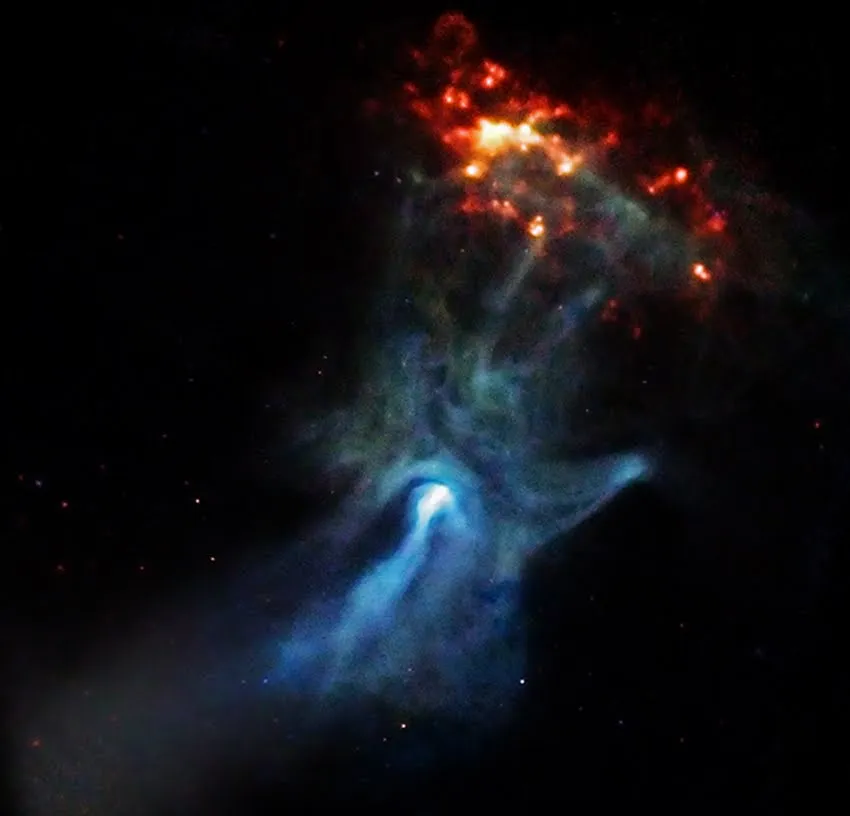
This famous Chandra image corresponds to a highly magnetized nebula by the pulsar PSR B1509-58. The pulsar is a rapidly rotating neutron star, about seven times per second. At the tip of these fingers lies a gas cloud known as RCW 89. It is a supernova remnant that together with RCW 87 forms part of the same structure at about 3,000 parsecs. RCW is a catalog of H-alpha emission regions in the southern Milky Way, compiled by Rodgers, Campbell and Whiteoak.
Credit: NASA/CXC/SAO/P.Slane, et al.
It was the image of the week at HEASARC.
An active galaxy in Centaurus
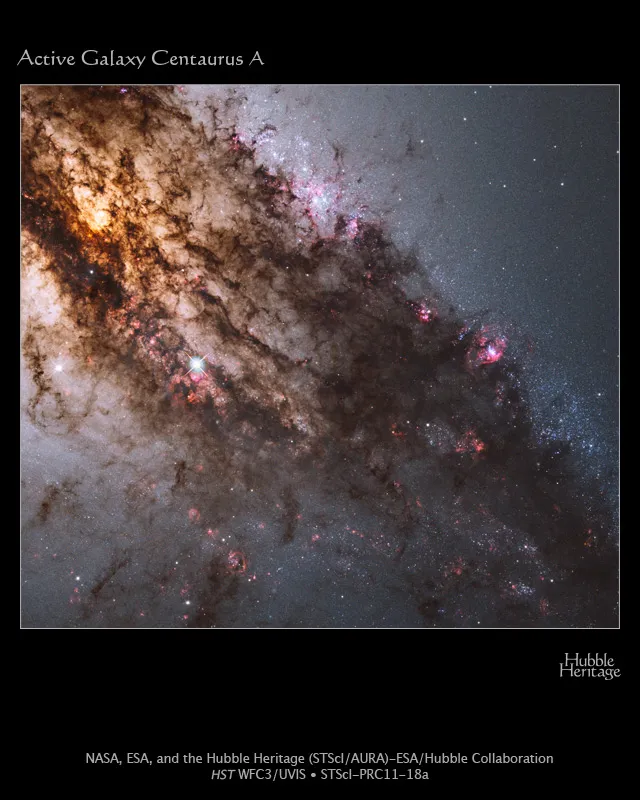
Dark lanes of dust cross the giant elliptical galaxy Centaurus A. Hubble's vision reveals the glow of young clusters of blue stars. It is a lenticular galaxy 11 million light-years away, also known as NGC 5128. It is one of the brightest galaxies in the sky, near the bright globular cluster Omega Centauri.
Credit: Credit: NASA, ESA, and the Hubble Heritage (STScI/AURA)-ESA/Hubble Collaboration
Acknowledgments: R. O'Connell (University of Virginia) and the WFC3 Scientific Oversight Committee
The image was released on June 16, 2011 on HubbleSite and there is a zoom version of the image.
The cosmic Green Lantern ring
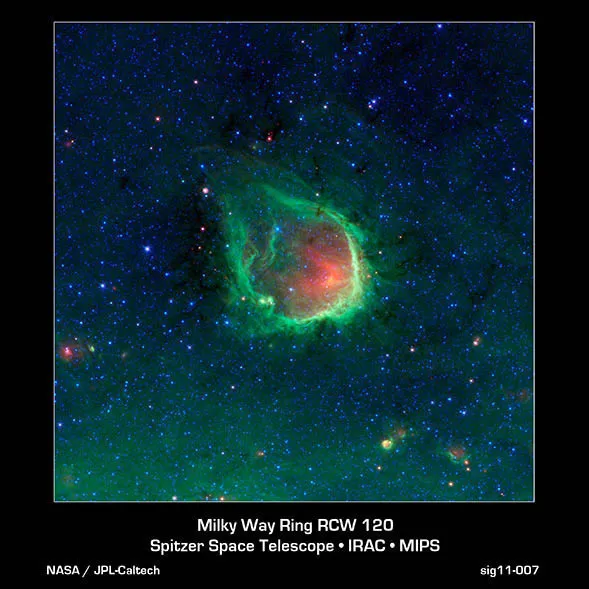
This emerald-colored nebula captured by Spitzer recalls the Green Lantern ring. In the comics, the guardians of planet Oa forged this powerful ring, but astronomers believe that rings like this are sculpted by the powerful light of spectral type O stars, the most massive known.
It is part of the RCW catalog as entry 120 and lies in Scorpius 4,300 light-years away.
Credit: NASA/JPL-Caltech/GLIMPSE-MIPSGAL Teams
It was published by Spitzer on June 14.
Space Music
Today: A circle of space and time
This album by American artist Jay P. Baker, called A Circle Of Space And Time, contains 10 tracks. According to the author, his music was not intended to be listened to by others, but only for his personal pleasure and his need to express himself. This "renegade" as he calls himself, combines styles in his productions, between distorted guitar rock and Latin sounds, as in Dance for me.
The track I like most from this work is the first one, Seasons.
Science in motion
Today: Jonathan Drori talks about what we think we know
This TED talk has been very controversial, but I think we must evaluate the intention of the message that can be expressed in just one question: why do we think the way we think?
Starting with four basic questions (which you might be surprised to find you can't answer), Jonathan Drori looks into the gaps in our knowledge -- and specifically, what we don't know about science that we might think we do.
Let's say something right away: the orbits of the planets, via Kepler's Laws, are elliptical. In fact, a circle is a special case of an ellipse with the two foci in the same place. Why does Drori ask these and not other questions? I think it relates to his interest in the environment: plants, sun, energy.
But the fundamental thing is to ask ourselves if we know what we think we know...
To access previous editions of this section, consult the Multimedia Selection Series.