Interview with Dr. in astrophysics Ezequiel Treister about active galactic nuclei (AGNs) and their relation to quasars, ULIRGs and black holes.
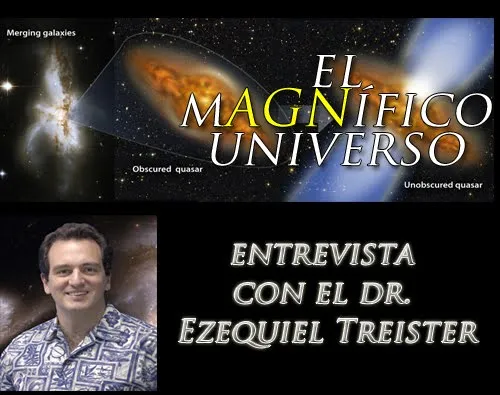
Ezequiel Treister was born in Argentina, but he made his career in Chile. He obtained his doctorate in the joint program of the University of Chile and Yale at the end of 2005 and after two postdoctoral stays at ESO-Chile and at the University of Hawaii he joined the Astronomy department of the University of Concepción in September.
His thesis was on AGN population and his work since then follows that line of study: Black holes, quasars, ULIRGs. But, what is the relationship between black holes and galaxies? That seems to be the question that guides his research interest.
-But, what is an AGN, a quasar, a ULIRG? Are there relationships between these objects?
Ideally we believe it's all related. Astronomy is a bit traditional: the issue of whether Pluto is a planet or not and things like that...
-The issue of definitions.
-Definitions. Quasars are a definition. They were the first to be discovered, they were the most luminous and then AGNs came. What was discovered is that quasars are a particular case of an AGN.
-Particular case because they are very far away?
-No, because they are much more luminous and are not obscured. One can talk about obscured or unobscured quasars.
-That is an interesting topic since you related obscured and unobscured AGNs in relation to redshift.
Well, that is a topic we published in 2006 [*1] where what we discovered is that the amount of obscured AGNs relative to unobscured ones increases with redshift. The idea was to try to explain why it happens.
-And why does it happen?
What we said at that time is that there is probably more dust, that is, in the more distant universe there was more dust and so it was easier to obscure it. What we did later, in 2010 [*2], was to focus only on quasars. And there was the idea of how they are generated, what causes them. And the general idea was that quasars are formed by the collision or merger of two galaxies (mergers, in English).
-How do you know that?
-Basically it's observing how the galaxies look and you see there is distortion from a collision.
-And do you observe any burst of star formation, probably?
- It's a little more complicated. In fact that's where ULIRGs come from. Two things are known separately. It is known that ULIRGs are formed by mergers and it is known that probably quasars are also formed by galaxy collisions. So it's easy to find a relationship. But most of the quasars that were observed were the unobscured ones. The obscured ones were much harder to see.
-Obscured by interstellar dust?
-In most cases and by the amount of obscuration you need, we believe it is mostly nuclear. That is, the dust and gas are very close, a few parsecs from the black hole.
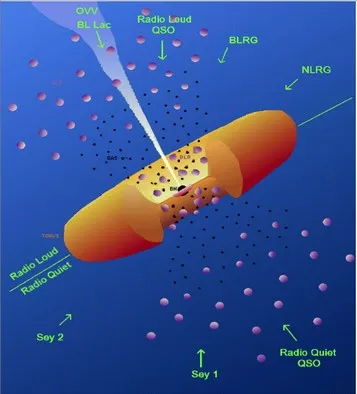
-Does this have to do with some accretion disk?
-You've probably seen the typical AGN diagram [referring to Fig.1] that has like a donut in between, the accretion disk, etc. The idea is that the accretion disk is inside, it is geometrically flat and then it is surrounded by this kind of donut, thicker, that covers a much larger angle. But ultimately what is thought now is that it's all a continuum.
-Therefore AGNs and ULIRGs are related.
-Of course. The most novel thing we did was to establish a timeline. We said: you have a collision and it was known from simulations that when that happens the gas and dust falls quickly into the center. The collision is a very efficient way to bring gas to the center. It was one of the problems with quasars. Because although one thinks that galaxies have a lot of gas, if it is distributed over kiloparsecs, in the arms, like the Milky Way, it is useless because the gas never reaches the black hole. But if you collide two galaxies, the gas reaches the center.
That galaxy collision generates star formation and that turns it into a ULIRG, which are ultra luminous galaxies in the infrared. The question is where does the infrared luminosity come from? And what we believe is that it is a combination of the AGN, that is, material falling into the black hole with star formation. And it has been observed that in these ULIRGs, the star formation rates are very high.
-Is it one black hole or the combination of two, hosted in each of the colliding galaxies?
Recently we found -in a work I am collaborating on- two galaxies in the process of merging and each of them is an AGN. This one we found is in process, but when it finishes merging there will be a single black hole, combination of the two.
-Supermassive.
-All these black holes are massive. The one in the Milky Way is 4 million times the mass of the Sun. What we estimated in the Science paper is how much black holes grow in one of these collisions: between 10 to 100 million times the mass of the Sun. The best example is the Milky Way, which in a few billion years will merge with Andromeda. The black hole in the latter is about ten times larger than that of the Milky Way. When they collide, however, the black hole will take the material that is now dispersed in both galaxies. That material that reaches the center makes the black hole grow by this amount. So, even though we start from an initial mass of, say, 10 million solar masses, we will end up with 100 million and not with 14, for example. Because most of the mass is gained in the collision, as the dispersed material agglomerates.
And what we established, returning to the topic, is a timeline: the collision occurs, the black holes merge, there are high rates of star formation and the ULIRG forms. The minimum luminosity to be a ULIRG is 1012 solar luminosities.
What we have up to this point is a growing black hole, but obscured by gas and dust, not detectable at almost any wavelength. An obscured AGN. In a previous work to the one we are discussing, we looked for galaxies with an excess in the infrared compared to what they should have according to their star formation rates. That is, we looked for ULIRGs that had extra infrared light compared to the optical, for example. And we discovered that in those galaxies, when measuring the X-ray emission, it was typical of a growing AGN, but very obscured.
Thus we established that those ULIRGs had obscured black holes.
Then we measured what the ratio was between obscured and unobscured AGN, quasars actually because they were very luminous, and how that relationship evolved with redshift.
Returning to the timeline we wanted to establish: after some time the quasar's own radiation clears away the dust that surrounded it and it ends up being an unobscured quasar.
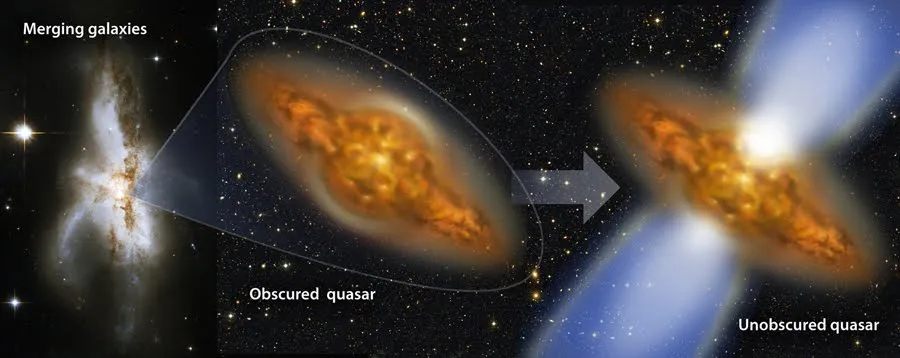
-107 to 108 years.
-That's what we established it took. The observable we used to test that theory was how the rate of obscured to unobscured quasars evolves and why do we expect evolution? Because the number of galaxy collisions depends on redshift, on the age of the universe. When you go to higher redshifts, the universe is younger and more compact, so the probability of two galaxies colliding is greater. It has been observed that there are more collisions at high redshifts, early ages of the universe, than now. If that happens, we thought, there should also be more obscured AGN. It's a balance equation: how many are being created, how many are turning into unobscured ones and how many are turning off. And that had to fit with our observable which was the rate of obscured versus unobscured quasars. And we concluded that it was so, that it fits.
What is Redshift?
-Is it the same Doppler-Fizeau effect or is it something else?
In this case it is cosmological redshift. Ultimately it is a Doppler shift, but produced by the expansion of the universe and not by the galaxy's own motion. We see that the galaxy is moving away, but not due to its own motion, but because the universe is expanding.
-And a difference arises in the spectra of those galaxies compared to the same ones performed in the laboratory.
Right. The typical thing we do is take an emission line of Hydrogen. We know the wavelength on Earth of that transition and when we measure it in a galaxy it is shifted to the red (to the red part of the spectrum). That is, it has longer wavelengths with respect to what it would have at rest on Earth. That's why it's called redshift.
Since this is due to the expansion of the universe, you are measuring the distance.
-Am I measuring it in units of distance?
-You must have heard of Hubble's Law by which more distant objects move away more quickly.
-That is, knowing the velocity I can establish the distance.
-In fact, z is the velocity. When it gets farther away it's a relativistic equation, but basically it's the velocity.
-z= v/c, at least for short scales.
-For z less than 0.1 z=v/c is a good approximation. For the redshifts we work with, no. You already have to use the relativistic equation. Because we are talking about expansion velocities comparable to the speed of light.
But it's important that we are not talking about a "real velocity", it's not that something is moving at that speed, but space itself that is expanding.
* Note: To delve into this topic I suggest following the SDSS Redshifts tutorial.
Astromia tutorial, by Pedro J. Hernández.
Online calculators Ned Wright. In Spanish, on astromia.
What we will get with these calculators is how much time passed since the big bang for that redshift, that is, how much time since the big bang passed for the emission of that photon that only reaches us now. For example, if when observing a galaxy we get z=1 (we use the calculator and we get): The age at redshift z was 5.935 Gyr, where Gyr are billion years. That is, a photon from a galaxy with z=1 was emitted when the universe was half its current age.
We can also try, in English, Wolfram Alpha.
-There are some theories of galaxy formation known as "top-down" or "bottom-up" (hierarchical) models. And you tell me that, logically, in the early universe there were more mergers, there was greater density as it was a more compact universe.
-What we believe now is what is called "downsizing". The first structures that form are the first to grow, the ones that become the biggest. The largest structures are the ones that formed first. And now, the ones that are still forming, are the smallest. Basically: which galaxies are growing the fastest? And at high redshifts the biggest things grew and now the smallest things are growing because the biggest things are already well formed. Current observations make us think that is the way: through collisions of things that were smaller they become bigger and the biggest things formed first (in the early universe).
-And does the same happen with black holes?
-It is believed so. There are some fairly recent observations that the biggest black holes grew first and the ones growing now are the smallest. Seyfert galaxies are the smallest, they have relatively smaller black holes. But if we go to a redshift of 2, for example, there were more quasars, it was the biggest things that were growing. So there is a kind of "cosmic downsizing" for black holes too.
-In the paper with Hubble observations [*3], they observed galaxies at z=2 and talk there about supermassive black holes. This is related to what we were discussing.
-Absolutely. In fact, the way to explain this is "downsizing". Basically what we discovered is that at high z (2 in this case) you have quasars growing a lot, but with deeper studies, in X-rays for example, galaxies are found that already have very massive black holes growing very little. Because the question that arises is: what is the fundamental mode of black hole growth? That is what we want to answer.
-For those studies, this one we are talking about for example, they use FITS images.
-Right, FITS images that have the intensity, the number of photons coming to you from a certain point. For each position in the image, each x,y, there is an intensity at different wavelengths, using Hubble for optical/IR, Spitzer, for infrared and Chandra for X-rays. In the case of Hubble, due to its excellent spatial resolution, we can see the morphology of these galaxies, which is what we did in that work.
-In that work they use two things I wanted a comment on: the PSF (point spread function) and Sérsic.
-When one wants to characterize the light distribution in a galaxy, a Sérsic profile is used. It is basically an exponential function with an index, the Sérsic index, which tells how concentrated or distributed the light is.
-How did they arrive at that index?
-Well, what Sérsic did is an atlas of galaxies. It's based on a lot of observational work: let's observe many galaxies and then try to fit a mathematical function to the light profile we observe. What Sérsic discovered is that if one uses an exponential profile, with an index, i.e., a parameter, that fit all galaxies well. The impressive thing is that it is used. He did it in the 60s and it is still used, it is "the" way to do it. And not many people know he was Argentine [*4].
-I thought it appropriate to bring it up for both reasons: because it is used and because it is a national example worthy of highlighting.
-It's a very good case of what can be done. You don't have to have been born in the United States or Europe to do something important.
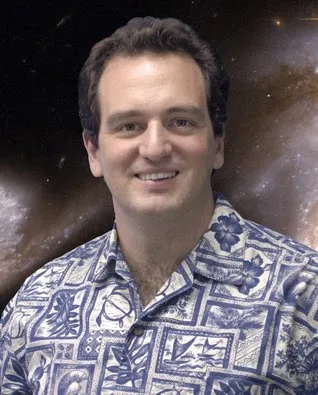
Another good example is Ezequiel Treister. He is 31 years old and has two postdocs. On Wednesday he will be part of a panel at NASA that will hold a press conference for the world, which can be followed on NASATV, in which he will present a study on supermassive black holes in the early universe. The next day the work will be published in Nature. As is logical, we did not talk specifically about that work. Publications like Nature place embargoes on those papers, which cannot be discussed until their publication. Besides, it wouldn't make sense to preview here what will be said at the conference. But that will be news this week. And you will have already met this astrophysicist who is not talked about in the world for the first time, since, as indicated, he has also published in Science which also generates a lot of visibility.
The important thing, what should be highlighted, is that they achieved important things because they worked very hard. And it shows that ability has no borders.
Chat with Ezequiel
On the same Wednesday, June 15, Ezequiel Treister and Kevin Schawinski will be available to talk, via chat, with the public after the conference. It will be at 15:00 EDT, that is, 19:00 UTC, for Argentina, at 16:00 local time.
How to access? At that time the chat will be enabled on NASA Connect.
I hope the game of hide-and-seek between the Moon and Earth doesn't eclipse the conference and the chat...
Sources and related links
- [*1]: The Evolution of Obscuration in AGN
Ezequiel Treister (ESO, Chile), C. Megan Urry (Yale) 2006 ApJ 652 L79
DOI: 10.1086/510237
arXiv:astro-ph/0610525v1 - [*2]: Major Galaxy Mergers and the Growth of Supermassive Black Holes in Quasars
Ezequiel Treister (IfA, Hawai), Priyamvada Natarajan (Yale), David Sanders (IfA, Hawaii), C. Megan Urry, Kevin Schawinski (Yale), Jeyhan Kartaltepe (NOAO)
Science 30 April 2010 Vol. 328 no. 5978 pp. 600-602
DOI: 10.1126/science.1184246
arXiv:1003.4736v1
Published Online 25 March 2010 Galaxy Collisions Give Birth to Quasars
http://news.sciencemag.org/sciencenow/2010/03/galaxy-collisions-give-birth-to-.html
See also:
Black Holes in the Universe Gain Weight and Light Up during Galaxy Collisions - [*3]: HST WFC3/IR Observations of Active Galactic Nucleus Host Galaxies at z~2: Supermassive Black Holes Grow in Disk Galaxies
Kevin Schawinski, Ezequiel Treister, C. Megan Urry, Carolin N. Cardamone, Brooke Simmons, Sukyoung K. Yi
Kevin Schawinski et al. 2011 ApJ 727 L31
DOI: 10.1088/2041-8205/727/2/L31
arXiv:1012.1855v1 - [*4]: José Luis Sérsic on Wikipedia.
About the images
- Fig. 1: Illustration of the unified model of AGN. Credit: Urry & Padovani, 1995.
- Fig.2: Artistic representation of the stages of a quasar after a major galaxy merger. Initially the growing black hole is completely surrounded by a large amount of gas and dust. After 100 million years the strong pressure generated by the quasar's emission is able to remove the gas and unveil the quasar, clearly detectable at optical and UV wavelengths. These objects will shine for another 10-100 million years.
Credit: Artistic vision: Karen Teramura (IfA, University of Hawaii). Galaxy image: NASA, ESA, the Hubble Heritage (STScI/AURA)-ESA/Hubble Collaboration, and A. Evans (University of Virginia, Charlottesville/NRAO/Stony Brook University). - Photograph of Dr. Ezequiel Treister, provided by him.