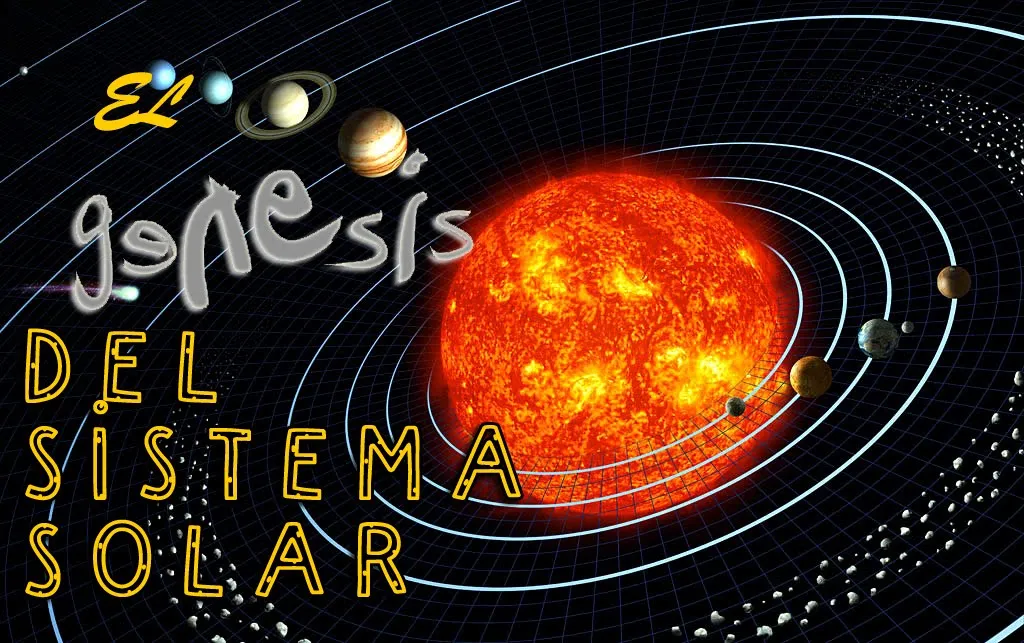
The Sun and the inner planets, including Earth, may have formed differently than thought, according to scientists from the Genesis mission. An entry to the rhythm of the Rock-osos planets and their progress.
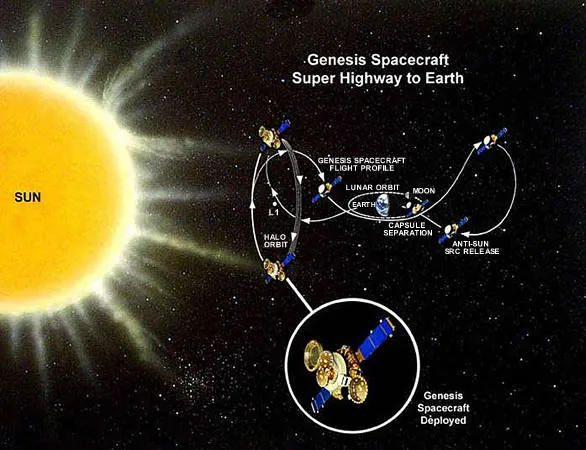
The Genesis probe was launched in August 2001. The spacecraft traveled to the Lagrange point L1, more than 1,600,000 kilometers from Earth. It is one of the five libration points in the Earth-Sun system that allows the necessary stability to make observations of the star. It remained there for 886 days between 2001 and 2004 collecting samples of the solar wind. In September 2004 the spacecraft launched a capsule with samples toward Earth. Although it was a complicated descent due to parachute failure, some samples survived and were the first since the end of the Apollo mission in 1972 of material from beyond the Moon.
The material is still being studied, to the point that this June 24, in the edition of Science, two investigations on the differences and similarities between our star and the inner planets are reported. The first is a study on oxygen and the second on nitrogen.
A cocktail of shaken, not stirred isotopes
Like a spy movie, scientists try to unravel the mysteries of Nature.
"We want to understand how rocky planets form, particularly our own," said UCLA professor Kevin McKeegan, lead author of the first study. "To understand that, we need to know how the isotopic composition of the most abundant element on Earth became what it is," said this "James Bond" of isotopes.
On Earth, the air contains three types of oxygen atoms or isotopes, which differ in the number of neutrons they contain. All have eight protons and almost all also have eight neutrons (O-16), but a small fraction have nine (O-17) or ten (O-18) neutrons. Although the isotopes of an element behave similarly, there are differences in reaction rates according to isotopic mass, McKeegan noted.
"We found that Earth and the Moon, as well as samples of Martian meteorites and others, have a lower concentration of O-16 than the Sun. The implication is that we did not form from the same nebula that created the Sun. How and why remains uncertain," commented the researcher.
McKeegan and his colleagues measured, for the first time, the isotopic composition of oxygen in the solar wind. They found that the Sun has 6% more O-16, relative to the other oxygen isotopes, than Earth. Since the Sun represents "the initial composition of the entire solar system," the findings are surprising, explained the astrophysicist.
"It is the most abundant element on Earth and is isotopically anomalous," and he added that something chemically unexpected happened to the material that finally formed Earth and the other rocky planets 4.6 billion years ago, after the star had formed.
The data were obtained from the analysis of material ejected from the outermost portion of the Sun. That material can be thought of as a "fossil of our nebula" because scientific evidence suggests that those outer layers of the Sun have not changed significantly in billions of years.
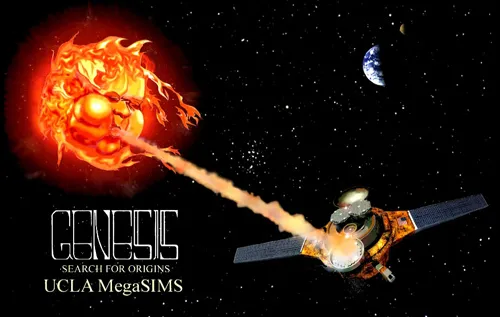
"It is the first time that the isotopic composition of heavy elements in the Sun has been determined with precision, directly from solar material," said McKeegan. The samples, although not very abundant, seem sufficient to be analyzed with UCLA's MegaSIMS instrument, a mass spectrometer.
According to the author of this research, Martian meteorites indicate that the oxygen on the red planet would be similar, but not identical, to that of our world.
Why did it take so long to reach these results?
There are at least two reasons. On one hand, arduous work of separating both the real samples from possible contamination and the oxygen, since what was obtained was mainly hydrogen. The second reason was the need for a sufficiently precise instrument. The SIMS instrument existed, but they needed to develop an even better one: MegaSIMS.
I have a neutron left over
The second paper details differences between the Sun and the planets regarding nitrogen. This element has one isotope, N-14, which is by far the most abundant, but there is also a small amount of N-15.
Researchers studying the Genesis samples found that compared to Earth's atmosphere, the nitrogen of the Sun and Jupiter has a little more N-14, but 40% less N-15. The star and the gas giant seem to have the same nitrogen composition, but as with oxygen, the nitrogen composition on Earth and the rest of the inner system is different.
"These discoveries show that all objects in the solar system, including rocky planets, meteorites, and comets, are anomalous compared to the initial composition of the nebula from which the system formed," states Bernard Marty, lead author of the second work presented in Science, Professor of geochemistry at the Centre de Recherches Pétrographiques et Géochimiques (CRPG) in France.
From Genesis to Revelation (musical)
The Progressive Rock band Genesis, my favorite music group, produced some musical pieces with some relation to the star that illuminates us and the planet we inhabit.
For example, on the album From Genesis to Revelation, the first track was "The Silent Sun." Years later that track became a stand-alone album, from Decca.
http://www.youtube.com/watch?v=SO_JTvPar4c
The lyrics, however, reveal that it doesn't have much to do with our Sun.
Back in 1976 they released "A trick of the tail" which contains the song "Mad man moon."
http://www.youtube.com/watch?v=zYc5kv5vLcc
Ahh, it doesn't talk about the Moon either, although metaphorically it does. It's a lonely place, ideal for talking about some feeling we've probably had.
That year the English band also released a formidable album "Wind and Wuthering" which contains the piece "Afterglow."
Guillermo Abramson spoke last year about a "twilight glow." Could that be an "afterglow"? Here is a version of that piece performed by the Argentine group Bad Dreams.
http://www.youtube.com/watch?v=wzXdV9tBe6Y
The lyrics propose an environment suitable again for transmitting feelings. Perhaps it's a loving "glow," isn't it? That's what some think.
However, there is another meteorological phenomenon associated with dust particles in the atmosphere: haze or calima. And for that there is also a Genesis theme, from the formidable Duke album. Again, a version of Bad Dreams (as I experienced it):
http://www.youtube.com/watch?v=8k1OG86V8Es
Heathaze or "heat haze" as it has been translated, points out to us that sometimes this atmosphere, rarefied, makes us feel strange, in an alien place.
This world is probably not the only inhabited one. Perhaps someday intelligent beings will come from other worlds to ours. Perhaps we will already be gone. Perhaps only the lizards will be here.
The lyrics of Watcher of the skies (Watcher of the skies), they say, are based on the story "Rescue Party" by Arthur C. Clarke.
http://www.youtube.com/watch?v=g8EkU3Ta5Ys
Anyway. A review of recent publications on the origins of the solar system with data from the Genesis probe, seasoned with the rock-ous melodies of the British group. And there is some similarity between this kind of "progressive" music and scientific discoveries, don't you think?
Sources and related links
- K. D. McKeegan et al (2011)
The Oxygen Isotopic Composition of the Sun Inferred from Captured Solar Wind. Science, 2011; 332 (6037): 1528
DOI: 10.1126/science.1204636 - B. Marty et al (2011)
A 15N-Poor Isotopic Composition for the Solar System As Shown by Genesis Solar Wind Samples.
Science, 2011; 332 (6037): 1533
DOI: 10.1126/science.1204656 - Experientia docet: Where did Earth's heavy nitrogen come from?
About the images
- Initial image with one of the logos of the group Genesis and an illustration of the solar system (NASA).
- Illustration from the MegaSIMS site. Credit: UCLA.
- Illustration of the Genesis spacecraft's trajectory. Credit: JPL.