Some reflections on the "hibernation" of ATA, with a video recreation with texts and audio by Carl Sagan.
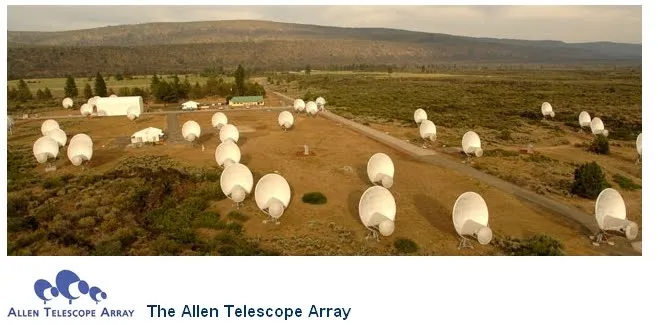
Since the news of ATA's hibernation was made public, many things have been said. Certainly, SETI programs continue. In an email sent to supporters of the SETI Institute, Tom Pierson noted, on April 22, that ATA not only allowed the SETI search, but also other considerable achievements. ATA is one of the best instruments in the world for searching for possible signals from hundreds of planets identified by NASA's Kepler mission.
But the lack of funds for the operations of the Hat Creek Radio Observatory, where ATA is located, put the instrument into hibernation.
It's not that SETI isn't making efforts to overcome the situation. More than two years ago the institute began the search for a partnership with the United States Air Force to conduct space debris surveillance experiments.
But the budget cuts in the U.S. reach there too.
SETI projects continue, such as setiQuest.org, an open community for coding and developing algorithms, as well as citizen science: setiQuest Explorer is the first version of an application that allows citizens to search for patterns in ATA data that might not have been detected by the programs. They plan to expand the development of new tools in partnership with Galaxy Zoo.
But funds are needed: they need one and a half million dollars annually to operate ATA and at least another additional million annually to cover the cost of SETI's scientific efforts. For this reason, a fundraising campaign for two years will be launched. 2.5 million dollars seems like a lot of money, but the cost of one F/A-18 could finance several decades.
The instrument, when "hibernating", will not be operational, but it will also not be completely stopped or dismantled. Stopping it would involve removing critical components and it would be very expensive to make it operational again. In hibernation, the instrument is maintained, but it implies a cost. If a source of funding is not found even for that maintenance, in the long run it would have to be completely shut down, as Eric Korpela points out in the SETI@home forum.
Pierson's email didn't reach all of us when he first sent it, and given the press coverage, on the 27th the rest of the contributors had direct communication.
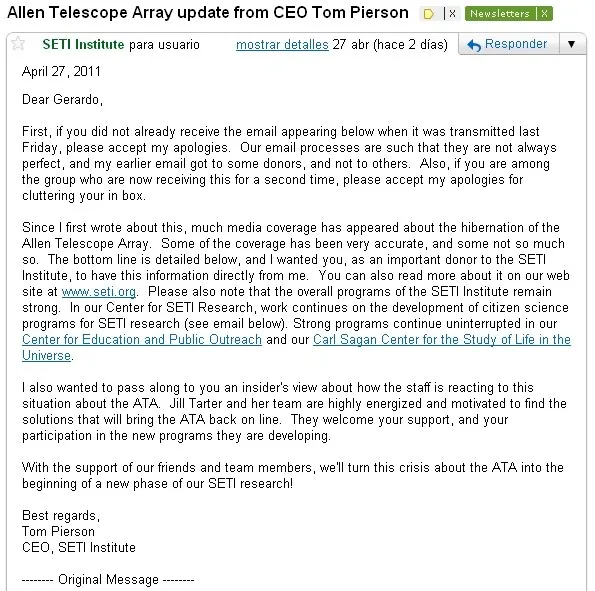
It is important to remember that the SETI Institute was created when U.S. federal funds for the search for ET intelligence were cut. From 1994 to 2004, the Center for SETI research at the Institute was funded entirely by donations from individuals and private foundations. In 2005, a NASA grant was awarded for signal detection with ATA. Donations are still the main source of funding for the center.
None of this applies to the SETI@home project, which does not use data from ATA, but from Arecibo.
More at SETI.cl: SETI continues the search: conversation with Jill Tarter
A light in the darkness
It is paradoxical that many people who claim to believe in UFOs do not collaborate with SETI in its continuous effort to search for evidence of extraterrestrial intelligence.
There is no worldwide conspiracy to hide supposed visits from other worlds. What there is is a lack of concrete evidence. This is not to the detriment of those who seriously investigate the UFO phenomenon, because there are people who use rigorous methods to evaluate photos, videos, sightings, etc.
But a large number of people hold these beliefs only because they like to believe in them. If, having an idea of reality, we do not want to change it despite acquiring data that may be contrary, then we act as "blind", intellectually speaking. We cover our eyes so as not to see the reality we don't like and we live in darkness.
It is so. Darkness surrounds us. Space is huge, beyond understanding, and the stars, although many, are only faint glimmers in the dark cosmos.
Science is a light in that blackness, an imperfect light, perfectible, but better than living with capricious ideas that have no relation to what is observed.
I invite the reader to reflect on this darkness in which we live through a video made by the Youtube user callumCGLP, author of Milky Way Musings. This young man in his second decade of life has been amazed by the production of Carl Sagan and has been making a series of tributes, using the original voice of the American astronomer, to which he adds background music and related images. In this case, his ninth tribute is Darkness, here translated into Spanish with subtitles.
Video: Carl Sagan: Darkness
http://www.youtube.com/watch?v=lBcoVesWErE
I also invite the public to become a member of TeamSeti and to subscribe to SETI news.
Sources and related links
- SETI Institute
- ATA project stops
- SETI@home
- First results from the Allen Telescope
About the images
- Image of Allen Telescope Array. Credit: ATA.