In a collaboration between amateur and professional astronomers, the recent discovery of the death throes of a dying star could help resolve an astronomical debate: Are stellar companions key in the formation and structure of planetary nebulae?
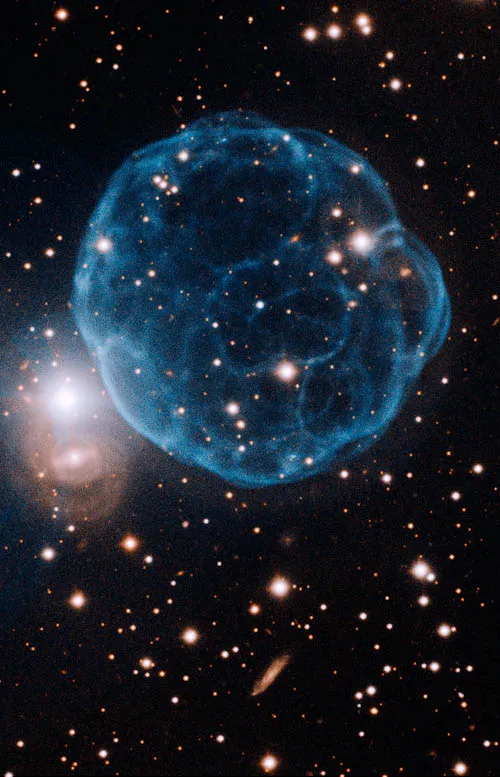
The discovery, made by Austrian amateur astronomer Matthias Kronberger, was presented at a symposium of the International Astronomical Union this week in the Canary Islands.
The research team's work includes an incredible image of the found nebula, obtained with the Gemini Observatory.
It is no coincidence that the location of the nebula, called Kronberger 61 or Kn 61, is within a relatively small region of the sky being monitored by Kepler. Kepler's goal is to determine the frequency of Earth-like planets around other stars. In the process, it is possible to detect other stellar and planetary systems.
"Kn 61 is among a small collection of planetary nebulae strategically located in Kepler's field of view," said Orsola De Marco of Macquarie University in Sydney, author in 2009 of a paper that speculated on how companion stars or even planets can influence and shape the intricate structures seen in many planetary nebulae.
NASA's Kepler mission monitors a portion of the sky of 105 square degrees, near the constellation Cygnus, the Swan. The spacecraft continuously observes over 150,000 stars in the same region, watching their brightness changes. The presence of a companion would cause the brightness to fluctuate and thus very faint stars or planets can be detected.
However, it is very common in binary systems for the amount of light to change for other reasons. But with enough objects it is statistically very likely that many planets will be discovered.
To increase the chances, professional astronomers are working with amateurs in search of planetary nebula candidates. To date, six have been found, including Kn 61 which was discovered by the group "Deep Sky Hunters" (DSH) -"Deep Sky Hunters"- who have scored two discoveries of this class and, perhaps, a third, not yet confirmed.
The techniques used by professionals and amateurs are similar. In the case of Kn 61, images from DSS (the Digital Sky Survey) provided the data used to make the discovery. "Without this close collaboration with amateurs, this find probably would not have been made before the end of the Kepler mission. Professionals, using precious telescope time, are not as flexible as amateurs who can dedicate their free time. This was a fantastic pro-am discovery collaboration," said George Jacoby of the Carnegie Observatories, who served as a liaison with the DSH and requested their help to study the Kepler field. Jacoby published a paper in 2010 with DSH members describing the techniques used.
It should be said that this group has a history of serious publications: in 2006 they published in Astronomy&Astrophysics, together with Philipp Teutsch (Institut für Astrophysik) on open cluster candidates in DSS and 2MASS.
"Planetary nebulae present a profound mystery. Some recent theories suggest that these objects form only in binary or even planetary systems. On the other hand, the conventional notion is that most stars, like our Sun, will meet this fate. Perhaps that is too simple," explained De Marco.
Planetary nebulae are common throughout our neighborhood, with about 3,000 known and identified. They arise in the last stages of the life of a star like ours, forming after nuclear fusion can no longer continue and sustain the pressure of gravity and it becomes unstable. The star then ejects a significant amount of gas from its outer layers. The name of this class of objects comes from the first observations made with telescopes, in the 17th century, through which these objects looked similar to gas giant planets, like Jupiter. But, in reality, they have nothing to do with planets. Or almost.
Planetary nebulae can be seen because the gas is ionized and glows due to the radiation still emitted by the central star. But how can the stars or planets that may orbit the primary star impact the complex structures seen in these objects?
This idea points to a star or a planet around a star going through the planetary nebula phase, possibly influencing that expelled gas, giving it the shape they have.
However, to date, a small percentage (20%) of the central stars in planetary nebulae appear to have companions. If that low fraction is because the companions are relatively small or distant, then observations made from the ground will not be able to detect those companions, in which case Kepler could fill the gap.
The discovery, as well as the Gemini image, were presented at the symposium “Planetary Nebulae: an Eye to the Future” ("Planetary Nebulae: an Eye to the Future"), in Puerto de la Cruz, Tenerife, between July 25 and 29, 2011.
Sources and related links
- Gemini Image Captures Elegant Beauty of Planetary Nebula Discovered by Amateur Astronomer
- The role of amateur astronomy
- The AmAstro2012 Survey
About the images
- Image credit: Gemini Observatory/AURA