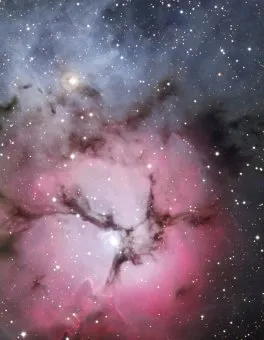
A new image of the Trifid Nebula was published today, showing why it is one of the public's favorites. This massive stellar factory is named for the dark bands of dust that divide its bright heart into three and is a rare combination of three types of nebulae, revealing the fury of newly formed stars and foreshadowing more stellar births.
Several thousand light-years away, in the constellation Sagittarius, the Trifid Nebula presents a powerful portrait of the early stages of a star's life, from gestation to its first light. The heat and winds from the newborns stir the gas and dust of this cosmic cauldron. The distance to this fascinating object is somewhat uncertain, with values ranging between 2,200 and 7,600 light-years. SEDS and Wolfram Alpha indicate a distance of 5,200 light-years.
French astronomer Charles Messier first observed it in June 1764, recording the hazy, bright object as entry number 20 in his famous stellar catalog. Observations made about 60 years later by John Herschel of the dark lanes that seem to divide the cosmic cloud into three lobes inspired the English astronomer to coin the name "Trifid". It was also cataloged as NGC 6514.
The new image was made by the WFI camera on the MPG 2.2-meter telescope at the European Southern Observatory in La Silla, Chile, and shows the different regions of the nebula seen in visible light. In the bluish part, top left, called a reflection nebula, the gas scatters light from nearby stars. The largest of these stars shines brightest in the blue portion of the visible spectrum. This, along with the fact that dust grains and molecules scatter blue light more efficiently than red light—a property that explains why we see a blue sky and red sunsets—dyes that portion of the Nebula with a bluish hue.
Below, in the rounded, pinkish-red area of the emission nebula, the gas in the core is heated by hundreds of new stars until it emits the red signal of hydrogen, the main component of the gas, in the same way that neon gas glows in luminous signs.
The gases and dust crossing the Trifid Nebula configure the third class of nebula in this cloud, known as a dark nebula, courtesy of its effects of light and dark. The iconic Horsehead Nebula is one of the most famous of this type. In the dark lanes, the remnants of previous stellar births continue to merge under the inexorable gravitational attraction. The density, pressure, and temperature within these gas bubbles will eventually trigger nuclear fusion and new stars will form.
Close-up of the Trifid Nebula http://www.youtube.com/watch?v=ZAXeSVwa_Hw
At the bottom of this emission nebula, a finger of gas protrudes from the cloud, pointing directly at the central star. This is an example of an evaporating gas globule, also seen in the Eagle Nebula, another star-forming region. At the tip of the finger, which has been photographed by Hubble, a knot of dense gas has withstood the merciless radiation from the massive star.
Sources and related links
- ESO: Trifid Triple Treat
About the images
- Trifid Nebula
Credit: ESO